
Dolby Vision 2 supported TVs 2026 is suddenly the question that matters if you watch a lot of Dolby Vision streaming and you’re shopping around CES-season announcements. Dolby Vision 2 isn’t just “more HDR.” It’s Dolby rebuilding the picture pipeline around a next-gen image engine and scene intelligence — aiming to fix the two biggest real-world complaints: “HDR is too dark” and “motion looks wrong unless I crank processing.” ✅
Quick Takeaways
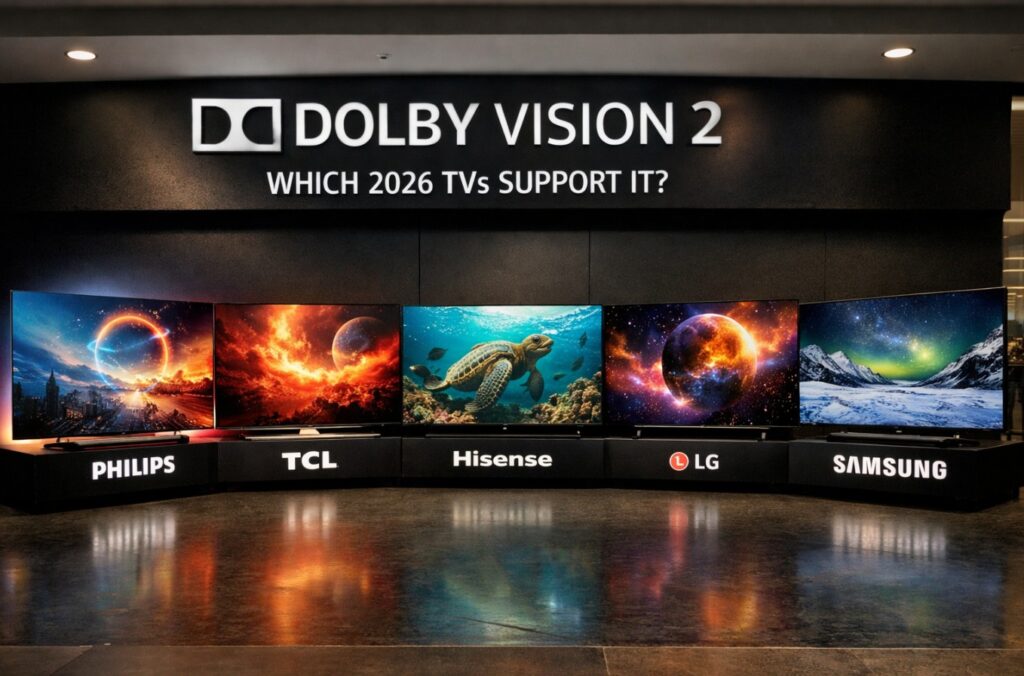
- Confirmed Dolby Vision 2 TV brands (2026): Philips, TCL, Hisense.
- LG (2026 OLED): Dolby Vision stays, Dolby Vision 2 is not part of the lineup messaging.
- Samsung: no Dolby Vision ecosystem on TVs (so no Dolby Vision 2); Samsung pushes HDR10+ evolution instead.
- Expect some Dolby Vision 2 rollouts via OTA (software update), not necessarily at launch.
Dolby Vision 2 supported TVs 2026: compatibility matrix (brand-by-brand)
| Brand | Dolby Vision 2 status in 2026 TV lineup | Confirmed model families (as announced) | How you’ll get it | What to watch for |
|---|---|---|---|---|
| Philips (TP Vision) | Yes (planned) | OLED811, OLED911 series, OLED951 | Built into 2026 OLED lineup (details/regions can vary) | Philips specs usually land later; final HDMI/ports can differ by SKU |
| TCL | Yes (planned) | X QD-Mini LED series, C series; flagship direction includes X11L | OTA update planned for 2026 series | Which exact models get DV2 vs DV2 Max may vary by tier/region |
| Hisense | Yes (planned) | RGB MiniLED families: UX, UR9, UR8 | Core RGB line + broader models via OTA in some regions | DV2 availability can depend on firmware cadence and regional SKUs |
| LG | No DV2 positioning for 2026 | 2026 OLED line keeps Dolby Vision (standard) | N/A | LG may prioritize its own ambient/processing stack instead of DV2 branding |
| Samsung | No (Dolby Vision not adopted) | N/A (Samsung TV ecosystem is HDR10/HDR10+) | N/A | Samsung’s “DV2 rival” story sits in HDR10+ evolution + AI processing |
🎬 The most important buyer detail: “Supported” doesn’t always mean “enabled day one.” TCL and Hisense explicitly lean on OTA language in the early messaging for parts of their lineups.
What Dolby Vision 2 actually changes (technical, not marketing)
The Dolby Vision pipeline, simplified
Dolby Vision has always been about dynamic metadata: the content carries per-scene (or per-shot) instructions that help the TV map the master to your panel’s capabilities.
Dolby Vision 2 keeps that philosophy, but the “new” part is the processing layer:
- a next-generation image engine
- content intelligence (scene understanding)
- creator-controlled motion capability (in the “Max” tier)
The goal is a picture that is more consistent across different rooms and different TVs — less dependent on a brand’s own “secret sauce” tone-mapping.
Key feature blocks (what you’ll notice on a real couch)
- Precision Black: aims to keep dark scenes readable without raising blacks into gray.
- Light Sense: adapts the Dolby Vision presentation based on room light (practically: daytime vs night behavior without you switching modes).
- Live sports optimization: targets motion clarity and realism for fast content.
- Authentic Motion (DV2 Max): a creator-guided approach to motion that’s meant to reduce judder while staying natural. 🌈
Important nuance: these are “system” features — they depend on the TV’s sensors, processing budget, and firmware maturity. A DV2 badge won’t magically fix bad factory settings, but it can reduce how often you need to fight the TV.
Dolby Vision 2 vs Dolby Vision 2 Max: what’s the difference?
Here’s the practical way to think about it:
- Dolby Vision 2 = the new image engine + content intelligence + adaptive tools (black handling, ambient response, sports tuning).
- Dolby Vision 2 Max = Dolby Vision 2 plus the most advanced motion pipeline (Authentic Motion) and the “full” implementation.
Dolby Vision 2 Max: who is most likely to get it?
Flagship models first. In practice, that usually means:
- TCL’s top “X” tier (flagship mini-LED direction)
- Hisense top RGB miniLED tier
- Philips flagship OLED tier
But the exact “Max” label is the detail to verify per model, per region.
Brand-by-brand breakdown (what to expect, and why)
Philips (TP Vision): DV2 on OLED in 2026
Philips is the most interesting “format person” here because Philips has historically leaned into cinema-centric tuning and processing identity (P5 class behavior) alongside Dolby support.
What you can safely publish today:
- Philips positions DV2 on OLED811, OLED911, OLED951 in 2026 messaging.
- Full sheets may arrive later than CES-week headlines (common for Philips).
Buyer note: if you want Dolby Vision and you care about a “filmic” presentation without endless tinkering, Philips is often a strong play — but you must confirm your regional SKU.
TCL: DV2 via OTA across 2026 X and C series
TCL’s practical advantage is scale: when TCL pushes a firmware feature broadly, it can quickly become “the mainstream DV2 TV” in a way boutique brands can’t.
What to expect:
- DV2 is positioned across X QD-Mini LED and C series, often via OTA.
- Flagships may land DV2 earlier and may use a “Max” tier label.
Watch-out: TCL lineups can be region-split (US vs EU naming). Make your article table “family-based,” not model-number-only, until EU product pages lock.
Hisense: DV2 anchors on RGB MiniLED families
Hisense’s DV2 story ties directly into its RGB MiniLED push — i.e., the brand is making a case that DV2 is part of a “premium color” package.
What to expect:
- DV2 is tied to RGB miniLED families (UX/UR9/UR8 class messaging).
- Some broader miniLED families may inherit DV2 later via OTA, depending on region.
Watch-out: Hisense model codes are notoriously regional (U8 / U8K / U8Q style differences). Focus on series families + year.
LG: Dolby Vision stays, DV2 branding does not
LG remains a Dolby Vision-friendly brand for streaming, but 2026 OLED messaging leans on:
- panel evolution
- anti-reflection improvements
- LG’s own processing stack
If your readers ask “Should I avoid LG because no DV2?” the honest answer is:
- No, if they mainly want Dolby Vision compatibility today.
- Yes, if they specifically want DV2 as a “future-proof” checkbox.
Samsung: no Dolby Vision, therefore no DV2
Samsung is consistent: it doesn’t build its TV ecosystem around Dolby Vision. So the DV2 question is simple: it won’t be the reason you buy Samsung.
If your audience watches a lot of Netflix/Disney+ in Dolby Vision, you should say it plainly:
- Samsung buyers should care about HDR10/HDR10+ availability, not DV2.
How to confirm Dolby Vision 2 on your TV (once it’s in your home)
Step 1: Confirm firmware / software update status
- Update TV firmware (system update)
- Update streaming app(s)
- Power cycle the TV after updates (a real unplug helps) 🔧
Step 2: Confirm the format badge (but don’t trust it blindly)
On many TVs, you can check:
- an “HDR info” panel, or
- picture mode labels that change when Dolby Vision content is detected
DV2 can be more subtle than “big new logo.” Some brands will show “Dolby Vision,” while DV2 enhancements run under the hood.
Step 3: Use a controlled test scene
Pick content with:
- dark shadow detail (faces in low light)
- bright highlights (neon signs, sparks)
- motion (sports pans)
DV2’s best tells are dark-scene readability and motion that doesn’t look like soap opera.
Common Mistakes to Avoid
- Buying purely on “DV2 support” without checking how it arrives (OTA) and when.
- Confusing Dolby Vision support with Dolby Vision 2 support (they are not the same checkbox).
- Expecting DV2 to fix a bad “Vivid” mode. Start in a cinema/filmmaker-style mode first.
Troubleshooting / Pro Tips
If your DV2-capable TV feels underwhelming at launch, don’t panic. Early firmware often ships conservative. The clean approach:
- Update firmware, then reboot properly
- Disable energy saving during HDR testing
- Keep motion processing modest — let the DV2 pipeline do its job
- If a scene still looks too dark, check whether the TV is using an ambient-adaptive Dolby mode in a room that’s actually bright
DV2 is supposed to reduce “format anxiety.” The best setups feel like the TV understands the room, not like you’re calibrating a spaceship every night. ✨
FAQ
- Dolby Vision 2 supported TVs 2026 — which brands have it?
Dolby Vision 2 supported TVs 2026 are confirmed (in announced lineups) from Philips, TCL, and Hisense. LG and Samsung do not position DV2 in their 2026 TV messaging. - Is Dolby Vision 2 the same as Dolby Vision IQ?
No. Dolby Vision IQ is an adaptive Dolby Vision feature set; Dolby Vision 2 is a broader next-gen picture pipeline that includes new engine + intelligence and can include more advanced motion control. - What is Dolby Vision 2 Max?
It’s the top DV2 tier that adds the most advanced motion capability (Authentic Motion) alongside the DV2 engine and intelligence features. - Will I need new HDMI cables for Dolby Vision 2?
DV2 is primarily a TV-side processing/format capability. You still need a Dolby Vision-capable source, but there’s no specific “DV2 HDMI cable” requirement. - Will DV2 work on existing Dolby Vision content?
DV2 is designed as the next generation of Dolby’s picture system and is expected to enhance Dolby Vision playback behavior on compatible TVs. Exact behavior can vary by brand implementation and firmware. - Which Philips TVs get Dolby Vision 2?
Philips positions DV2 on OLED811, OLED911 series, and OLED951 in its 2026 OLED lineup messaging. - Which TCL TVs get Dolby Vision 2?
TCL positions DV2 for 2026 X QD-Mini LED and C series families via OTA updates, with flagships likely leading. - Which Hisense TVs get Dolby Vision 2?
Hisense positions DV2 for 2026 RGB MiniLED families (UX / UR9 / UR8 class messaging), with broader miniLED coverage potentially arriving later via OTA. - Does LG support Dolby Vision 2 in 2026?
LG positions Dolby Vision (standard) for 2026 OLED but does not position Dolby Vision 2 support in the 2026 OLED story. - Does Samsung support Dolby Vision 2?
No — Samsung TVs don’t adopt Dolby Vision as a core HDR format, so Dolby Vision 2 isn’t part of Samsung TV support.
Final Verdict
If you want the simplest buying logic: Dolby Vision 2 supported TVs 2026 currently point to Philips, TCL, and Hisense. LG remains a strong “Dolby Vision today” choice without DV2 branding, while Samsung stays committed to its own HDR ecosystem path.
My advice is quietly practical: treat DV2 as a future-proof bonus, not a reason to ignore fundamentals. You’ll feel DV2 most when a streaming thriller stops looking like a black rectangle — and when sports motion looks clean without turning your living room into a soap opera studio. ✅