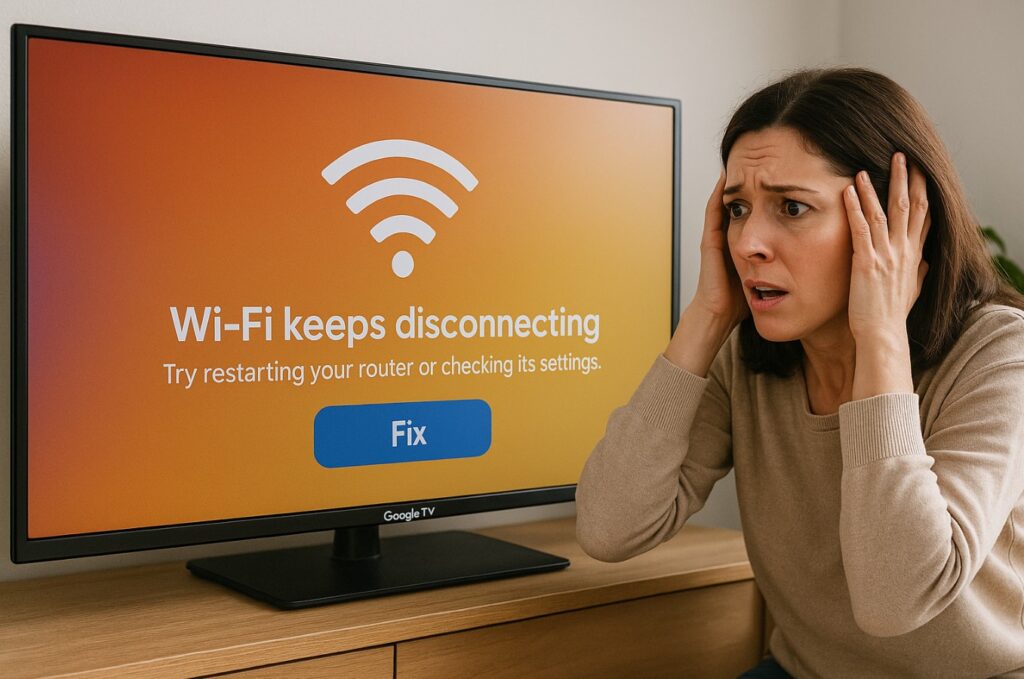

Google TV Wi-Fi keeps disconnecting fix is all about removing one simple illusion: most “Wi-Fi problems” aren’t one problem. They’re usually a mix of router steering, band interference, DHCP/IP quirks, and Google TV power/network behavior—and the symptoms look identical until you test them in the right order. 📶
This guide gives you a repeatable workflow for Google TV (Sony/TCL Google TV sets, Chromecast with Google TV, and similar Google TV devices) that keeps dropping the connection, reconnecting every few minutes, or getting stuck on “Obtaining IP address.”
Menu names/paths vary by model/region/firmware.
Quick Takeaways
- If your device disconnects mostly on 5GHz, it’s often DFS channels, band-steering, or weak signal through walls.
- If you see “IP configuration failed” / “Obtaining IP address”, it’s commonly DHCP lease issues, router bugs, or IPv6 quirks.
- The fastest stability win is often: forget network → reboot router + Google TV → reconnect.
- If you want “it just works” reliability, Ethernet (or USB-to-Ethernet) beats troubleshooting forever. ✅
Fast symptom → cause → fix table (start here)
| Symptom | Most likely cause | Fast confirmation | Fix |
|---|---|---|---|
| Drops every 5–15 minutes | Band steering, DFS channel hops, interference | Happens mostly on 5GHz | Force a stable 5GHz channel (non-DFS) or use 2.4GHz for range |
| “Obtaining IP address” loop | DHCP/IPv6/router bug | Other devices also glitch | Reboot router, disable IPv6 (test), adjust DHCP lease |
| Works near router, fails in the room | Weak RSSI through walls | Phone Wi-Fi also weaker there | Move router, use mesh node, reduce 5GHz channel width |
| Only Google TV drops; phones stay fine | Device-side sleep/network state | Drops after idle | Toggle network settings, update firmware, disable aggressive router features for that client |
| Drops right when you start streaming | Congestion/buffer + roaming events | Only during 4K/Atmos streams | Prefer Ethernet, or isolate band + channel; avoid “Auto” channel width |
Main “known-good” setup table (what stable looks like)
| Goal | Best practice | Why it helps |
|---|---|---|
| Stable streaming | Ethernet (built-in port or USB adapter) | Removes Wi-Fi interference and roaming completely |
| Stable Wi-Fi | 5GHz on a non-DFS channel (if signal is strong) | Fewer collisions than 2.4GHz, fewer random drops than DFS |
| Range-first Wi-Fi | 2.4GHz (when the TV is far away) | Better wall penetration, fewer “edge-of-signal” disconnects |
| Fewer IP glitches | Reliable DHCP + sane lease time | Prevents IP renew loops and “obtaining IP” stalls |
Google TV Wi-Fi keeps disconnecting fix: do this 5-minute diagnosis
1) Confirm it’s not your internet line
Open a streaming app on your phone/laptop on the same network. If everything drops together, this is an ISP/router stability issue first—not Google TV.
2) Separate “signal” problems from “network” problems
- If the disconnect happens only in one room, treat it as signal/interference.
- If it happens everywhere, treat it as router configuration or Google TV behavior.
3) Run the “forget + clean reboot” reset (fastest win)
On Google TV:
- Settings → Network & Internet → Wi-Fi → your network → Forget
Then: - Reboot the router (power off 30 seconds)
- Restart Google TV (Settings → System → Restart)
Reconnect to Wi-Fi.
This one step alone fixes a surprising amount of “it used to work, now it doesn’t” cases. 🔁
Design & Build Quality
This sounds unrelated, but it matters: Chromecast-style dongles and some compact streaming devices sit behind the TV where:
- Wi-Fi signal is blocked by the panel and wall mount
- HDMI cables and power bricks add interference
- the device runs warmer (which can reduce stability)
If you use a dongle, try a simple test: extend it away from the TV (HDMI extender) and keep it clear of bundled cables. It can turn a flaky connection into a stable one.
Panel Technology Explained
Also “not a picture topic,” but OLED/Mini-LED and large TVs share one practical truth: the TV is a big slab of electronics. When the Wi-Fi antenna is tucked behind metal/plastic layers and you’re asking it to hold a 5GHz signal through a wall, drops become normal—not mysterious.
So your first job is to decide: do you want maximum speed (5GHz) or maximum reliability (Ethernet / strong 2.4GHz)?
Brightness & HDR Performance
Higher bitrate content (4K HDR, high-bitrate apps) increases sustained network demand. That doesn’t “cause” Wi-Fi drops by itself, but it exposes weak links:
- borderline signal strength
- router CPU load under traffic
- roaming/band steering events
If drops happen only during heavy streams, treat it as network stability under load—not as an app bug.
Color Accuracy & Picture Processing
Not relevant for Wi-Fi directly—except one workflow trap: people chase TV picture settings while the real issue is the network, then blame the TV for buffering or app crashes. Keep troubleshooting clean: network first, then app, then TV settings.
Motion Handling & Refresh Rates
If your Google TV device is also handling game streaming or high-refresh content, you’re stacking load. Again: don’t overthink it. Stabilize the connection, then optimize.
Gaming Performance
If you game via cloud services or remote play, Wi-Fi drops feel brutal because latency spikes are obvious. Two practical rules:
- Prefer Ethernet if you can.
- If you must use Wi-Fi, don’t chase “max speed” — chase low interference and consistent signal.
A stable 200 Mbps connection that never drops beats a 700 Mbps connection that disconnects twice an hour.
Smart Platform & UX
Google TV network settings that matter (safe, common labels)
In Settings → Network & Internet, look for:
- Wi-Fi on/off toggle
- Your connected SSID
- Forget network
- Advanced (sometimes shows IP settings)
If you see frequent IP issues, testing a different path can help:
- Try a different band (2.4GHz vs 5GHz)
- Try a guest network (some routers isolate features differently)
- Try a hotspot for 10 minutes as a diagnostic (if hotspot is stable, your router setup is the culprit)
Audio & Connectivity
Port-by-port connectivity map (what to use for stability)
| Connection option | Where it plugs in | Best use case | Notes |
|---|---|---|---|
| Built-in Ethernet | TV’s LAN port | Always-on stability | The simplest “done” fix |
| USB-to-Ethernet adapter | TV USB port | When the TV has no LAN or it’s inconvenient | Works well on many Google TV sets/devices |
| Wi-Fi 5GHz | Wireless | Fast when close to router | Can drop on DFS or weak signal |
| Wi-Fi 2.4GHz | Wireless | Most reliable at distance | Slower but stable for streaming |
| Mesh node near TV | Power + Wi-Fi | When walls kill signal | Treat it like “Ethernet without drilling” |
Manufacturer claims vs rounded independent measurements (real-world expectation)
Rounded independent measurements in accurate, typical home conditions (short distance, normal interference). Your router/firmware/layout can change results.
| Wi-Fi standard claim | Typical stable throughput (rounded) | What that means for you |
|---|---|---|
| Wi-Fi 5 (802.11ac) | ~150–400 Mbps | Plenty for 4K streaming; stability matters more than peaks |
| Wi-Fi 6 (802.11ax) | ~250–700 Mbps | Better efficiency with many devices; still can drop with bad channels/steering |
| 2.4GHz “strong range” | ~30–120 Mbps | Usually enough for streaming; best for far rooms |
| Ethernet “gigabit” | ~300–900 Mbps | Most stable; eliminates Wi-Fi dropouts entirely |
Thermal Design & Longevity
Overheating rarely causes Wi-Fi drops on a TV, but it can on compact streaming sticks tucked behind a hot panel. If your device is warm to the touch, give it airflow and avoid burying it in cable bundles.
Real-World Impressions
The most common pattern I see:
- Wi-Fi works for weeks
- then a router auto-update, channel change, or “smart” band steering tweak happens
- Google TV becomes the first device to complain, because it’s the least forgiving about roaming and DHCP weirdness
Once you simplify the router’s behavior (stable channels, predictable DHCP), Google TV usually behaves.
Common Mistakes to Avoid
- Leaving router settings on “Auto everything” while expecting consistent results
- Using 5GHz from far away and blaming the TV instead of physics
- Ignoring DFS channels (they can force channel changes)
- Never rebooting the router after changing key settings
- Testing 10 variables at once (you’ll never know what actually fixed it)
Troubleshooting / Pro Tips
Google TV Wi-Fi keeps disconnecting fix checklist (in the right order)
Step 1: Update and restart (boring, but it clears bad states)
- Update Google TV system software
- Restart Google TV
- Reboot router
Step 2: Kill band-steering chaos (most common “random” drop cause)
In your router:
- Split SSIDs if possible (separate 2.4GHz and 5GHz names)
- Connect Google TV to the band that actually fits your distance
- Use a non-DFS 5GHz channel for testing (router UI varies)
Step 3: Stabilize DHCP/IP behavior (fix “Obtaining IP address” loops)
Try (as tests, not permanent dogma):
- Increase DHCP lease time (router-dependent)
- Disable IPv6 temporarily to test (some router/ISP combos behave badly)
- If you have an option for “Private MAC / randomized MAC” behavior per client, keep it consistent for the TV/device
Step 4: Reduce interference (simple physical wins)
- Move the router higher and more open (not behind furniture)
- Keep the TV/device away from dense cable bundles
- If using a dongle, extend it away from the TV
Step 5: Choose the “I’m done” solution
If you’re tired of chasing it:
- Run Ethernet to the TV, or use a nearby mesh node with Ethernet backhaul if possible
- If you can’t run cable, a mesh node placed near the TV is usually the cleanest compromise 🧩
FAQ
- Why does my Google TV disconnect from Wi-Fi but my phone is fine?
Google TV devices can be more sensitive to roaming, band steering, and DHCP quirks. Phones often mask instability better. - Is 5GHz always better for Google TV?
Only when the signal is strong and stable. At distance, 2.4GHz can be more reliable. - What does “Obtaining IP address” mean?
The device is failing to complete IP assignment via DHCP (router/IPv6/lease/state issues are common causes). - Can DFS channels cause disconnects?
Yes. DFS can trigger channel changes that look like random drops. - Will a mesh system fix this?
Often, yes—especially if the TV is far from the router or behind multiple walls. - Does an Ethernet adapter work on Google TV?
Many Google TV TVs/devices support USB-to-Ethernet adapters, and it’s one of the most reliable fixes. - Google TV Wi-Fi keeps disconnecting fix — what’s the first thing I should do?
Google TV Wi-Fi keeps disconnecting fix starts with forgetting the network, rebooting router + device, then reconnecting to a stable band/channel before changing anything else. - Should I factory reset Google TV?
Only after you’ve stabilized router settings and tested Ethernet/mesh. Reset is a last resort, not step one.
Final Verdict
Wi-Fi dropouts feel like bad luck until you look at what’s actually moving under your feet: channels, roaming rules, DHCP leases, and “smart” router features that aren’t smart for every device. The best Google TV Wi-Fi keeps disconnecting fix is a calm system: a stable band, a stable channel, predictable IP behavior, and—when you want the argument to end—Ethernet.
When your connection stops “negotiating” and starts simply existing, Google TV becomes what it should be: quiet, instant, dependable. ✅
Internal links (LIVE on TVComparePro)