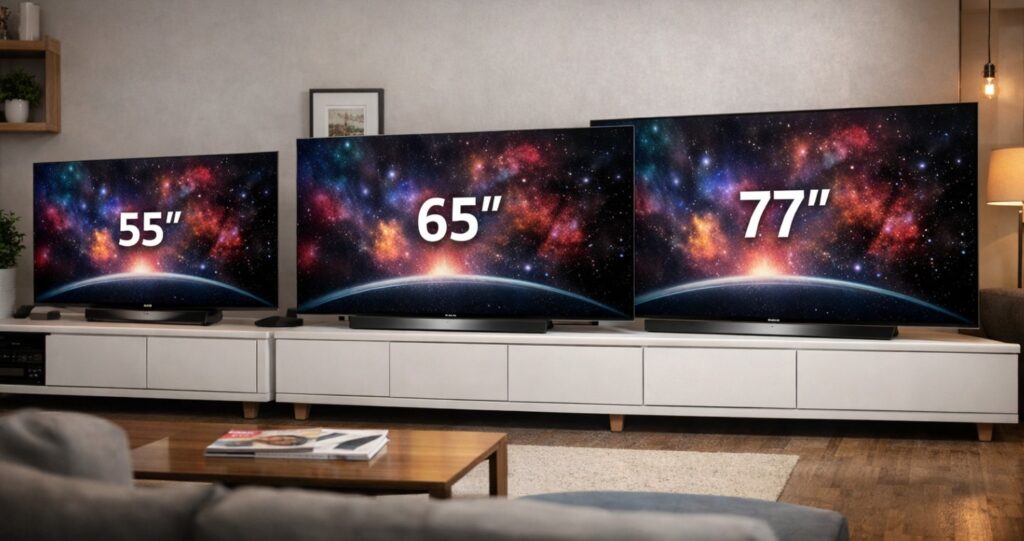

LG C6 sizes explained is suddenly a much more important search than it looked back in January. At CES, the story sounded simple: a new C-series OLED, a stronger processor, and better gaming language. But once pricing, model pages, and hands-on coverage landed, the picture became a lot more specific.
The short version is this: not every LG C6 is the same TV in the ways that matter most. The 77-inch and 83-inch models are effectively a different value proposition from the 42-inch, 48-inch, 55-inch, and 65-inch models. If you are shopping by size first and assuming the rest of the experience scales evenly, this is exactly where you can make an expensive mistake.
That is why this article matters. It is not another generic lineup recap. It is a buyer-focused guide to what changed, which sizes get the better panel tier, what stays shared across the range, and who should actually pay the premium. 🎯
LG C6 sizes explained — the part most buyers need first
| LG C6 size | Model family | Panel tier | Brightness positioning | Best fit |
|---|---|---|---|---|
| 42-inch | C6 | Standard OLED tier | Lower than C6H and G6 | Desk gaming, smaller rooms |
| 48-inch | C6 | Standard OLED tier | Lower than C6H and G6 | Compact premium OLED setup |
| 55-inch | C6 | Standard OLED tier | Lower than C6H and G6 | Mainstream movie / gaming use |
| 65-inch | C6 | Standard OLED tier | Lower than C6H and G6 | Safe all-round size for most rooms |
| 77-inch | C6H | Higher panel tier | Clearly above smaller C6 sizes | Bigger-room HDR and flagship-adjacent value |
| 83-inch | C6H | Higher panel tier | Clearly above smaller C6 sizes | Premium large-screen buyers |
The key split is not subtle. The smaller C6 sizes remain the more traditional C-series play: premium OLED picture quality, strong gaming support, flagship-class processing, and better value than the gallery flagship. The larger C6H sizes step closer to LG’s higher OLED tier.
What is actually new since the January LG lineup coverage?
What changed after the CES wave is not just more confirmation. It is better buyer clarity.
First, LG’s official US listings now make the size split easier to see in public-facing model names. The 77-inch and 83-inch versions are listed as C6H, while the 42-inch through 65-inch models stay under the regular C6 naming. That matters because it tells buyers the panel story is not just a rumor or reviewer shorthand.
Second, launch pricing is now real rather than theoretical. That turns this from a technology headline into a purchase decision. Once prices appear next to model numbers, buyers stop asking “what is new?” and start asking “which one is worth it?”
Third, the hands-on and lineup reporting is now much more aligned: the bigger C6 sizes are the ones getting the meaningful panel lift, while the smaller sizes still rely more on processing, gaming polish, and LG’s usual OLED strengths than on a dramatic raw panel jump.
In other words, the most important update is not that LG launched a new C-series. It is that the C-series now has an internal class split. ⚠️
Which LG C6 sizes get the newer OLED panel?
This is the heart of the buying question.
The 77-inch LG C6H and 83-inch LG C6H are the sizes tied to the upgraded panel tier. The 42-inch, 48-inch, 55-inch, and 65-inch C6 models do not get that same step up.
That does not make the smaller sizes bad TVs. Far from it. They still get a major processing upgrade compared with the previous C-series generation, and they still carry the strong LG OLED formula that makes the line popular with gamers and movie fans. But it does mean the large-screen story is stronger than many buyers will expect if they only skim the model name.
For practical shopping, think of the range like this:
Smaller C6 sizes are the refined mainstream option
The 42 to 65-inch C6 models look like the safer, more traditional C-series choice. You still get OLED contrast, webOS, Dolby Vision, strong gaming support, and a much stronger processor story than before. For a lot of buyers, especially at 55 or 65 inches, that will still be enough.
C6H is where the big technology jump happens
The 77 and 83-inch C6H sizes are where the lineup becomes more interesting. These are the models that move closer to the higher-end OLED tier in brightness and color punch. They are not simply “the same TV, but larger.” They are closer to being the sweet spot for buyers who want more than a regular C-series without paying full G6 money.
C6 vs C6H vs G6 — how the real hierarchy now looks
At launch, the hierarchy is cleaner than the naming suggests.
| Model group | What it really means | Who it is for |
| C6 (42–65) | Traditional C-series value OLED with better processing | Buyers who want balance over maximum panel performance |
| C6H (77–83) | Bigger C-series with a more premium panel tier | Buyers who want a substantial large-screen jump without going full G6 |
| G6 | LG’s flagship gallery OLED | Buyers chasing the strongest OLED package LG offers in regular sizes |
That middle tier matters because it changes the upgrade logic.
Before, the answer was often simple: if you want the better panel, move to G-series. Now the answer is more conditional. If you are shopping specifically for 77-inch or 83-inch, the C6H may be the smarter value pivot. If you are buying 55-inch or 65-inch, the gap to G6 remains more meaningful.
Manufacturer claims vs rounded independent expectations
Because early launch messaging and retail listings do not always tell the full real-world story, this is the safer way to read the lineup.
| Model group | Manufacturer / launch positioning | Rounded independent expectation |
| C6 (42–65) | Brightness Booster, stronger processing, premium OLED positioning | Expect a noticeable overall refinement, but not the dramatic brightness leap associated with the bigger C6H or G6 |
| C6H (77–83) | Higher OLED tier with stronger brightness and color positioning than smaller C6 sizes | Expect performance closer to last year’s higher LG OLED class than to the smaller standard C6 sizes |
| G6 (55–83, with 97-inch caveat) | LG’s brightest regular OLED positioning, stronger bright-room story, top-tier flagship placement | Expect a real step above C6H, especially in highlight intensity, bright-room punch, and flagship polish |
That last point matters. The large C6H models look exciting because they close part of the historical C-to-G gap. They do not erase it completely.
Why the processor upgrade still matters, even on the smaller sizes
It would be a mistake to reduce this entire lineup to “panel or nothing.” LG also moved the C6 family to a much more serious processor tier, and that affects more than menus.
Better processing can help with:
- cleaner upscaling on average streaming content
- more stable tone-mapping behavior
- better handling of near-black transitions
- lower-risk motion weirdness in difficult scenes
- a snappier overall feel in webOS
That is part of why the smaller C6 models are still interesting. They may not get the headline panel lift, but they are not stranded on old mid-tier logic either. In daily use, that can matter more than spec-chasing buyers expect.
Gaming changes: very strong on paper, but read the details carefully
LG is clearly still leaning into gaming as a core selling point. The C6 family is marketed with up to 165Hz, VRR, ALLM, G-Sync support, and FreeSync Premium support. For gaming buyers, that is the right language.
But here is the nuance worth respecting: official LG connectivity listings for the current US model pages still describe the HDMI inputs as 4K 120Hz capable while also supporting eARC, VRR, ALLM, QMS, and QFT. That does not necessarily mean LG’s 165Hz claim is false. It usually means buyers should avoid assuming every device, resolution path, color format, and use case behaves identically across every input scenario.
So the sane interpretation is this:
- yes, the C6 family is positioned as a serious gaming TV
- yes, the gaming story is stronger than before
- but exact high-refresh behavior may still vary by source device, resolution choice, firmware, and picture mode
That is especially important for PC gamers, who tend to uncover the edge cases before console buyers do. 🎮
Port-by-port I/O map
The currently listed US specifications point to a strong and practical connectivity layout across the C6 and C6H models.
| Port / connection | What is listed | Why it matters |
| HDMI 1 | HDMI input | Main video source option |
| HDMI 2 | HDMI input + eARC | Best slot for soundbar or AVR return audio chain |
| HDMI 3 | HDMI input | Useful for console or streamer |
| HDMI 4 | HDMI input | Useful for second console or gaming PC |
| Total HDMI | 4 inputs | Better flexibility than many mid-range rivals |
| HDMI feature set | 4K 120Hz, VRR, ALLM, QMS, QFT | Strong next-gen gaming and switching feature support |
| USB | 2 x USB 2.0 | Media playback, accessories, service tasks |
| Optical audio | 1 | Older sound systems still have a clean fallback |
| Ethernet | 1 | Better streaming stability than Wi-Fi in difficult networks |
| RF / antenna | 1 | Broadcast / cable input |
| RS-232C | 1 | Control integration use cases |
| Bluetooth | 5.3 | Headphones and accessory convenience |
| Wi-Fi | Wi-Fi 5 | Fine for most homes, but not a headline upgrade |
For buyers using a console, streaming box, and soundbar together, this is a genuinely comfortable setup. It is not just premium on paper; it is practical in a real living room.
Pricing reality: where the value story gets interesting
Now that pricing is public, the range tells a more useful story.
The regular C6 line starts much like buyers would expect: 42-inch as the entry point, then the familiar climb through 48, 55, and 65 inches. But the large-screen C6H models are where the conversation changes.
If you were already aiming at 77 inches or 83 inches, the question is no longer simply “Can I afford larger?” It becomes “Does the C6H give me enough of the premium panel story that I no longer need the G6?”
For many people, the answer may be yes.
That is why the 77-inch C6H in particular looks like one of the most important models in LG’s new range. It has the size advantage, the stronger panel narrative, and a price step that still leaves breathing room below G6. That combination is rare. ✅
Common buying mistakes to avoid
1. Assuming all C6 sizes are equal
They are not. This is the biggest trap.
2. Reading “C6” and ignoring “C6H” completely
If you are shopping 77 or 83 inches, the suffix is not a minor detail. It changes the panel conversation.
3. Assuming the smaller C6 sizes are poor value
They are not poor value. They just are not the same kind of value story as the larger C6H sizes.
4. Treating 165Hz marketing as the whole connectivity story
High-refresh marketing matters, but source device behavior, firmware, and HDMI path details still matter too.
5. Jumping straight to G6 without checking your room and use case
If you mostly want a big, premium OLED with strong gaming support and better-than-expected panel positioning, C6H may already be enough.
Who should buy which size?
Buy the 42-inch or 48-inch C6 if…
You want a premium smaller OLED for a desk, bedroom, or compact gaming setup. In those roles, the smaller C6 sizes still make a lot of sense.
Buy the 55-inch or 65-inch C6 if…
You want the safest all-round LG OLED choice without climbing into gallery pricing. These sizes still look like the mainstream heart of the lineup.
Buy the 77-inch C6H if…
You want the most interesting value point in the range. This may be the model where size, panel class, and price align best.
Buy the 83-inch C6H if…
You want a very large OLED and care more about panel tier than about owning the absolute flagship badge.
Move to G6 if…
You want LG’s stronger flagship OLED package, more ambitious bright-room confidence, and the cleaner “top-tier” answer without compromise.
Final Verdict
LG C6 sizes explained is no longer a niche enthusiast question. It is one of the most important buyer filters in LG’s current OLED range.
The smaller C6 sizes still look like very strong premium OLED TVs. But the larger C6H versions are where this lineup becomes genuinely strategic. They are the models most likely to change a buying decision, because they blur the old line between “mainstream premium” and “flagship-adjacent.”
If you are shopping 55 or 65 inches, the C6 still looks like the familiar balanced choice. If you are shopping 77 or 83 inches, you should not casually lump those models into the same basket. They deserve separate attention.
That is the real story here: LG did not just refresh the C-series. It quietly turned size into a technology decision. And in a market where one wrong assumption can cost a lot of money, that is exactly the kind of detail worth slowing down for. ✨