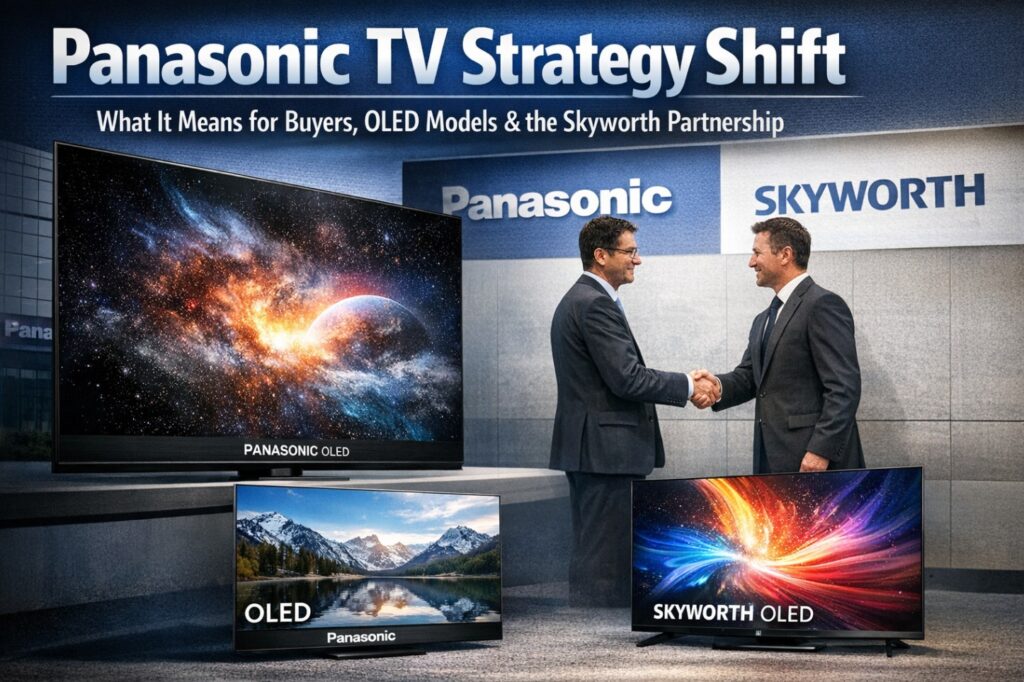

The Panasonic TV Strategy Shift marks a major structural change in how Panasonic televisions are produced and distributed in several global markets. While Panasonic remains active in product development, it has reorganized manufacturing and commercial operations through a strategic partnership with Chinese manufacturer Skyworth.
For buyers considering a Panasonic OLED or Mini-LED model, the important questions are:
- Does this affect picture quality?
- Will support and firmware updates continue?
- Is Panasonic still building its own TVs?
Let’s break this down carefully — and separate operational restructuring from product reality.
Panasonic Models & Platform Context (Applies to Current Buyers)
Before diving into the restructuring details, it’s important to understand Panasonic’s recent TV ecosystem:
- Fire TV models (2024–2025 lines) in selected regions
- My Home Screen platform (2017+ models) in others
- Premium focus on OLED with cinema-grade tuning
- Select Mini-LED models targeting brighter environments
Menu names and features may vary by region or firmware version.
The Panasonic TV Strategy Shift does not automatically change platform software direction — but distribution strategy now differs by region.
What Is the Panasonic TV Strategy Shift?
The Panasonic TV Strategy Shift refers to Panasonic’s decision to:
- Transition manufacturing and distribution responsibilities in certain regions
- Enter a strategic partnership with Shenzhen Skyworth Display Technology Co.
- Focus more heavily on brand-level engineering, picture processing, and premium positioning
Starting from the new operational phase, Skyworth will handle:
- Production logistics
- Distribution operations
- Commercial rollout in key Western markets
Panasonic retains control over:
- Product design philosophy
- Image processing development
- Quality standards
- Brand identity
This is a strategic partnership — not a full brand exit.
Who Is Skyworth — and Why It Matters
Skyworth is a large global TV manufacturer and part of the broader Chuangwei-RGB Group. It already:
- Produces OLED and LCD televisions under its own brand
- Manufactures at large industrial scale
- Supplies TVs across multiple continents
Skyworth’s role in the Panasonic TV Strategy Shift is operational, not branding.
Important distinction:
Many major TV brands today rely on global manufacturing partners.
The critical factor is not factory location — but who controls:
- Firmware
- Picture processing algorithms
- Quality control standards
Panasonic continues to supervise those elements 🎯
Why Panasonic Made This Move
The global television market has shifted dramatically in the last decade:
- Panel production is concentrated among a few large suppliers
- Chinese manufacturers operate at extremely high scale
- Profit margins in mid-range segments have tightened
- Logistics and distribution costs have increased
Rather than compete on volume pricing alone, Panasonic appears to be repositioning around:
- Premium image accuracy
- Brand heritage
- Operational efficiency
The Panasonic TV Strategy Shift is about sustainability — not retreat.
Does This Affect Picture Quality?
This is the most important section.
Panasonic’s brand identity has long centered on:
- Hollywood collaboration
- Reference-level color calibration
- Conservative motion processing
- Balanced HDR tone mapping
These characteristics are controlled primarily by:
- Panasonic’s internal image processing
- Firmware tuning
- Calibration profiles
Manufacturing changes do not automatically change picture science.
As long as Panasonic maintains:
- Firmware control
- QA validation
- Engineering oversight
Picture behavior should remain aligned with past Panasonic standards 🎬
OLED and Mini-LED: What Happens Next?
Panasonic’s OLED lineup remains central to its premium strategy.
Strength areas historically include:
- Accurate skin tones
- Natural motion handling
- Filmmaker-focused profiles
- Stable HDR tone mapping
Mini-LED models address:
- Higher peak brightness
- Brighter room usage
- Reduced ABL sensitivity
The Panasonic TV Strategy Shift does not indicate abandonment of OLED development.
However, buyers may notice:
| Area | Potential Impact |
|---|---|
| Regional availability | Fewer SKUs in some markets |
| Launch timing | Staggered rollouts |
| Pricing | Adjusted by distribution partner |
| Retail presence | More selective channel focus |
Premium positioning appears intact.
Warranty, Support & Firmware Updates
A common concern with restructuring is long-term support.
Key considerations:
- Warranty is region-dependent
- Service centers operate through local distribution networks
- Firmware updates typically follow model lifecycle commitments
The Panasonic TV Strategy Shift does not inherently cancel firmware support cycles.
Still, buyers should confirm:
- Authorized service availability
- Firmware history for similar prior models
- Local distributor reliability
Operational clarity matters more than corporate headlines 💡
Market Implications: Is Panasonic Becoming a “Label Brand”?
Some industry observers question whether this transition signals a move toward a label-based model.
That depends on one factor:
Does Panasonic retain meaningful control over engineering decisions?
If Panasonic continues to define:
- Image tuning
- HDR behavior
- Calibration defaults
- Quality validation
Then the brand remains engineering-driven.
If control shifts toward cost-optimized specification decisions, brand identity could dilute.
At this stage, Panasonic publicly maintains oversight of quality and development.
What Buyers Should Actually Do
If you’re considering a Panasonic TV:
- Check your regional model lineup
- Confirm warranty coverage
- Verify firmware update cadence
- Compare spec sheets carefully
- Focus on real-world image performance
The Panasonic TV Strategy Shift is operational — your buying decision should remain performance-based 🎯
FAQ
What is the Panasonic TV Strategy Shift?
It is a restructuring of Panasonic’s TV manufacturing and distribution through a partnership with Skyworth while maintaining brand-level development.
Is Panasonic leaving the TV market?
No. Panasonic continues to develop and market televisions.
Will OLED quality change?
There is no confirmed change to Panasonic’s image processing philosophy.
Does Skyworth now control Panasonic TVs?
Skyworth manages production and distribution in certain regions, but Panasonic retains brand and development control.
Should I delay buying a Panasonic TV?
Only if you are waiting for a specific upcoming model. The restructuring itself is not a quality warning.
Does this affect Fire TV or My Home Screen models?
Platform implementation may vary by region, but core strategy remains aligned with Panasonic’s ecosystem.
Final Verdict
The Panasonic TV Strategy Shift is a business restructuring designed to adapt to a hyper-competitive global TV market. It is not a sudden collapse of Panasonic’s television division.
For buyers, the essential factors remain:
- Picture processing
- Calibration philosophy
- Firmware support
- Regional service reliability
If those pillars remain strong, the brand’s cinematic DNA remains intact 🎥
Corporate logistics may evolve.
Image integrity is what ultimately defines the product.