
Samsung Eclipsa Audio explained starts with one simple idea: Samsung wants a next-gen, immersive 3D audio format that can live everywhere — on TVs, on the web, and inside creator pipelines — without being locked behind a proprietary ecosystem. 🔊
At CES 2026, Samsung positioned Eclipsa Audio as a core part of the 2026 Samsung TV lineup, alongside its other “format strategy” moves. The big practical question for buyers is not “is it cool?” but “will I actually hear it, and on what TVs?” ✅
Quick Takeaways
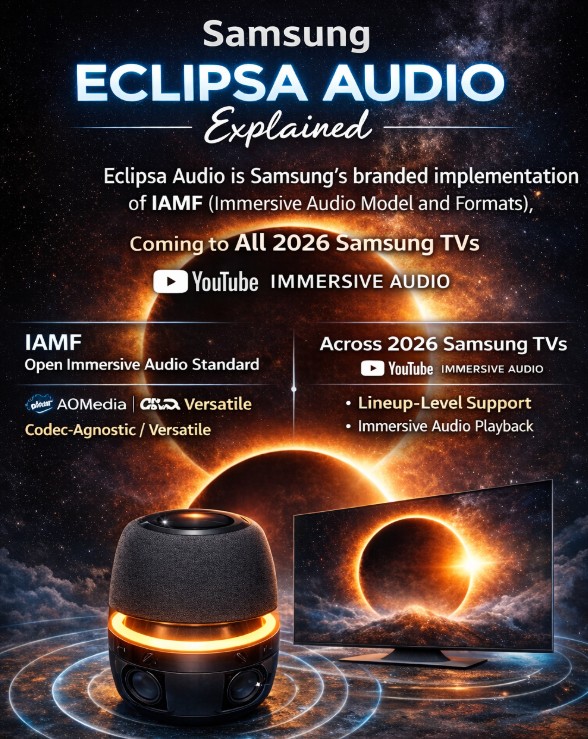
- Eclipsa Audio is Samsung’s branded implementation of IAMF (Immersive Audio Model and Formats), an open immersive audio standard.
- Samsung says Eclipsa Audio is introduced across all 2026 Samsung TVs (lineup-level support).
- Real-world use depends on content availability and your audio chain (TV speakers vs soundbar/AVR via eARC).
- If you set your output chain wrong, you can easily end up with stereo PCM even when immersive audio is available.
Eclipsa Audio at a Glance (what it is vs what it isn’t)
| Item | What it means in practice |
|---|---|
| Format family | Open immersive audio standard (IAMF) with Samsung’s Eclipsa branding |
| Target experience | 3D/spatial audio that adapts to different speaker layouts |
| Where it lives | TV decoding + app playback (and potentially browser-based delivery paths) |
| What it’s not | Not “Dolby Atmos with a new sticker”; not guaranteed on every app day one |
| What you need | A 2026 Samsung TV (for native support) + compatible content + correct output settings |
Which 2026 TVs support Eclipsa Audio (Samsung lineup)
Samsung’s CES messaging frames Eclipsa Audio as lineup-wide across 2026 TVs — meaning the support is not only “one flagship model thing,” but intended as a platform capability.
Practical support map (how to think about it)
| 2026 Samsung TV family | Eclipsa Audio support | What to verify on your unit |
|---|---|---|
| 2026 OLED lineup (S-series family) | Yes (lineup-level) | Tizen version/firmware updated, app supports immersive track |
| 2026 Neo QLED / premium LCD families | Yes (lineup-level) | eARC output mode, passthrough behavior, lip sync |
| 2026 Lifestyle TVs (Frame-family) | Yes (lineup-level) | Same: firmware + app track availability |
| 2026 “halo” models (Micro RGB class) | Yes (lineup-level) | Same: content pipeline maturity (early adopter reality) |
Important reality check: “TV supports it” does not automatically mean “Netflix/Disney/Prime uses it tomorrow.” Immersive formats live and die by distribution and creator adoption.
How Eclipsa Audio works (technical but readable)
1) IAMF is object-aware, layout-flexible audio
Traditional surround formats often assume fixed channel layouts (5.1, 7.1). Modern immersive audio is closer to objects + metadata that describe where sound should be placed in space.
IAMF’s goal is to make that immersive mapping portable and consistent across different devices:
- TV speakers (virtualized spatial field)
- soundbars
- AVR setups
- web playback scenarios
2) Decoding vs rendering: the part people miss
Two separate stages matter:
- Decode: the TV/app understands the audio bitstream.
- Render: the system maps that decoded scene into your actual speaker setup.
If your TV decodes Eclipsa Audio but your output chain forces PCM stereo, the render stage never gets a chance.
That’s why setup matters more than marketing.
Eclipsa Audio vs Dolby Atmos: what changes for the viewer
| Category | Eclipsa Audio (IAMF path) | Dolby Atmos path |
|---|---|---|
| Ecosystem | Open standard approach | Proprietary ecosystem approach |
| Near-term availability | Likely limited at first | Widely available today |
| Device strategy | “Decode on TV + expand outward” | Common across streaming devices, TVs, soundbars |
| Setup sensitivity | High (output chain matters) | Also high, but more mature in apps/devices |
If you’re choosing a TV in 2026, the safest mindset is:
- Atmos = today’s guaranteed answer
- Eclipsa = the “platform bet” that may grow quickly once content momentum starts 🎬
Audio & Connectivity
This is the section that determines whether readers will actually hear Eclipsa Audio.
Port-by-port I/O map (what you should look for)
Because exact port counts vary by model/size/region, the “I/O map” here is capability-based:
| Connection point | What you want | Why it matters |
|---|---|---|
| HDMI eARC (TV → soundbar/AVR) | eARC enabled + passthrough option | Best chance of preserving immersive audio |
| Digital Optical (TOSLINK) | Use only as fallback | Often forces compressed legacy formats |
| Bluetooth audio | Avoid for immersive | Typically downmixes and adds latency |
| Wi-Fi casting / multiroom | Optional | Convenience, not a “highest fidelity” path |
| TV internal speakers | Works, but virtualized | Spatial effect depends on speaker design + processing |
The “clean” audio chain for immersive formats
- TV app plays compatible content
- TV decodes audio track (Eclipsa/Atmos/etc.)
- TV outputs via eARC to soundbar/AVR in Bitstream/Passthrough mode
- Soundbar/AVR renders to your speaker layout
If step (3) collapses to PCM stereo, everything above becomes irrelevant.
Smart Platform & UX
On Samsung, the practical limiter is rarely the TV hardware. It’s usually:
- whether the app build supports the new track
- whether the TV OS + firmware exposes the right output modes consistently
- whether HDMI-CEC/eARC behavior remains stable after updates
So for early adopters, the first month reality can be: great promise, uneven app support, and a few “why is my sound suddenly stereo?” moments.
Common Mistakes to Avoid
- Turning on eARC but leaving output on “PCM” (instant downmix).
- Routing everything through an older AVR/switch that can’t pass modern audio cleanly.
- Using optical because “it works” — then wondering why immersive never triggers.
- Assuming YouTube/TV Plus/app X will ship immersive tracks immediately.
Troubleshooting / Pro Tips
If you want the fastest “is it working?” workflow:
- Update TV firmware, then do a real power cycle (unplug 60 seconds) 🔧
- Set Sound Output to your eARC device (if used)
- Set Digital Output Audio Format to Pass-Through / Auto (not PCM)
- Temporarily disable HDMI-CEC control conflicts if audio toggles back to TV speakers
- Test with one known compatible source/app track (then retest across apps)
Early format rollouts are always a little messy. The goal is to keep your chain simple until the ecosystem matures.
✨
FAQ
- Samsung Eclipsa Audio explained — what is it?
Samsung Eclipsa Audio explained: it’s Samsung’s branded immersive 3D audio format based on the open IAMF standard, designed to scale across devices and speaker layouts. - Do all 2026 Samsung TVs support Eclipsa Audio?
Samsung’s CES messaging positions Eclipsa Audio as introduced across the 2026 TV lineup. Real-world playback still depends on content and correct output settings. - Is Eclipsa Audio the same thing as Dolby Atmos?
No. Atmos is a proprietary ecosystem with wide adoption today; Eclipsa/IAMF is positioned as an open alternative that may expand as content support grows. - Will Eclipsa Audio work on TV speakers?
It can, but the effect is virtualized and depends on the TV’s speaker design and processing. For the best result, use a soundbar/AVR via eARC. - What’s the #1 reason immersive audio doesn’t trigger?
Your TV output is set to PCM stereo, or your chain forces downmix (optical, Bluetooth, older switches/AVRs). - Do I need eARC for Eclipsa Audio?
For the highest chance of preserving immersive audio to external gear, yes. Otherwise you risk fallback formats. - Will streaming apps support Eclipsa Audio quickly?
That depends on each service. Early on, support is often limited and rolls out gradually. - Can I use Eclipsa Audio with a non-Samsung soundbar?
If the TV outputs a compatible immersive bitstream cleanly over eARC and your sound system supports decoding/rendering, it can work — but compatibility will vary by device generation and firmware.
Final Verdict
Samsung Eclipsa Audio explained in one sentence: it’s Samsung’s attempt to make immersive audio feel like a modern, platform-level standard — not a boutique feature.
For buyers, the honest value is future leverage. If content adoption accelerates, 2026 Samsung TVs will be ready. But right now, the daily experience still belongs to the formats with deep, universal support — and your success will depend less on the logo and more on the unglamorous details: eARC, passthrough, and a clean chain.