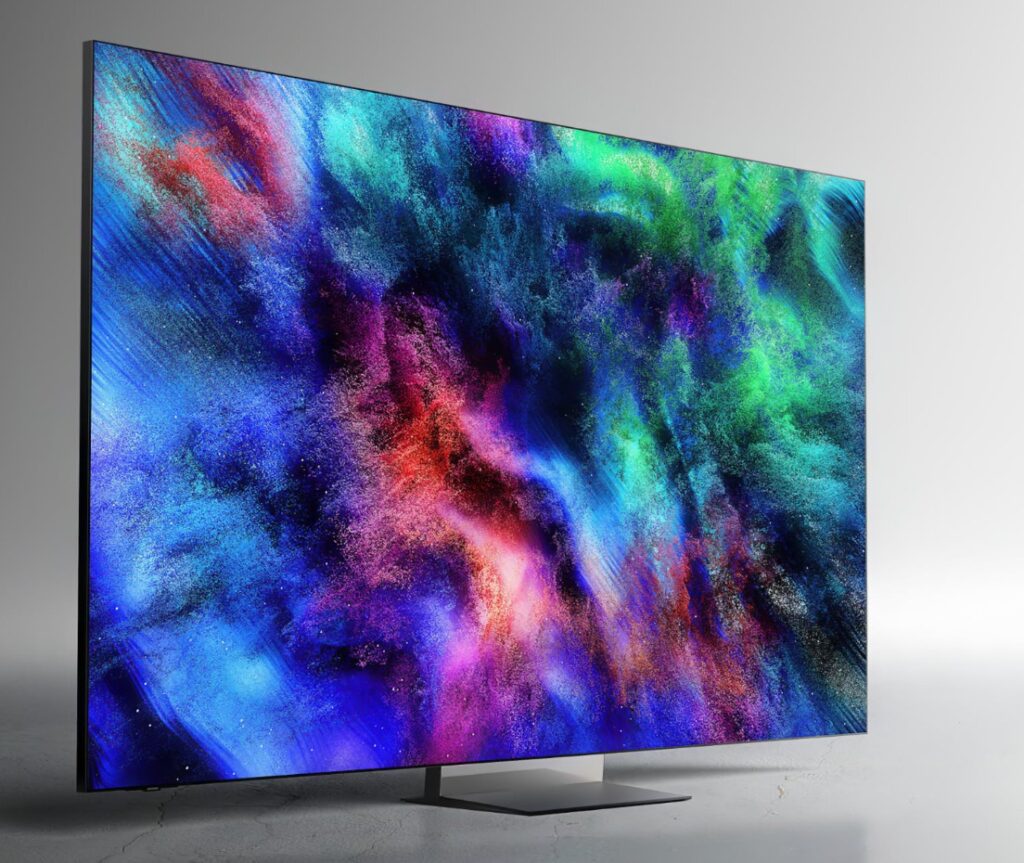

Samsung S95H is Samsung doing two things at once: polishing the flagship QD-OLED experience, and widening the “premium LCD” story with Micro RGB models that clearly want to own the bright-room narrative. The most quoted promise is simple: S95H is claimed to be 35% brighter than S95F.
Menu names/paths vary by model/region/firmware.
Quick Takeaways
- S95H (QD-OLED): 35% brighter vs S95F claim + Wireless One Connect Ready + up to 165Hz.
- S90H: Samsung also claims 15% brighter (baseline not fully specified in the announcement context).
- HDR formats: Samsung leans into HDR10+ Advanced as a strategic answer to Dolby Vision’s latest messaging—Samsung TVs still don’t position Dolby Vision as part of their ecosystem.
- Micro RGB expands: new processor branding (Micro RGB AI Engine Pro) + 100% BT.2020 coverage promise for those models.
Main CES 2026 Samsung TV Table (What Actually Matters)
| Segment | Model(s) | What’s new | Why it matters |
|---|---|---|---|
| Flagship OLED | Samsung S95H | 35% brighter claim, Wireless One Connect Ready, 165Hz | Brighter HDR + cleaner installs + more ports flexibility |
| Main OLED | Samsung S90H | 15% brighter claim | More punch at a lower tier (details still thin) |
| Premium LCD (new direction) | Micro RGB lineup (R95H/R85H etc.) | Micro RGB AI Engine Pro, RGB local dimming, 100% BT.2020 claim, HDR10+ Advanced | Bright-room color volume + marketing war vs “format advantages” |
| Large-screen LCD & lifestyle | “More big sizes”, The Frame up to 98″ mentioned | Fewer 8K headlines, more “big and practical” | Buyer intent searches skew big-screen, bright-room, sports |
Design & Build Quality
Samsung S95H adds an unusual detail for a flagship: a metal bezel approach (a deliberate frame language rather than “borderless invisibility”). It’s a vibe choice—some will love it, some will call it regression, but it’s clearly meant to make wall installs feel “architectural,” not just thin.
Panel Technology Explained
- S95H is QD-OLED. That means self-emissive pixels + quantum-dot color conversion, typically excellent color volume and viewing angles.
- Samsung’s other CES 2026 flex is Micro RGB (LCD with RGB backlight concept and dedicated processing), meant to deliver “premium LCD” without ceding the top shelf entirely to OLED.
Brightness & HDR Performance
Samsung’s strongest CES headline is a rare thing: a clear % uplift statement.
- S95H: “35% brighter than S95F.”
- S90H: “15% brighter.” (Samsung didn’t fully pin the comparison baseline in the same way, but it’s positioned as a generational uplift.)
Manufacturer claims vs rounded independent expectations (context today)
| Metric | Manufacturer claim (2026) | Rounded independent expectation (context) |
|---|---|---|
| Peak HDR brightness (S95H) | +35% vs S95F | Prior-gen flagship QD-OLEDs typically measure in the mid-to-high 1,000s for peak HDR in accurate modes, depending on window size/firmware (final S95H: TBD) |
| Sustained bright scenes | Not specified | QD-OLED is often more “highlight spectacular” than “full-screen floodlight”; Micro RGB LCD is Samsung’s bright-room counterweight |
If Samsung delivers that uplift without crushing near-black detail or adding aggressive tone-mapping artifacts, it will be a real-world win—not just a showroom spike. ⚡
Color Accuracy & Picture Processing
Samsung’s CES 2026 OLED messaging references its AI processing stack rather than publishing “CPU/GPU % faster” style numbers for S95H specifically.
- CES coverage positions S95H with Samsung’s modern AI processor branding (NQ-series AI framing), but Samsung hasn’t attached a public “X% faster than last year” compute figure in the OLED announcement coverage we have.
Where Samsung does talk processing explicitly is Micro RGB:
- Micro RGB AI Engine Pro is named as the enabler for RGB local dimming and related backlight features.
Motion Handling & Refresh Rates
Samsung is leaning harder into the “TV as monitor” overlap:
- S95H and S90H are positioned up to 165Hz.
Gaming Performance
For gaming-buyers, the keyword chain is simple: 4K120, VRR, low latency, stable HDR tone mapping.
Samsung’s bigger “living-room win” is not the refresh ceiling—it’s the flexibility of the connection ecosystem (more below). 🎮
Smart Platform & UX
Samsung remains on Tizen for its TV platform. The CES 2026 story is less “new OS” and more “new panel + new connectivity options.”
Audio & Connectivity (Port-by-Port I/O Map)
Samsung S95H — what’s confirmed
Multiple CES reports converge on the key point:
- 4 full-spec HDMI 2.1 ports on the TV, and
- Wireless One Connect Ready, which (optionally) adds access to eight more HDMI ports via the wireless box concept.
That’s the kind of detail buyers actually search for, because it solves a real pain: consoles + PC + receiver/soundbar + streamer + disc player… without switchers.
| Connection | On TV | With Wireless One Connect (optional) | Notes |
|---|---|---|---|
| HDMI (total) | 4× HDMI 2.1 (confirmed) | +8 HDMI via wireless box (reported) | Exact retail configuration should be verified at launch |
| eARC | TBD | TBD | Typically present on one HDMI port; final spec sheet will confirm |
| USB | TBD | TBD | Not detailed in CES highlights |
| Optical | TBD | TBD | Not detailed in CES highlights |
| Ethernet | TBD | TBD | Not detailed in CES highlights |
| Wi-Fi / BT | Yes (platform standard) | Yes | Final standards depend on regional SKUs |
New Technologies (CES 2026): Who Has What?
Samsung’s “format move”: HDR10+ Advanced vs Dolby Vision
Samsung’s CES 2026 strategy is clear: push HDR10+ forward rather than adopt Dolby Vision.
- CES coverage frames HDR10+ Advanced as Samsung’s answer to Dolby Vision’s latest “generation” messaging.
- Practically: if someone’s priority is “Dolby Vision everywhere,” Samsung remains the brand that does not build its TV ecosystem around Dolby Vision.
So who has “Dolby Vision 2”?
- Samsung: positions HDR10+ Advanced instead.
- LG: explicitly reported as no Dolby Vision 2 for 2026 OLED; standard Dolby Vision remains.
Thermal Design & Longevity
This is where QD-OLED buyers are quietly rational:
- higher brightness can mean higher thermal load,
- which can trigger more protective behavior if not well managed.
Samsung’s CES 2026 messaging doesn’t publish “cooling system” specifics for S95H in the headline materials, so the honest play is: wait for retail teardown/spec confirmation.
Real-World Impressions
What makes Samsung S95H genuinely interesting is that it’s not just “brighter.”
It’s Samsung trying to make the flagship feel like a hub:
- ports without anxiety,
- wall mounting without clutter,
- and HDR as a Samsung-owned ecosystem story (HDR10+ Advanced) rather than Dolby Vision dependence.
If it lands, it’ll be one of those TVs that disappears into the room—until a highlight hits, and your eye snaps back to it. ✅
Common Mistakes to Avoid
- Treating “Wireless One Connect Ready” as “the box is included.” It’s positioned as optional in CES reporting—buyers should confirm the exact bundle per region/retailer.
- Buying for “Dolby Vision 2” headlines: Samsung’s play is HDR10+ Advanced; Dolby Vision isn’t the core story here.
- Assuming brightness % automatically equals “better HDR.” Tone-mapping behavior and near-black control decide whether the uplift feels premium or forced.
FAQ
- What is Samsung S95H and what changed at CES 2026?
Samsung S95H is Samsung’s 2026 flagship QD-OLED with a 35% brightness claim vs S95F, 165Hz positioning, and Wireless One Connect readiness. - Is Samsung S95H really 35% brighter?
That’s Samsung’s CES claim; final confirmation depends on retail review measurements in accurate modes. - How many HDMI 2.1 ports does S95H have?
CES coverage reports 4 full-spec HDMI 2.1 ports on the TV, with optional Wireless One Connect adding access to more HDMI connectivity. - Does Samsung S95H support Dolby Vision?
Samsung’s CES 2026 messaging emphasizes HDR10+ (including HDR10+ Advanced); Dolby Vision isn’t positioned as part of the ecosystem strategy. - What is HDR10+ Advanced?
It’s a new HDR10+ evolution Samsung is promoting as a direct counter-move to Dolby Vision generation messaging. - Is S90H also upgraded in 2026?
Samsung claims 15% brighter for S90H (details in CES highlights are limited beyond that). - What are Micro RGB TVs and why do they matter?
They’re Samsung’s premium LCD direction: RGB backlight control + dedicated processing + BT.2020 coverage promises for those models.
Final Verdict
Samsung S95H is a flagship built around two buyer fears: brightness regret and port regret.
- The +35% brightness claim is the headline—simple, searchable, buyer-friendly.
- The deeper play is the ecosystem: Wireless One Connect Ready and a “no switcher boxes” lifestyle.
- On formats, Samsung stays Samsung: HDR10+ Advanced is the banner, not Dolby Vision.
If Samsung nails the tone-mapping discipline and keeps near-black detail clean, S95H could be the rare flagship that feels both technical and effortless—like power that doesn’t need to shout. ✨