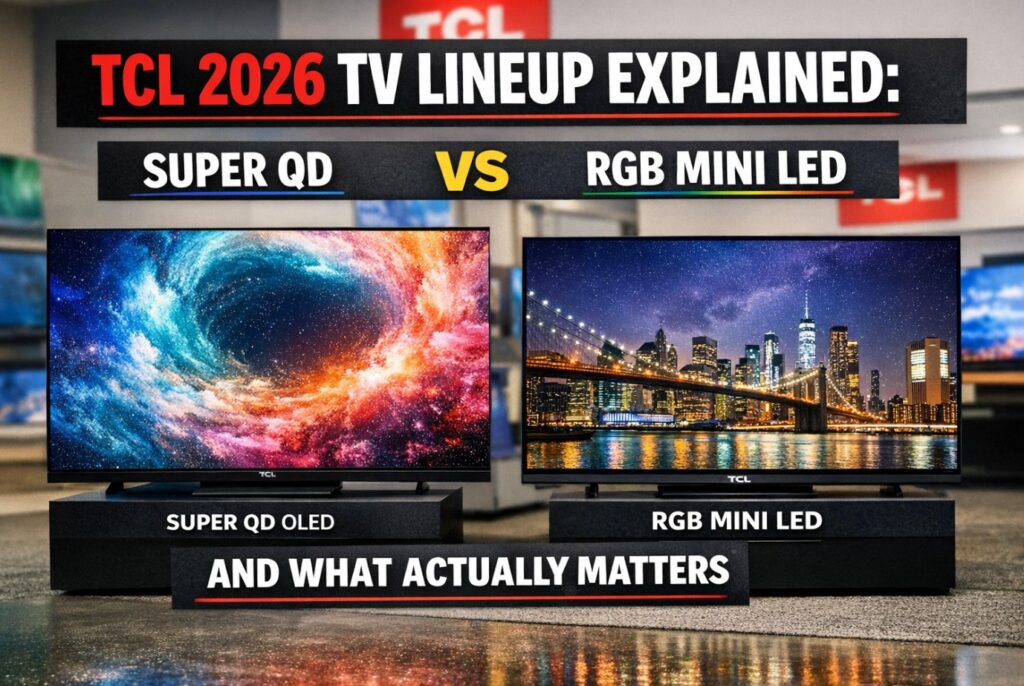

TCL 2026 TV lineup explained is not just another launch recap. This year, TCL is making its LCD story more ambitious, but also more complex. Instead of pushing one simple Mini LED message across the whole range, TCL is now splitting its premium 2026 direction into two clearer paths: models built around Super QD and models built around RGB Mini LED.
For buyers, the real question is not which TCL TV has the loudest headline claim. It is much simpler than that: which TCL 2026 models are genuinely new, which technologies matter in real viewing, and where does the marketing get ahead of practical value?
That is why this article matters. The range is now easier to understand if you stop looking at it as one giant wall of specs and start reading it as a family with different priorities. Some models are about refining TCL’s current Mini LED formula. Others are about pushing LCD into a more aggressive new color direction. 🎯
TCL 2026 TV lineup explained — the quick buyer table
| Model family | Core technology | What it is trying to do | Best fit |
|---|---|---|---|
| X11L | SQD-Mini LED | TCL’s halo performance statement | Buyers chasing the boldest TCL LCD |
| C8L / QM8L | Super QD Mini LED | Premium mainstream Mini LED with stronger color ambitions | Buyers who want high-end TCL value |
| C7L / QM7L | Super QD Mini LED | Step-down premium option with a similar technology message | Buyers who want strong value below flagship tier |
| RM9L | RGB Mini LED | A more radical premium LCD direction | Buyers who want the newest TCL LCD concept |
| RM7L | RGB Mini LED | Lower RGB Mini LED tier | Buyers who want the newer backlight direction at a less extreme level |
The big shift is simple: TCL is no longer telling just one premium LCD story. It is now asking buyers to compare two different approaches to improving Mini LED performance.
What is actually new in TCL’s 2026 strategy?
The biggest change is conceptual.
In earlier TCL launches, the message was easier to summarize: more dimming zones, more brightness, better value. In 2026, TCL is making a more layered argument. One branch of the range refines the familiar Mini LED path through Super QD. Another branch pushes toward RGB Mini LED, which is a more dramatic attempt to change how TCL positions premium LCD against OLED and against other Mini LED brands.
That matters because buyers are no longer just comparing brightness tiers. They are comparing two different ways of chasing better color, stronger HDR impact, and more premium LCD performance.
The short version
- Super QD looks like TCL’s refined premium Mini LED path.
- RGB Mini LED looks like TCL’s bolder and more experimental premium LCD path.
- X11L still sits above the range as the statement model that shows how far TCL wants to push this category.
TCL 2026 TV lineup explained for buyers confused by Super QD
This is where TCL’s naming can become slippery.
Super QD sounds dramatic, but the smarter interpretation is calmer. It does not mean TCL has suddenly abandoned everything that came before. It means TCL is trying to improve color performance, efficiency, and premium positioning inside a more familiar Mini LED structure.
That distinction matters.
Some buyers will read “Super QD” and assume it automatically means a huge jump over every previous TCL Mini LED. That may not be the right expectation. In real-world buying terms, Super QD is better understood as a refinement path rather than a total reset.
So if you are looking at C8L / QM8L or C7L / QM7L, the right question is not “Is this magic?” It is “How much of TCL’s flagship thinking reaches this price tier without forcing me into the top model?”
RGB Mini LED is the bigger headline, but also the riskier one
If you only care about what feels genuinely new, RGB Mini LED is the bigger story.
That is because RGB Mini LED is easier to frame as a technology shift rather than just an evolution. It suggests a cleaner, more aggressive color story and gives TCL a stronger way to market premium LCD against rival technologies.
Why buyers should care:
- it aims for stronger color separation
- it promises a more ambitious LCD identity
- it may improve color volume and HDR presentation in a more obvious way
Why buyers should stay calm:
- first-generation implementations usually need time
- launch messaging is often more confident than real-world results
- size, region, and firmware can still affect how impressive the final experience feels
So yes, RGB Mini LED is the more exciting phrase. But it is also the one that deserves the most caution. ⚠️
Manufacturer claims vs rounded real-world expectations
| Technology path | Manufacturer positioning | Rounded real-world expectation |
|---|---|---|
| Super QD Mini LED | Better color and a more advanced premium Mini LED direction | Expect a meaningful refinement, not a miracle |
| RGB Mini LED | A more radical step for premium TCL LCD | Expect the biggest potential jump on paper, but also the greatest need for careful real-world validation |
| X11L flagship positioning | TCL’s most ambitious 2026 LCD statement | Expect it to remain the benchmark for what TCL wants the rest of the range to suggest |
That is the safest way to read the lineup. Super QD looks like the evolution path. RGB Mini LED looks like the more disruptive path. X11L remains the halo model that sets the tone for the year.
Where the hierarchy now makes sense
If you strip away the noise, TCL’s 2026 hierarchy is actually easier than the naming suggests.
X11L = the flagship statement
This is still the TV that tells you what TCL wants enthusiasts to notice first. It is the model that carries the most aggressive identity in the lineup.
C8L / QM8L = the premium mainstream sweet spot
This may be where the real value story lives for many buyers. It carries the newer Super QD message without forcing buyers into the most extreme flagship class.
C7L / QM7L = the value premium step-down
This is likely the model family that will appeal to serious buyers who still want a strong spec sheet without paying flagship money.
RM9L / RM7L = the technology wildcard
These are the models to watch if you care about where premium LCD is heading next, not just where it is today. But they are also the models where buyers should be most careful with first-wave claims.
TCL 2026 TV lineup explained for gamers
For gaming buyers, TCL’s broader 2026 direction still looks aggressive.
The general message remains familiar: high refresh rates, strong Mini LED ambitions, and modern console-friendly feature language. But the smarter question is not whether TCL wants to sound gaming-ready. It clearly does. The smarter question is how convenient each model really is once you connect multiple devices, add eARC, and start planning around daily use.
That is where the lineup becomes more interesting.
The stronger premium sets are not just about brightness or zones. They are also about whether the TV feels easy to live with if you have a console, a streaming device, and a soundbar all connected at once. 🎮
TCL 2026 TV lineup explained for HDMI planning
This year, all HDMI ports are now HDMI 2.1, which is a meaningful quality-of-life improvement for buyers who hate port compromise. That makes the lineup easier to understand and easier to use in real homes. Instead of constantly checking which one or two ports get the best features, buyers can think more freely about console placement, eARC planning, and multi-device setups.
That does not make every model identical for gaming. Refresh rate, brightness behavior, motion handling, and panel class still matter. But it does remove one of the most annoying practical compromises that often shows up on otherwise good TVs.
Port-by-port I/O map
| Port / feature | What it offers | Why it matters |
|---|---|---|
| HDMI 1 | HDMI 2.1 | Good for console, streamer, or PC |
| HDMI 2 | HDMI 2.1 | Useful for second console or gaming source |
| HDMI 3 | HDMI 2.1 | Important if eARC is part of the setup |
| HDMI 4 | HDMI 2.1 | Adds real flexibility in multi-device homes |
| Total HDMI | 4 x HDMI 2.1 | Strong convenience advantage for gaming and AV setups |
| USB | USB connectivity | Useful for media playback and accessories |
| Ethernet | Wired networking | Better stability for heavy streaming use |
| Wi-Fi / Bluetooth | Standard smart TV wireless features | Helpful for daily convenience, but not the main buying reason |
Menu names may vary by region or firmware.
The practical takeaway is simple: TCL’s connectivity story is easier to recommend this year because buyers do not have to think in such a restrictive, port-by-port way.
What actually matters for real buyers?
This is where the launch becomes practical.
If you want the safest premium TCL buy
Watch the C8L / QM8L side of the lineup closely. It may become the sweet spot between new technology language and sane everyday value.
If you want the boldest TCL headline TV
That is still X11L. It remains the most obvious statement product in the range.
If you want to bet on TCL’s newest LCD direction
That means RM9L or RM7L, because RGB Mini LED is the fresher and more experimental branch of the lineup.
If you want value without becoming a first-wave test case
Then the safer move may be to focus on how the Super QD models are priced once the range settles.
Common mistakes buyers could make
Assuming every 2026 TCL uses the same display strategy
It does not. This is the biggest trap.
Reading Super QD and RGB Mini LED as the same thing
They are not the same message and not the same promise.
Treating X11L and RM9L as interchangeable halo products
They represent different directions inside the same broader TCL ambition.
Buying only on brightness language
Brightness matters, but it is not the whole TV.
Ignoring rollout timing and regional variation
Naming, pricing, and software details can still vary depending on market.
Final Verdict
TCL 2026 TV lineup explained is really about one thing: TCL is no longer trying to win premium LCD buyers with one single story. It now has two. One is the more refined path through Super QD. The other is the more disruptive path through RGB Mini LED.
That makes the lineup more ambitious, but also more confusing.
For most buyers, the smartest move is not to chase the loudest phrase. It is to decide what kind of TV experience they actually want. If you want the most familiar premium TCL route, the C8L / QM8L side may become the smartest place to look. If you want the boldest statement, X11L still wears the crown. If you want to watch where premium LCD goes next, RM9L / RM7L is the branch worth tracking.
TCL has made its 2026 lineup more interesting. Now buyers need to be a little more selective, a little less dazzled, and a little more curious about what each branch really means. ✨