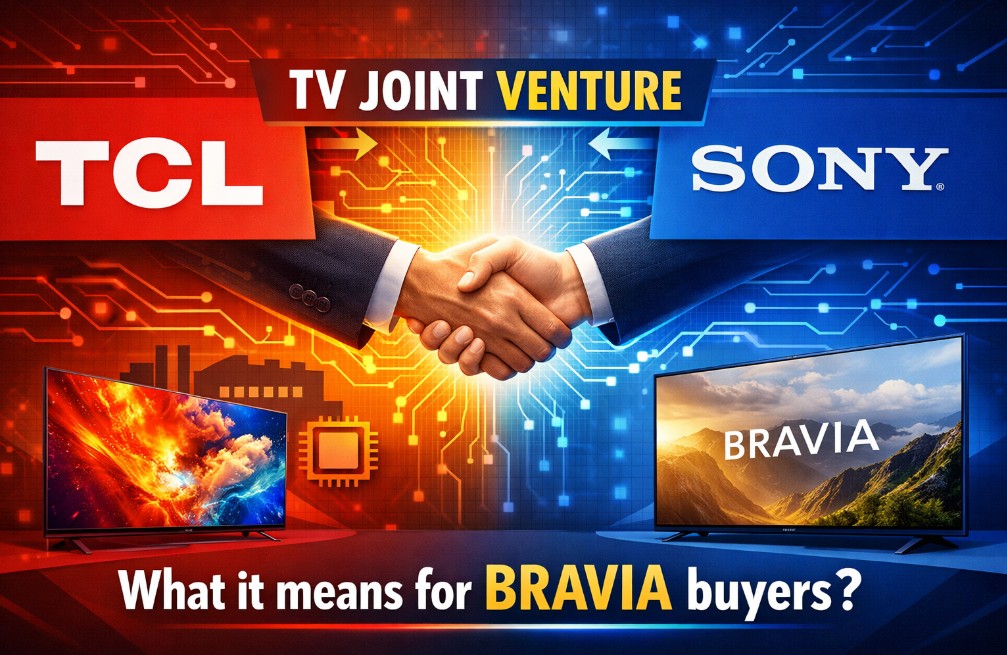

The TCL Sony TV joint venture story isn’t about “Sony being sold overnight.” It’s about control and execution: who builds, who supplies panels, who runs the manufacturing and logistics engine—while the brand and premium processing identity try to stay intact. This guide breaks down what’s actually being proposed, what can change for buyers, and what to watch for so you don’t make a rushed upgrade decision.
Update (2026): This article reflects the most recent public information about the proposed Sony–TCL TV/home-audio joint venture. Details can still change before final agreements and regulatory approvals.
Quick Takeaways
- This is a business structure change, not a “Sony disappears tomorrow” event.
- The biggest buyer impact will likely show up in panel sourcing, pricing tiers, and product cadence—not instantly, but over time.
- Treat early “leaks” about specs cautiously: wait for final model sheets before buying based on a rumor.
- For gamers and soundbar users, the real watchlist is: HDMI 2.1 behavior, VRR stability, eARC consistency. 🎮
- If you’re shopping now, buy what looks good today—don’t buy future promises. 🙂
What’s confirmed vs what’s still pending
| Topic | What’s confirmed | What’s still pending / can change |
|---|---|---|
| Structure | A proposed joint venture where TCL holds a majority stake and Sony holds a minority stake | Final binding agreement terms, governance details, scope |
| Scope | The JV is described as covering TVs and home audio operations (development → manufacturing → sales → support) | Exact product lines, regional carve-outs, long-term brand rules |
| Branding | Products are expected to continue using Sony / BRAVIA branding | How branding is applied across tiers (entry → flagship) |
| Timeline | Proposed timelines usually involve agreements first, then operations later | Regulatory approvals and operational start dates |
Plain-English translation
- Sony keeps influence (brand, processing know-how, product direction)
- TCL brings scale and vertical supply chain control (panels, manufacturing, cost efficiency)
- Buyers should expect gradual, not instant, changes.
Why this is happening (the real “why”)
The TV market has become a brutal efficiency game: panel supply, yield, logistics, and scale matter. Sony’s edge has long been processing + premium tuning, but premium tuning alone doesn’t reduce bill-of-materials costs. A majority-controlled JV lets the manufacturing side get more efficient, while Sony tries to preserve the “BRAVIA identity” in picture and audio.
This is the part that will decide whether buyers win: does the premium tuning remain a non-negotiable standard, or does the product strategy drift toward volume-first compromises?
What it could mean for BRAVIA buyers
| Buyer concern | Best-case outcome | Worst-case outcome | What you can do |
|---|---|---|---|
| Picture “DNA” | Sony processing remains consistent across mid/high tiers | Processing gets simplified on lower tiers; tuning becomes less distinct | Compare real content, not store demos; test motion + near-black |
| Pricing | More aggressive pricing in mid-range models | Confusing lineup, fewer “sweet spot” models | Buy based on value today, not “maybe cheaper later” |
| Panel consistency | Better access to modern panel tech + stable supply | More variance by region/size | Check exact model code and region sheets |
| Firmware & updates | Faster update cadence and better platform stability | Fragmented firmware paths across regions | Avoid first-wave firmware; wait for early fixes if risk-averse |
| Support & parts | Better parts availability due to scale | Slower warranty workflows during transition | Keep purchase proof + register product; avoid gray imports |
What this could mean for TCL buyers
If TCL gains deeper access to Sony’s picture/audio know-how, the mid-to-premium TCL models could get stronger in:
- motion handling and upscaling behavior
- tone mapping consistency in HDR
- sound processing + better “out-of-the-box” tuning
But again: this is not a magic flip. Real improvements show up when:
- a new platform baseline is standardized
- model families are designed under the new rules
- firmware teams converge
The buyer checklist: what to watch for (don’t guess)
1) Panel + anti-reflection behavior (real-room friendly)
- Ask: “Is this model tuned for bright rooms or cinema rooms?”
- Watch for: raised blacks, reflection haze, aggressive ABL-like dimming in HDR highlights
2) HDMI 2.1 chain stability (console/PC)
Look for clarity on:
- which ports are full-bandwidth
- VRR behavior in dark scenes
- whether the TV holds signal cleanly at 4K120/144
This is where “premium branding” either proves itself… or doesn’t. 🔧
3) eARC behavior (soundbars/AVRs)
- Dropouts and lip-sync delay are deal-breakers for many.
- Don’t assume: test eARC with your exact soundbar/receiver if possible.
4) Regional and size variance
Even today, features vary by region/size. Under a JV transition, that risk can rise:
- different panels
- different ports enabled
- different firmware branches
So always confirm the exact model code for your market.
“Does this mean Sony TVs become TCL TVs?”
Not automatically. The more accurate answer is:
- The business engine changes (who runs manufacturing/supply chain)
- The product identity is what’s on trial (processing, QA standards, firmware discipline)
If Sony’s picture standards remain enforced, buyers could see premium traits at more accessible prices. If standards slip, the BRAVIA badge becomes a marketing wrapper—and consumers will notice fast.
Common mistakes to avoid
- Buying based on “ownership headlines” instead of current product performance
- Assuming specs are identical across regions/sizes
- Overvaluing store demo loops (they hide motion issues and near-black problems)
- Ignoring the chain (cable/port/eARC) and blaming the TV first
FAQ
What is the TCL Sony TV joint venture, in simple terms?
It’s a proposed new company structure for Sony’s TV/home-audio operations where TCL would hold majority control, while Sony retains a significant stake and contributes its picture/audio expertise.
Does the TCL Sony TV joint venture mean Sony is sold?
No. The claim is about a TV/home-audio business structure, not “Sony as a whole company” being acquired.
Will BRAVIA quality drop?
Too early to call. The key variable is whether Sony’s premium processing and QA standards remain mandatory across the lineup. That’s the make-or-break detail.
Should I wait to buy a TV because of this news?
If you need a TV now, buy based on today’s proven models and your room. If you can wait, wait for final model sheets and early real-world reports—especially for HDMI/eARC stability.
Could prices go down?
They could—scale and supply chain efficiency often push prices down—but don’t buy solely on a future pricing promise.
What should gamers care about most?
HDMI 2.1 stability at 4K120/144, VRR behavior in dark scenes, and whether eARC stays stable with your soundbar/AVR. 🎮
Final Verdict
The TCL Sony TV joint venture isn’t a tabloid-style “Sony got bought” moment—it’s a slow tectonic shift. If executed well, it could blend Sony’s taste in images with TCL’s manufacturing muscle. If executed poorly, it risks diluting what people think they’re paying for.
For buyers, the smartest move is calm and practical: judge the TV in front of you, verify the chain, and let the headlines fade into background noise—where they belong. ✨
Related TVComparePro guides
https://tvcomparepro.com/tcl-x11l-sqd-mini-led-tv/
https://tvcomparepro.com/tcl-tv-hdmi-is-not-working-heres-how-to-fix-it/
https://tvcomparepro.com/fix-vrr-flicker-on-tv/