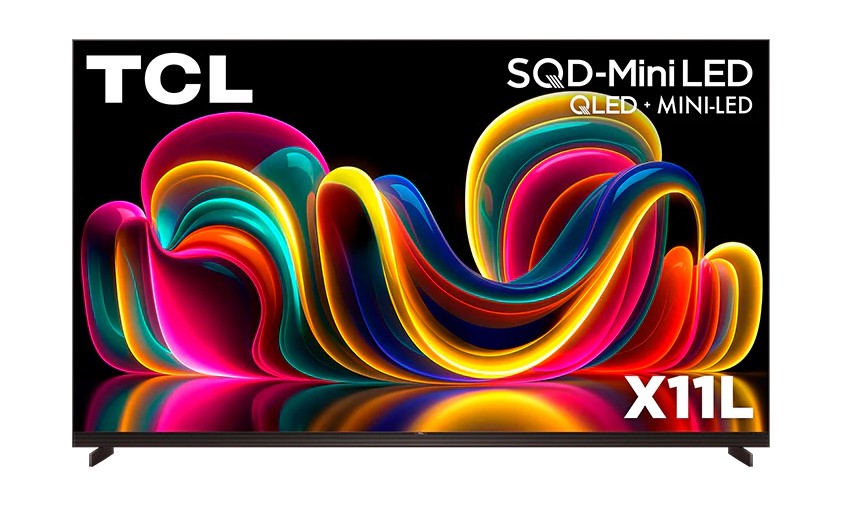

TCL X11L SQD-Mini LED TV is TCL’s new “all-in” flagship mini-LED concept shown at CES, built around one big promise: RGB-level color coverage without RGB crosstalk, while still pushing extreme peak brightness and very high local-dimming density.
This guide breaks down what’s confirmed, what’s likely to vary by size/region, the new TSR AI Processor, and how X11L compares to TCL’s 2025 premium mini-LED sets like X11K and QM-class models. Menu names/paths vary by model/region/firmware.
Quick Takeaways
- The headline claims are up to 10,000 nits peak brightness and up to 20,000 dimming zones (size-dependent).
- TCL positions SQD-Mini LED as an alternative to RGB backlights by using blue LEDs + reformulated quantum dots + an UltraColor Filter to reduce color crosstalk while targeting huge gamut coverage.
- The new processing headline is TSR AI Processor (TCL Super Resolution) paired with an upgraded 26-bit backlight controller and “Halo Control System” updates.
- For gamers, TCL confirms four HDMI 2.1 ports (bandwidth/features still region-dependent). 🎮
TCL X11L SQD-Mini LED TV — Key Specs at a Glance (confirmed vs size/region dependent)
| Category | What’s confirmed | What may vary |
|---|---|---|
| Panel / Backlight | SQD-Mini LED (“Deep Color System”: new QDs + UltraColor Filter) | Exact panel supplier variant, coating/AR behavior by region |
| Peak brightness (HDR) | Up to 10,000 nits (claim) | Sustained brightness & APL behavior, size variance |
| Local dimming | Up to 20,000 zones (claim) | Zone count by size (75/85/98) |
| Processor | TSR AI Processor (TCL Super Resolution) | Region branding and feature toggles |
| Backlight control | 26-bit backlight controller + updated Halo Control System | Algorithm tuning by firmware updates |
| HDR formats | Dolby Vision + HDR10+ + HDR10 + HLG; DV2 mentioned as future update in coverage | DV2 availability and naming by region/OTA rollout |
| Gaming | 4× HDMI 2.1 | Exact VRR range, “Game Accelerator” modes, certification |
| Smart platform | Google TV (global) | App availability by region |
Design & Build Quality
TCL positions X11L as a premium “statement” TV: very large sizes, very high brightness targets, and a chassis designed to handle a dense mini-LED backlight system. Some CES coverage mentions an ultra-thin profile for this class, but thickness and stand options typically vary by size and region. ✅
What matters in real rooms: at this brightness tier, anti-reflection coating and panel uniformity matter as much as raw nits. A high-end AR layer can decide whether the TV feels “punchy” at noon or just “bright but hazy.”
Panel Technology Explained
What “SQD-Mini LED” is trying to fix
RGB backlights can deliver spectacular color volume, but they can also create color crosstalk (a kind of colored halo/contamination) because different colored LEDs interact through diffusion layers and filters.
TCL’s SQD approach uses:
- Blue LED backlight
- Reformulated quantum dots
- UltraColor Filter
- A color purity algorithm that aims to keep saturation clean even at extreme luminance
TCL claims this combo targets full coverage of BT.2020 (and also DCI-P3/Adobe RGB) without RGB-style crosstalk side effects. 🌈
WHVA / high-contrast panel notes
CES coverage also references a high-contrast LCD panel family (often described as WHVA) with wide viewing improvements and a high native contrast claim. Treat those as “panel-family intent” rather than a guarantee, because panel variants can differ across regions and sizes.
Brightness & HDR Performance
Manufacturer claims vs rounded independent expectations
Right now, X11L is new, so independent, retail-mode measurements will arrive later. Here’s the clean way to treat the numbers:
| Metric | TCL X11L claim | Rounded independent measurements (accurate modes) |
|---|---|---|
| Peak HDR brightness | Up to 10,000 nits | TBD (depends on window size, mode, thermal limits, firmware) |
| Local dimming zones | Up to 20,000 | N/A (zone count is a spec; impact depends on algorithm + panel) |
| Color gamut | 100% BT.2020 (claim) | TBD (verification depends on measurement method and accuracy mode) |
Methodology note: when we add “rounded independent measurements,” we’ll base them on accurate picture modes (Movie/Filmmaker-class), with panel variance and firmware potentially shifting results.
The important practical point (even before measurements)
At ultra-high peak brightness, the real win is not “sun brightness,” it’s specular highlight control without ugly blooming, raised blacks, or color shift. That’s why TCL talks so much about the 26-bit backlight controller and Halo Control evolution. 🔥
Color Accuracy & Picture Processing
The TSR AI Processor (what it is, and what it does)
TCL explicitly calls out the TSR AI Processor (TCL Super Resolution AI) as a new step for X11L. The claim is improved “AI” handling across:
- color
- contrast
- clarity
- motion
- upscaling
- sound
What to expect in real content:
- Better texture retention in 4K streams (less “waxiness”)
- Cleaner gradients in HDR (less banding)
- More stable tone mapping in bright scenes (less pumping)
That said, processing behavior is heavily firmware-tuned. Early retail firmware often changes quickly in the first months.
Motion Handling & Refresh Rates
CES coverage mentions high-refresh behavior (and TCL’s typical “Game Accelerator” marketing), but the safest confirmed gaming headline is still the connectivity: four HDMI 2.1 ports.
Practical expectation: if TCL targets native high refresh, you’ll still want to check two things on retail units:
- whether full-resolution 4K high refresh is available on all HDMI 2.1 ports
- whether local dimming remains stable with VRR enabled (mini-LED + VRR can sometimes cause luminance fluctuations)
Gaming Performance
For a flagship mini-LED, the “must-haves” are implied:
- 4K high refresh input
- VRR + ALLM
- Low input lag in Game Mode
- No HDMI bottlenecks (TCL calling out 4× HDMI 2.1 is a big deal for multi-device setups)
If you’re the kind of user with a console + PC + soundbar/AVR, port flexibility alone can be a deciding factor.
Smart Platform & UX
Global models are positioned around Google TV, and CES coverage also mentions ecosystem features like Xbox/Game Pass app presence on Google TV.
Reality check: Google TV app availability still depends on region, and some features land via OTA updates (especially new streaming/gaming integrations).
Audio & Connectivity
Audio highlights (as reported in CES coverage)
Some CES reporting notes premium speaker tuning and multi-channel intent on the X11L line, including Bang & Olufsen branding in certain materials. Treat audio branding as region dependent until your local product page confirms it.
Port-by-port I/O map (what we can state safely right now)
| Port / Wireless | TCL X11L status |
|---|---|
| HDMI total | 4 (HDMI 2.1) |
| HDMI 2.1 count | 4 |
| eARC port | Not explicitly confirmed (likely on one HDMI, but confirm per region/spec sheet) |
| USB | Not confirmed in CES press materials we reviewed |
| Optical (TOSLINK) | Not confirmed in CES press materials we reviewed |
| Ethernet (LAN) | Not confirmed in CES press materials we reviewed |
| Wi-Fi / Bluetooth | Not confirmed in CES press materials we reviewed (typical for Google TV sets, but confirm per region) |
Thermal Design & Longevity
At this brightness tier, thermal management is not a side note — it determines whether “10,000 nits” is a headline number or a behavior you can actually sustain without aggressive dimming.
TCL’s messaging focuses on:
- the higher precision backlight controller (26-bit)
- algorithmic halo control improvements
- optical distance (“Micro OD” reductions) in the backlight system US.TCL+1
What that implies: better control at the pixel-adjacent level, potentially less blooming, and more stable highlights — but again, final behavior will be firmware + panel dependent.
Real-World Impressions (what to expect)
Based on the design goals TCL is signaling, X11L should be strongest in:
- bright rooms (anti-reflection becomes crucial)
- high APL HDR scenes (sports, live events, games)
- “wow” specular highlights (neon, sparks, sun glints)
Where ultra-bright mini-LEDs can still stumble:
- near-black uniformity (clouding/dirty screen effect variance)
- very dark movie scenes if local dimming is overly aggressive
- VRR luminance shifts in some implementations
Differences vs 2025 TCL Premium Models (what’s actually new)
Here’s the clearest way to show “what changed”.
X11L vs X11K (2025 flagship premium mini-LED)
| Spec / Feature | X11L (new) | X11K (2025 flagship) | What it means |
|---|---|---|---|
| Peak brightness (claim) | Up to 10,000 nits | 6,500 nits (claim) | X11L is ~54% higher on the headline peak claim |
| Dimming zones (claim) | Up to 20,000 | Up to 14,112 (98″) | Higher zone density can reduce blooming if algorithms are good |
| Processor | TSR AI Processor (Super Resolution) | AiPQ Pro Processor | X11L signals a new processing stack focus |
| Backlight control | 26-bit controller emphasized | Halo control emphasized | More precision should help highlight/shadow separation |
| HDMI 2.1 | 4 ports | Region-dependent; confirm per spec sheet | X11L is more “multi-device gamer” friendly on paper |
X11L vs TCL 2025 premium/value mini-LED (C8K/QM-class)
Compared with TCL’s 2025 high-value mini-LED sets (like C8K-class models), X11L is a different category: it’s chasing maximum brightness + maximum zone density + maximum color coverage rather than price/performance. Expect a jump in “halo control cleanliness” if the processing and backlight controller deliver.
Common Mistakes to Avoid
- Treating “10,000 nits” as how the TV looks all the time (it’s a peak claim, not an average picture level).
- Assuming zone count alone guarantees OLED-like blacks (algorithms + panel uniformity matter).
- Ignoring region differences: Google TV models, port maps, and even audio branding can change.
Troubleshooting / Pro Tips
When X11L hits real retail, the first two settings that will decide whether people love or hate it are usually:
- Local Dimming aggressiveness (bloom control vs crushed shadow detail)
- Tone mapping / contrast enhancers (wow highlights vs clipped detail)
FAQ
- What is TCL X11L SQD-Mini LED TV designed to improve over RGB backlights?
It targets very wide color coverage while avoiding RGB-style color crosstalk, using a blue LED + quantum dot + UltraColor Filter approach. - Is the “up to 20,000 dimming zones” number the same on every size?
It’s stated as “up to,” so expect the highest count on the largest model, with lower counts on smaller sizes. - What is the TSR AI Processor?
TCL describes TSR as its Super Resolution AI processor stack for color/contrast/motion/upscaling and sound improvements. - Does X11L support HDR10+ and Dolby Vision?
CES materials and coverage indicate broad HDR support including HDR10+ and Dolby Vision (region-dependent details can vary). - How many HDMI 2.1 ports does it have?
TCL highlights four HDMI 2.1 ports in CES coverage and press materials. - Is X11L a replacement for X11K?
Think of it as a next-step flagship direction. On paper it pushes higher peak brightness, higher zone counts, and a new processor stack. US.TCL+2US.TCL+2 - Will it be available in Europe exactly as shown at CES?
Availability, sizes, and exact specs often differ by region. Treat CES specs as the baseline, then confirm via your regional product page.
Final Verdict
The TCL X11L SQD-Mini LED TV is TCL making a very specific bet: that the next premium leap is not just “more nits” or “more zones,” but cleaner color at extreme brightness — the kind of clarity that stays composed when HDR highlights get violent.
If TCL’s new backlight precision (26-bit control) and TSR processing land the way the spec story suggests, X11L could be the rare mini-LED that feels confident in both daylight punch and saturated color — without the messy halos that make people swear off LCD in the first place.