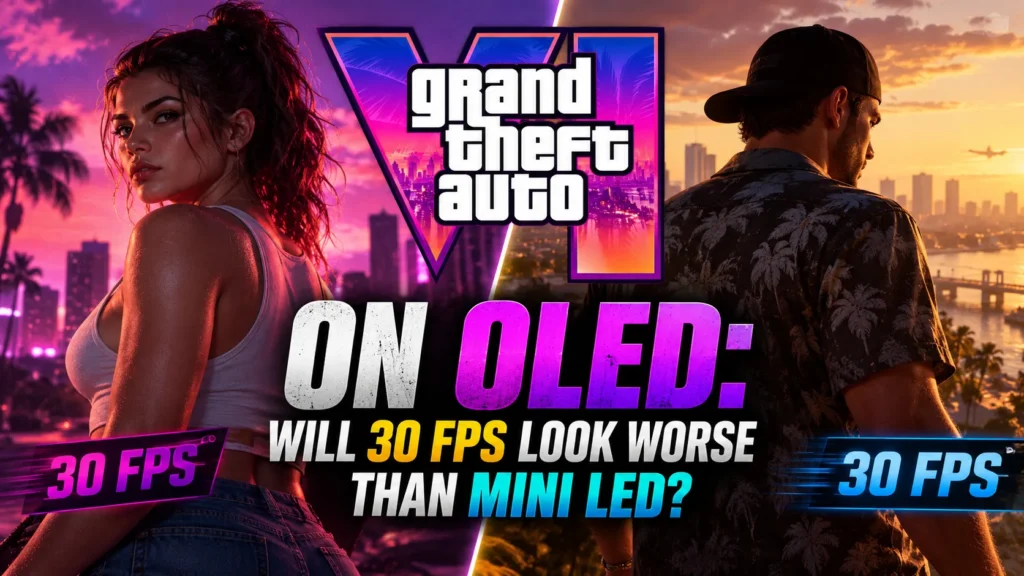

Buying a better television should improve your games, not create a new worry. If you’re considering GTA 6 on OLED, you’ve probably seen warnings that a game running at 30 FPS can appear choppier on OLED than on an LCD or Mini LED TV. That concern has a real technical basis, but it doesn’t make OLED a poor choice for Grand Theft Auto VI.
My advice: don’t replace an OLED just because GTA 6 might target 30 FPS. An OLED’s very fast pixel response can expose the gaps between low-frame-rate images, especially during slow camera pans. Some LCD televisions soften those gaps with slower transitions, but the trade-off is additional motion blur. Neither display can turn 30 rendered frames into 60 without extra processing.
There is one vital caveat before comparing anything: Rockstar has not officially specified GTA 6’s final console frame-rate modes. The 30 FPS discussion below is a technical scenario, not a claim that I’ve played or measured the unreleased game.
What Rockstar Has Actually Confirmed About GTA 6 Performance
Grand Theft Auto VI is scheduled to launch on November 19, 2026 for PlayStation 5 and Xbox Series X|S. Rockstar published a new launch trailer on October 15. PlayStation’s game listing also carries the PS5 Pro Enhanced label.
Those announcements still leave the most relevant TV questions unanswered. We do not yet have official specifications for resolution modes, a 30 FPS cap, a 40 FPS option, a 60 FPS performance mode or the final HDR presentation. A console enhancement badge is not evidence of any particular frame-rate target.
| Confirmed as of October 16, 2026 | Not confirmed for the final game |
|---|---|
| November 19, 2026 release for PS5 and Xbox Series X|S | Specific 30, 40, 60 or 120 FPS modes |
| PlayStation lists GTA 6 as PS5 Pro Enhanced | Exactly what the PS5 Pro enhancement changes |
| Rockstar released a launch trailer on October 15 | Final console rendering resolution and HDR implementation |
The distinction matters because a purchase based on an assumed 30 FPS cap could look very different once the game ships. Until Rockstar details its settings, I would not pay extra for a feature solely on the assumption that GTA 6 will use it.
Why 30 FPS Can Look Choppier on an OLED TV
At a steady 30 FPS, the console produces a new image every 33.3 milliseconds. As the in-game camera turns, objects move from one recorded position to the next. No television can display intermediate detail that the game never rendered, unless it uses some form of image interpolation.
An OLED pixel changes state extremely quickly. That’s excellent when the game is updating at 60 or 120 FPS: moving edges look clean, with little of the trailing blur associated with slower LCD panels. At 30 FPS, though, the same clean transitions can make the discrete steps between frames easier to see.
A Mini LED television is still an LCD television; Mini LED describes the backlight, not a fundamentally different type of image pixel. Depending on its LCD response times, transitions may blend part of one frame into the next. That blur can make a slow pan feel less abrupt to some viewers, even though the game is running at exactly the same 30 FPS.
This is known as response-time stutter. It does not mean the OLED is dropping frames, suffering from ghosting or receiving a faulty HDMI signal. The effect occurs because OLED pixels transition almost instantly, making the gaps between low-frame-rate updates more noticeable. How strongly you perceive it depends on your sensitivity to motion, screen size, brightness and the type of scene being displayed.
Stutter is not the same as an unstable frame rate
A game can hold a perfectly consistent 30 FPS and still look visibly stepped during a slow pan. That is different from uneven frame delivery, where one frame arrives late, or from ghosting, where pixel transitions leave a visible trail behind movement. When somebody says a cheaper LCD looks “smoother,” it may be hiding the first effect by introducing a little of the third.
The important nuance is that modern Mini LED televisions vary considerably. A premium LCD with very fast response times can also make low-frame-rate stutter noticeable. It is misleading to claim that all Mini LED TVs automatically handle 30 FPS better.
OLED vs Mini LED for GTA 6: The Differences That Matter
The TV choice involves much more than low-frame-rate motion. GTA 6’s bright streets, darker interiors and fast camera movement should place different demands on a display, even though the final rendering settings remain unknown.
| What matters | OLED | Mini LED LCD |
|---|---|---|
| 30 FPS camera pans | Fast pixel transitions can make steps between frames more obvious | Slower transitions on some models can mask steps, but may add blur |
| Faster games | Very clear transitions with little LCD-style ghosting | Ranges from sharp to visibly smeared depending on panel and tuning |
| Night scenes | Pixel-level black control without blooming around highlights | Local dimming can reveal halos, depending on zone control |
| Sunny rooms | Performance depends on panel brightness and reflections | High-brightness models may have an advantage |
| Long static HUD sessions | Consider cumulative image-retention and burn-in risk | No OLED-type burn-in risk; other LCD limitations still apply |
For someone who primarily plays cinematic single-player games in a dark room, I would still strongly consider OLED. True blacks, excellent contrast and low input lag are meaningful strengths. In a bright family living room, a capable Mini LED may be more practical. If low-frame-rate camera pans bother you more than anything else, personally checking both technologies before buying becomes especially important.
The key is to compare specific models at the same frame rate, rather than assume an entire display category wins. A sluggish budget LCD and a well-tuned flagship Mini LED may have very different motion characteristics.
Would a 120Hz TV Make 30 FPS Look Smoother?
Not by itself. Refresh rate is how often the television can update its screen. Frame rate is how often the game generates a distinct image. These numbers are related, but they are not interchangeable.
If a game produces a consistent 30 FPS and the console sends those frames inside a 120Hz signal, each rendered frame can simply be shown across four refreshes. The timing is even, but you still see only 30 unique images each second.
| Scenario | Time per rendered frame | On a 120Hz output | Practical consequence |
|---|---|---|---|
| 30 FPS | 33.3 ms | Four display refreshes per game frame | Still 30 distinct frames; stutter can remain visible |
| 40 FPS | 25.0 ms | Three refreshes per game frame | More frequent updates, if a 40 FPS mode exists |
| 60 FPS | 16.7 ms | Two refreshes per game frame | Twice as many distinct frames as 30 FPS |
The more interesting possibility is 40 FPS. A 40 FPS mode can fit evenly into a 120Hz output, with each frame displayed across three refreshes. It reduces the time between newly rendered frames from 33.3 ms to 25 ms. That can be a worthwhile step up in both motion continuity and responsiveness, without requiring a 60 FPS mode. It only matters here if Rockstar offers a 40 FPS mode.
A 120Hz panel remains valuable for games that actually deliver higher frame rates, and as a more flexible purchase for future releases. It is not a secret fix for 30 FPS OLED stutter.
What about VRR?
Variable Refresh Rate lets compatible displays adjust refresh timing to better match the game, reducing tearing and some uneven delivery when frame rates fluctuate within the supported operating range. It does not manufacture additional animation frames. At a stable 30 FPS, it cannot erase the visible jumps inherent in 30 unique frames per second.
Low-frame-rate behavior depends on the console, the game, the TV and any available frame-duplication or compensation mechanism. Do not assume that a VRR logo guarantees an improvement at 30 FPS. Sony’s PS5 guidance explicitly warns that results can vary by game and display.
Can Motion Smoothing Fix 30 FPS Gaming?
Some TVs can estimate and insert intermediate images to make lower-frame-rate content appear more fluid. In movies, this is commonly called motion interpolation. For interactive games, the same process has a significant trade-off: the TV needs time to analyze frames, and that additional processing can increase input lag or introduce artifacts around moving objects.
Most TVs disable their strongest interpolation controls in Game Mode. A few offer dedicated gaming motion features, but support, latency and results differ by model and firmware. I would not recommend leaving Game Mode just to make a console game look smoother without checking how responsive the controls still feel.
Black Frame Insertion (BFI) is different. It reduces the time each frame remains visible, which can change perceived motion blur, but it does not create new frames. It may reduce brightness, produce visible flicker and be unavailable with some VRR or gaming configurations. It is not a universal cure for 30 FPS stutter.
When playing, I would normally start with the TV’s low-latency Game Mode and motion interpolation disabled. Only experiment with a gaming-specific motion setting if the TV supports it and you can tolerate the compromise in control response.
Does PS5 Pro Change the OLED vs Mini LED Decision?
The official PS5 Pro Enhanced designation tells us that GTA 6 is intended to use some benefit of the more capable console. It does not tell us whether the benefit is 60 FPS, improved resolution, visual effects or a combination of features. Until detailed performance information is published, promising smoother GTA 6 gameplay on PS5 Pro would be speculation.
Both standard PS5 and PS5 Pro can connect to suitable 4K120 televisions, but the game still decides which modes are available. The most useful TV features are low input lag, sensible HDR tone mapping, strong contrast and reliable support for whatever output the title eventually provides. A high-refresh panel is a sensible general-purpose feature, not evidence that GTA 6 will run at 120 FPS.
Similarly, the PS5 console’s HDR capability does not prove which HDR options GTA 6 will offer. I would wait for Rockstar’s own specifications or verified release-build testing before making game-specific HDR recommendations.
Try This Before Buying a New TV for GTA 6
You don’t need to wait until November to find out whether low-frame-rate OLED stutter bothers you. You can use an existing console game with a confirmed, locked 30 FPS graphics mode as a stand-in for the underlying display behavior. This tests your sensitivity to 30 FPS motion, not GTA 6 performance itself.
- Find a PS5 or Xbox game with a selectable 30 FPS quality mode. Confirm that the mode actually runs at 30 FPS rather than guessing from its name.
- Use the same scene, camera speed and console settings on both televisions. Keep Game Mode enabled on each set.
- Rotate the camera slowly across buildings, signs or vertical railings. Then try a faster turn and compare edge blur versus visible stepping.
- Watch from your normal seating position. Screen size, brightness and viewing distance can influence the result, so keep the comparison as consistent as possible.
- Check response to the controller. If you enable any motion processing, decide whether the smoother appearance is worth the added delay or artifacts.
If you don’t have access to two TVs, the same exercise on your existing OLED still tells you whether you personally find 30 FPS acceptable. A recorded gameplay video is a weaker substitute because the capture rate, video compression and player can affect the motion you see.
Should You Buy an OLED or Mini LED for GTA 6?
If you already own an OLED
Keep it. Don’t downgrade or replace a capable OLED solely because some players dislike 30 FPS on the technology. First try another stable 30 FPS game and judge it with your own eyes. You’ll retain OLED’s strengths across films and all the higher-frame-rate games you play.
If you already have a decent 4K60 LCD
There’s no urgent need to upgrade for GTA 6 before its graphics modes are confirmed. A good 4K60 display can present a stable 30 or 60 FPS signal appropriately. Upgrading to 120Hz makes more sense for your wider game library, or if Rockstar confirms an output mode that benefits from it.
If you’re choosing a new TV right now
Pick OLED if you value deep blacks, crisp pixel response, wide viewing angles and dark-room image quality. Compare Mini LED if you watch in strong daylight, prefer very bright HDR or are especially sensitive to the stepping of low-frame-rate motion. In either case, prioritize the actual panel’s motion behavior and Game Mode input lag over marketing claims such as “240 motion rate.”
My buying rule is simple: don’t buy a worse all-round TV to solve a frame-rate limitation that hasn’t even been confirmed for this game. A higher-refresh OLED remains an excellent gaming display, and a well-chosen Mini LED remains a compelling alternative for the right room and viewer.
What I Would Wait to Verify After Launch
Once GTA 6 releases on November 19, four results will matter more than any pre-launch speculation: the frame-rate modes on PS5 and Xbox Series X|S, what PS5 Pro Enhanced actually changes, whether a native 40 FPS mode exists, and how stable frame delivery feels during demanding gameplay. The final HDR implementation is another important question for choosing and configuring a TV.
Until then, the defensible conclusion is straightforward. OLED can make 30 FPS stutter more visible, but that does not mean GTA 6 will look worse overall on OLED. Mini LED can soften motion transitions on certain models, while OLED offers cleaner fast motion and superior pixel-level contrast. Choose for your room, your sensitivity and the games you play beyond one unreleased title.
More from TVComparePro: Best 65-inch TVs for different budgets and gaming needs and PS5 Pro TV settings for 4K120, HDR and VRR.