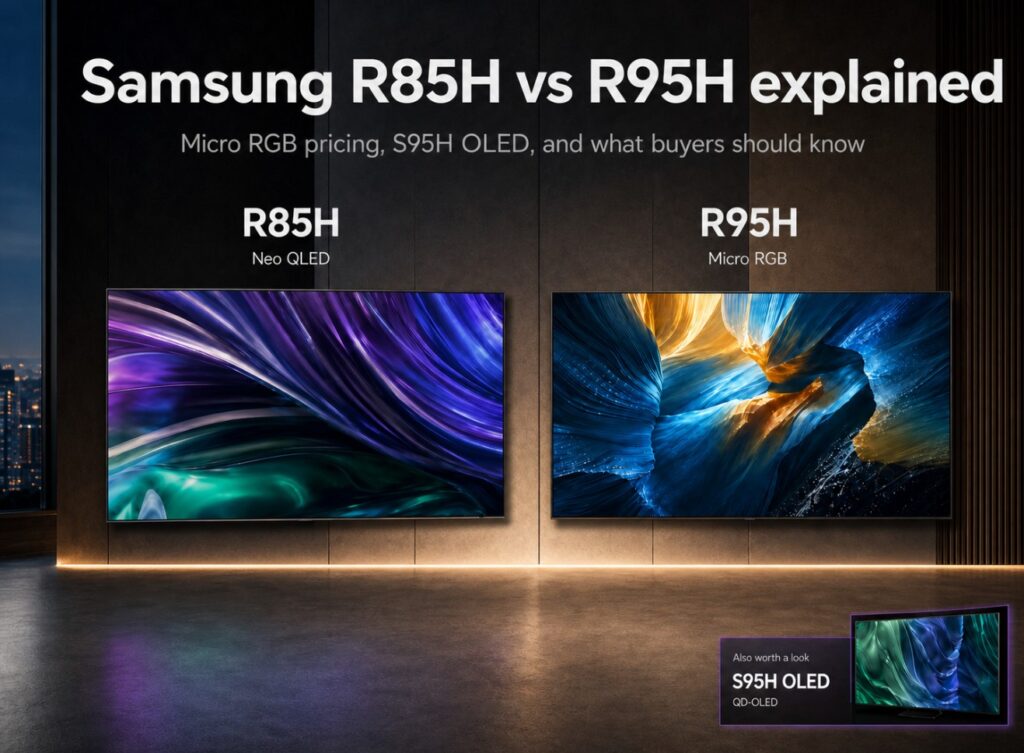

Samsung R85H vs R95H explained is the kind of comparison buyers need now that Micro RGB is no longer just a giant showcase technology. Samsung’s 2026 Micro RGB range is suddenly much more realistic for normal premium-TV shoppers, with the R85H starting at a price that looks aggressive against flagship OLED and high-end Mini LED rivals, while the R95H pushes harder on brightness handling, motion, processor tier, and premium features.
That makes the buying question more interesting than it first looks. The R85H is not simply “cheap Micro RGB,” and the R95H is not just “the expensive one.” They are two different ways of bringing Samsung’s red-green-blue backlight strategy into living rooms that still have to deal with daylight, sports, gaming, reflections, and price. The S95H OLED also matters here, because many buyers looking at R95H money will naturally ask whether they should buy Samsung’s flagship QD-OLED instead.
So this article is not only about price. It is about which display direction makes more sense for your room: Micro RGB LCD, higher-tier Micro RGB LCD, or Samsung’s S95H QD-OLED.
Samsung R85H vs R95H explained
| Category | Samsung R85H | Samsung R95H |
|---|---|---|
| Display type | Micro RGB 4K LCD | Micro RGB 4K LCD |
| Positioning | More accessible Micro RGB model | Higher-tier Micro RGB model |
| Processor / engine | Micro RGB AI Engine | Micro RGB AI Engine Pro |
| Color technology | Micro RGB Precision Color 100 | Micro RGB Precision Color 100 |
| Refresh / motion | Motion Xcelerator 144Hz | Motion Xcelerator 165Hz |
| Anti-glare | Glare Free listed on Samsung U.S. models | Glare Free listed on Samsung U.S. models |
| HDR positioning | Micro RGB HDR+ style positioning | Micro RGB HDR Pro style positioning |
| Smart platform | Samsung Vision AI / Tizen-based smart TV platform | Samsung Vision AI / Tizen-based smart TV platform |
| Starting price example | 55-inch listed at $1,599.99 | 65-inch listed at $3,199.99 |
| Best for | Buyers who want Micro RGB at a lower price | Buyers who want stronger performance headroom and premium motion |
The simple version: R85H is the value door into Micro RGB; R95H is the performance door.
Technical specifications: Samsung R85H vs R95H
| Specification | Samsung R85H | Samsung R95H |
|---|---|---|
| TV family | Samsung Micro RGB | Samsung Micro RGB |
| Resolution | 4K Ultra HD | 4K Ultra HD |
| Backlight / display approach | Micro RGB backlight LCD | Micro RGB backlight LCD |
| Color claim | 100% BT.2020 color area | 100% BT.2020 color area |
| Processor | Micro RGB AI Engine | Micro RGB AI Engine Pro |
| Motion technology | Motion Xcelerator 144Hz | Motion Xcelerator 165Hz |
| Anti-reflection | Glare Free | Glare Free |
| HDR naming | Micro RGB HDR+ positioning | Micro RGB HDR Pro positioning |
| Gaming | HDMI 2.1-class gaming features expected, verify exact regional model | HDMI 2.1-class gaming features expected, verify exact regional model |
| Audio features | Dolby Atmos, Object Tracking Sound / Q-Symphony style Samsung ecosystem features, region dependent | Dolby Atmos, Object Tracking Sound / Q-Symphony style Samsung ecosystem features, region dependent |
| Smart system | Samsung Vision AI / Tizen | Samsung Vision AI / Tizen |
| Example listed price | 55-inch: $1,599.99; 85-inch: $3,999.99 | 65-inch: $3,199.99; 85-inch: $6,499.99 |
| Best buyer type | Wants newer Micro RGB color technology at a more approachable price | Wants the stronger Micro RGB model before considering OLED or very large flagship screens |
Specifications, model names, HDMI behavior, pricing, and availability can vary by country, retailer, size, and firmware. Always check the exact local model number before buying.
What Micro RGB actually changes
Micro RGB is Samsung’s attempt to move premium LCD beyond the usual “more Mini LED zones and more brightness” conversation. Instead of relying only on a conventional white or blue LED backlight with filters and quantum-dot enhancement, Micro RGB uses much finer red, green, and blue backlight control to improve color precision and color volume.
That matters because LCD TVs have always had one big advantage over OLED: they can get very bright without the same burn-in anxiety. But they also have weaknesses, especially around blooming, viewing behavior, and how naturally they can render intense color in HDR scenes. Micro RGB is meant to give Samsung a stronger answer in that space.
In practical terms, buyers should expect Samsung to frame these TVs around:
- brighter-room confidence
- more intense color
- glare handling
- sports and gaming motion
- a premium LCD alternative to OLED
That does not automatically mean Micro RGB beats OLED in every room. It means Samsung now has a stronger LCD story for people who watch in bright spaces and do not want OLED’s particular trade-offs.
Practical setup notes before choosing R85H or R95H
In real living-room terms, the R85H makes sense if you want the Micro RGB idea without paying flagship OLED money. It gives buyers the newer color/backlight story, Samsung’s smart platform, Glare Free, and 144Hz motion language at a price that looks more aggressive than many premium-TV launches.
The R95H is the model for people who want more headroom. If your room is bright, you watch a lot of sports, or you care about high-refresh gaming, the R95H’s stronger processor and Motion Xcelerator 165Hz positioning make it the safer premium choice.
The important part is not to buy by technology name alone. A cheaper Micro RGB TV is still not automatically the best TV for every buyer. Think about the room first: bright living room, windows, sports, daytime streaming, gaming, and how much you care about black-level perfection at night.
Samsung R85H pricing: why it matters
The R85H is important because it lowers the entry point into Samsung’s Micro RGB family. The 55-inch U.S. model is listed at $1,599.99, while the 85-inch R85H is listed at $3,999.99. That immediately makes Micro RGB feel less like a concept technology and more like a real premium-TV option.
That price positioning is the reason the R85H deserves attention. It gives Samsung something that can compete with upper-mid Mini LED TVs, premium QLED models, and discounted OLED alternatives.
Samsung R95H pricing: where the premium starts
The R95H moves into a more serious premium category. Samsung lists the 65-inch R95H at $3,199.99 and the 85-inch R95H at $6,499.99, with the R95H carrying the stronger Micro RGB AI Engine Pro and Motion Xcelerator 165Hz positioning.
That makes the R95H more interesting, but also harder to buy casually. At this level, it must be compared not only with the R85H, but also with Samsung’s own S95H QD-OLED, LG’s premium OLEDs, and high-end RGB Mini LED models from other brands.
R85H vs R95H: where the real upgrade sits
| Upgrade area | Why R95H matters more |
|---|---|
| Processor | Micro RGB AI Engine Pro should give Samsung more room for scene analysis and picture optimization |
| Motion | 165Hz positioning is stronger for PC gaming and motion-heavy use |
| Premium HDR | R95H gets the more premium Micro RGB HDR Pro-style positioning |
| Large-screen use | Higher-tier processing and motion can matter more at larger sizes |
| Buyer confidence | Better fit for people who want Micro RGB as their main premium TV for several years |
The R95H is the better TV on paper. The R85H is the more interesting value story.
Samsung R95H vs S95H OLED: which direction makes more sense?
This is the comparison many buyers will actually make.
The S95H is Samsung’s flagship QD-OLED direction. Early reviews and first-look coverage position it as a very bright OLED with a strong anti-reflective finish, 4K/165Hz gaming support, deep OLED contrast, Tizen, and Samsung’s usual lack of Dolby Vision support. Some early coverage also notes that the matte/anti-glare finish can slightly lift black levels in bright-room viewing, even while making reflections easier to manage.
The R95H, by contrast, is Samsung’s premium Micro RGB LCD direction. It will not have per-pixel OLED black control, but it is built for brightness, color volume, Glare Free viewing, and LCD-style bright-room confidence.
| Buyer priority | Better fit |
|---|---|
| Dark-room movie contrast | S95H OLED |
| Bright living room | R95H or R85H |
| Sports in daylight | R95H |
| OLED black levels | S95H |
| LCD brightness and color punch | R95H |
| Lower entry into Micro RGB | R85H |
| PC gaming and high refresh | S95H or R95H, depending on room and panel preference |
| Burn-in anxiety | R85H / R95H |
The clean takeaway: choose S95H if OLED contrast matters most; choose R95H if bright-room color, glare handling, and LCD confidence matter more.
Gaming: 144Hz vs 165Hz
Gaming is one of the clearest differences between R85H and R95H. Samsung positions the R85H with Motion Xcelerator 144Hz, while the R95H moves up to Motion Xcelerator 165Hz. Samsung’s own Micro RGB announcement describes the R95H at 165Hz and the R85H at 144Hz.
For console buyers, this difference may not matter much. PS5 and Xbox Series X gaming usually centers on 4K 60Hz or 4K 120Hz. For PC gamers, 165Hz can be more interesting if your hardware can actually use it.
| Gaming setup | R85H | R95H |
|---|---|---|
| PS5 / Xbox | Strong enough | Strong enough |
| PS5 Pro | Strong enough | Better premium headroom |
| PC gaming | Good at 144Hz | Better at 165Hz |
| Competitive gaming | Good | Better if input and mode support align |
| Casual gaming | More than enough | More than enough |
If you are mostly a console gamer, do not overpay only for 165Hz. If you are a PC gamer and want the stronger Samsung Micro RGB package, the R95H makes more sense.
Port-by-port I/O map
Samsung’s regional pages can vary in how they show full port behavior, so treat this as a buying checklist rather than assuming every country page exposes the same details.
| Port / feature | What to verify | Why it matters |
|---|---|---|
| HDMI 1 | HDMI 2.1 / high-bandwidth support | Best for console or PC |
| HDMI 2 | HDMI 2.1 / high-bandwidth support | Useful for second gaming source |
| HDMI 3 | eARC / HDMI behavior | Important for soundbar or AVR |
| HDMI 4 | HDMI 2.1 or standard input depending on model/region listing | Useful for extra device planning |
| eARC | Confirm which HDMI port carries it | Prevents soundbar confusion |
| VRR / ALLM | Confirm supported modes | Important for gaming |
| PC high refresh | Confirm 144Hz or 165Hz mode support | Matters more for PC than console |
For S95H, early first-look coverage lists four HDMI 2.1 ports, with some optional wireless One Connect configurations offering expanded input flexibility. For R85H/R95H, check the exact Samsung local listing before purchase, because Samsung’s product pages emphasize motion and gaming but may present port details differently by region.
Manufacturer claims vs rounded real-world expectations
| Area | R85H | R95H | S95H OLED |
|---|---|---|---|
| Manufacturer positioning | Accessible Micro RGB | Premium Micro RGB | Flagship QD-OLED |
| Bright-room story | Strong | Stronger | Strong, but OLED behaves differently |
| Black levels | LCD local dimming | LCD local dimming | Per-pixel OLED black |
| Color story | 100% BT.2020 area claim | 100% BT.2020 area claim | QD-OLED color volume |
| Motion | 144Hz | 165Hz | 165Hz class on larger OLED models |
| Glare handling | Glare Free | Glare Free | Glare-reduction finish, model/region dependent |
| Value angle | Best Micro RGB entry | Best Micro RGB performance | Best OLED contrast direction |
| Risk | May not match R95H refinement | More expensive | OLED price and panel trade-offs |
This table is the safest way to think about the decision. R85H is not the same as R95H. R95H is not the same kind of TV as S95H. They are three different answers to three different rooms.
Who should buy Samsung R85H?
Choose R85H if you want:
- Micro RGB at the lowest practical entry point
- strong color and bright-room positioning
- 144Hz gaming language
- Glare Free viewing
- a premium Samsung LCD without jumping to the R95H price
The R85H is the smart pick for buyers who want newer Samsung display tech but still care about price.
Who should buy Samsung R95H?
Choose R95H if you want:
- the stronger Micro RGB model
- 165Hz motion
- Micro RGB AI Engine Pro
- better long-term premium headroom
- a bright-room alternative to flagship OLED
- a stronger fit for sports, PC gaming, and large living rooms
The R95H is the safer choice if you want Micro RGB to be your main premium TV, not just a value experiment.
Who should still consider S95H OLED?
Choose S95H if:
- you mostly watch in controlled lighting
- OLED contrast matters most
- you want Samsung’s flagship QD-OLED identity
- you care about cinematic black levels
- you prefer OLED’s per-pixel precision over LCD brightness confidence
The S95H is still the more obvious choice for OLED fans. The R95H is for buyers who want a premium Samsung TV but prefer the LCD/Micro RGB path.
Common buying mistakes
Assuming Micro RGB automatically beats OLED
It does not. It solves different problems.
Ignoring the difference between R85H and R95H
The R95H gets the stronger processor and higher refresh positioning.
Buying R95H only because it is newer
If your room is dark and movie-first, S95H may still be more attractive.
Buying S95H for a very bright room without thinking
OLED has improved a lot, but Micro RGB is clearly being pitched as a bright-room LCD answer.
Forgetting Dolby Vision
Samsung still does not support Dolby Vision on its TVs. If Dolby Vision is essential to you, that matters.
Which Samsung TV makes the most sense?
The R85H is the Micro RGB model that makes the technology feel accessible. It is the one to watch if you want Samsung’s newer LCD color direction without paying premium flagship money.
The R95H is the more serious Micro RGB choice. It makes more sense if you want a large, bright, high-performance Samsung TV for sports, gaming, and daytime viewing.
The S95H is still the OLED answer. It is better for buyers who care most about black levels, cinematic contrast, and per-pixel precision.
The simplest advice is this: buy R85H for value, R95H for bright-room Micro RGB performance, and S95H for OLED contrast.