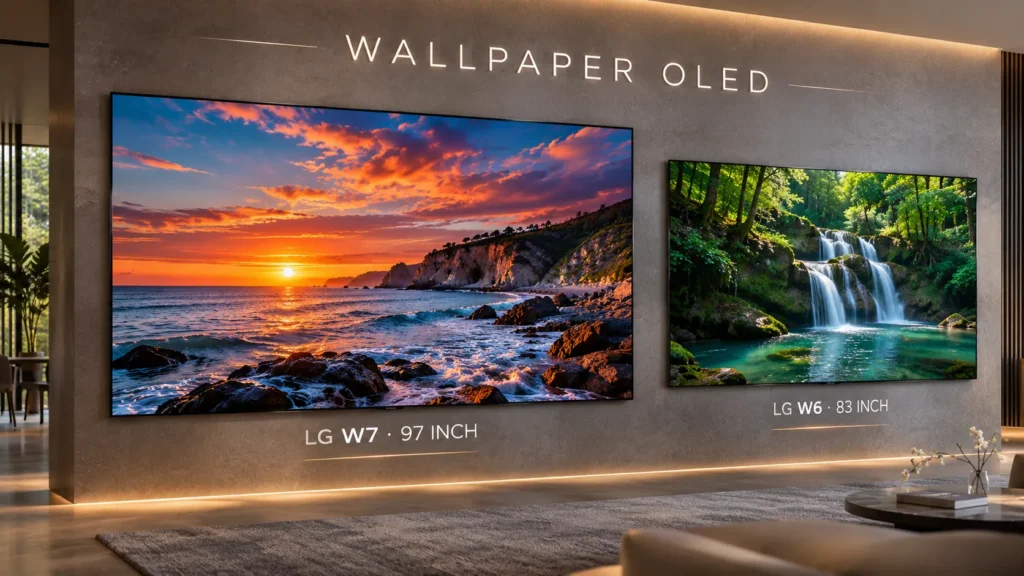

The Wallpaper idea is simple: make an enormous OLED look as though it belongs on the wall rather than in front of it. LG brought that design back with the W6, and now a 97-inch successor has appeared in the CES 2027 awards. The LG W7 vs W6 comparison is interesting, although not for the reason you might expect.
The W6 already supports 4K at up to 165Hz with VRR and uses a wireless Zero Connect box. The new W7 isn’t introducing either feature to the Wallpaper family. What catches my attention is the jump to a 97-inch panel and LG’s early claim of up to 4,000 nits of peak brightness. Those are meaningful changes, but they need to be read carefully before anyone talks about a dramatic picture-quality upgrade.
LG W7 vs W6: The Differences That Actually Matter
The W6 is a shipping 2026 model available in 77- and 83-inch sizes. LG’s 97W7 has been identified through the CES 2027 Innovation Awards ahead of the full retail specifications. That makes this a comparison of a finished product with an announced successor, not two televisions I’ve put side by side in a test room.
| Specification | LG W6 (2026) | LG 97W7 (2027) |
|---|---|---|
| Confirmed sizes | 77 and 83 inches | 97 inches announced |
| Resolution | 4K OLED | 4K OLED |
| Refresh rate | Up to 165Hz VRR | Up to 165Hz VRR, CES listing |
| Wireless connection | Zero Connect box | Zero Connect box, announced |
| Panel technology | 2026 Tandem WOLED / Hyper Radiant Color | New 97-inch panel; detailed production specification pending |
| HDR brightness | Up to 3.9× a conventional OLED, LG’s stated reference | Up to 4,000 nits peak, CES claim |
| Design depth | About 9.9 mm, LG specification | About 15.7 mm, early CES reporting |
| Retail position | Available; US launch price from $5,499.99 | Price and release date not announced |
There are two traps in this table. First, 165Hz is already available on W6. Second, the brightness figures use different reference points. Neither should be used to claim an upgrade that hasn’t been measured under identical conditions.
A small naming complication is worth clearing up: LG also sold a Wallpaper OLED called W7 back in 2017. Here, W7 refers to the newly announced 97W7 linked to CES 2027, not that original 2017 television.
Why Going From 83 to 97 Inches Matters More Than It Sounds
If you wanted a Wallpaper OLED larger than 83 inches, the W6 simply didn’t offer one. That’s the clearest reason the W7 is worth watching. LG is taking the same minimalist concept into a screen size normally associated with an expensive, dedicated theater wall.
Assuming the same 16:9 shape, a 97-inch screen has about 37% more picture area than an 83-inch screen. Compared with a 77-inch W6, the area increase is about 59%. Those are geometric comparisons, not measured panel dimensions, but they show why the extra diagonal is so noticeable.
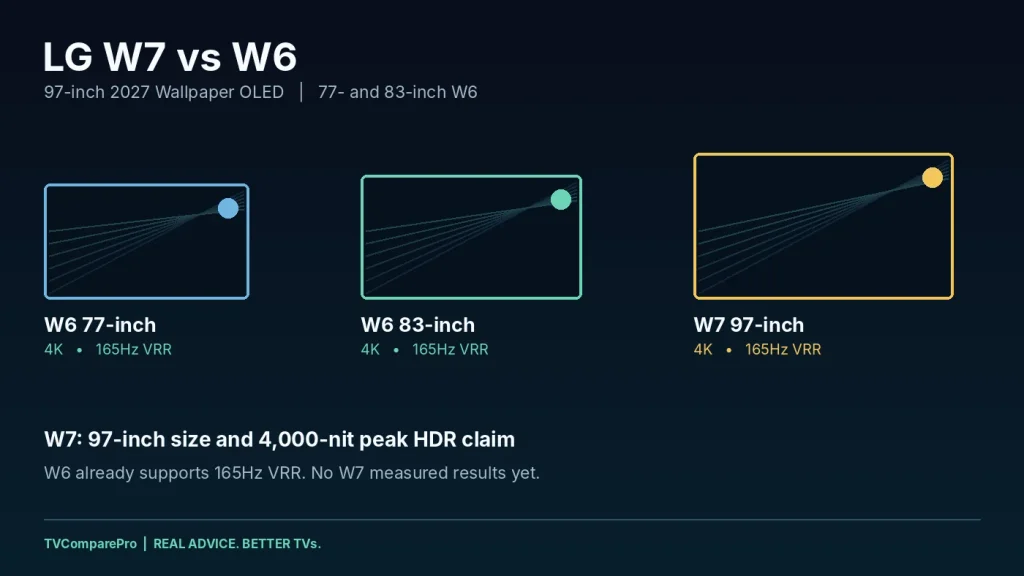
That extra size also affects seating distance. With the same 3840 × 2160 pixel count spread across a larger diagonal, the 97-inch panel has lower pixel density than the 83-inch W6. At a sensible viewing distance this may not matter at all for films, but it’s something I’d think about if the television will double as an enormous Windows desktop.
And there’s a practical side to going this big: access to the installation wall, mounting structure, moving the display through doorways and positioning the Zero Connect box. None of that can be judged from a brightness claim.
The 4,000-Nit W7 Claim: A Real Headline, Not a Measured Win Yet
The CES 2027 description associated with the LG 97W7 lists up to 4,000 nits of peak brightness, approximately 83% BT.2020 color coverage and 1.1% reflectance. These figures make the display interesting well beyond its dimensions. They’re also specifications provided ahead of independent testing.
I would be particularly interested in how the 97-inch panel handles real HDR scenes: small specular highlights, bright skies with large Average Picture Level, skin tones alongside saturated neon and changes in brightness over time. Peak brightness at one small test window can’t answer all of those questions.
For the W6, LG promotes Brightness Booster Ultra and a peak luminance claim of up to 3.9 times that of a conventional OLED. That is not a direct nit value for our comparison, and its reference conditions are different. Dividing 4,000 by 3.9 would not tell us how much brighter the W7 is.
BT.2020 coverage needs the same care. A wider measured gamut doesn’t automatically mean more accurate color, and a lower reflectance figure doesn’t guarantee that a bright living room will look better in every scene. I want to see independently measured HDR EOTF tracking, color accuracy, sustained brightness and reflections before calling W7’s picture quality definitively superior to W6.
Is the W7 Using a Better Tandem OLED Panel?
LG’s 2026 W6 benefits from its newer Tandem OLED generation and Hyper Radiant Color technology. At 77 and 83 inches, it was already one of the company’s more advanced panel implementations. This is why an old 97-inch G-series result shouldn’t be treated as a direct stand-in for a W6 measurement.
The W7’s 4,000-nit and wide-color claims strongly suggest that advanced Tandem technology is finally reaching the 97-inch format. HDTVTest and FlatpanelsHD have discussed that interpretation. But I would still distinguish the inference from a complete LG Display technical disclosure describing the exact layer structure of the retail W7 panel.
What I find more useful than the panel label is the expected result: does a 97-inch OLED finally deliver the HDR highlight intensity and color volume we’ve become accustomed to seeing from smaller premium OLEDs? If it does, that would be a meaningful step for very large screens. The CES figures make a strong case for investigating it, not for publishing a performance verdict in advance.
165Hz Gaming: W7 Is Not Faster Than W6 on Paper
This is the specification I would make absolutely clear in any comparison. LG W6 already offers up to 165Hz VRR on the 77- and 83-inch versions. The W7’s early listing also says 165Hz VRR. On the information available today, there is no refresh-rate upgrade between these two Wallpaper generations.
W6 is advertised by LG for wireless 4K165 operation with a compatible gaming PC, plus NVIDIA G-SYNC compatibility and AMD FreeSync Premium support. The W7’s award entry confirms a 165Hz VRR target, but a full model-specific signal compatibility table and independent PC testing are still missing. I wouldn’t promise identical input lag, signal stability or 4K165 chroma behavior just because the headline rate is the same.
| Gaming scenario | What matters |
|---|---|
| PC gaming at 4K165 | Both models advertise up to 165Hz VRR; verify the final W7 input modes and test results. |
| PS5 Pro or Xbox Series X | Consoles do not output 165Hz; 4K120 support and stable VRR are the more relevant questions. |
| Film streaming | Frame-rate handling, HDR tracking and picture processing are more important than 165Hz. |
| Desktop use on a 97-inch TV | Viewing distance, sharpness at 4K and image retention precautions matter alongside refresh rate. |
A 165Hz input is also not a promise of 165 frames per second in every game. Rendering a demanding title at native 4K with high settings is still a GPU problem. If I were building a PC for either television, I’d prioritize consistent frame delivery, HDR and working VRR rather than choosing a panel based on a refresh-rate number both already share.
Zero Connect: Both Are Wireless, So What’s Left to Improve?
With W6, the HDMI cables plug into the separate Zero Connect box, which sends video and audio to the display. LG specifies four HDMI connections in the box and promotes visually lossless wireless 4K165 operation under its stated certification conditions. The television itself still needs electrical power, so “wireless” doesn’t mean a completely cable-free wall.
The CES listing says W7 continues the Zero Connect approach, describing wireless 4K transmission to the 97-inch display. What isn’t yet demonstrated publicly is whether the larger new model improves latency, interference tolerance, range or specific HDR/VRR combinations compared with W6.
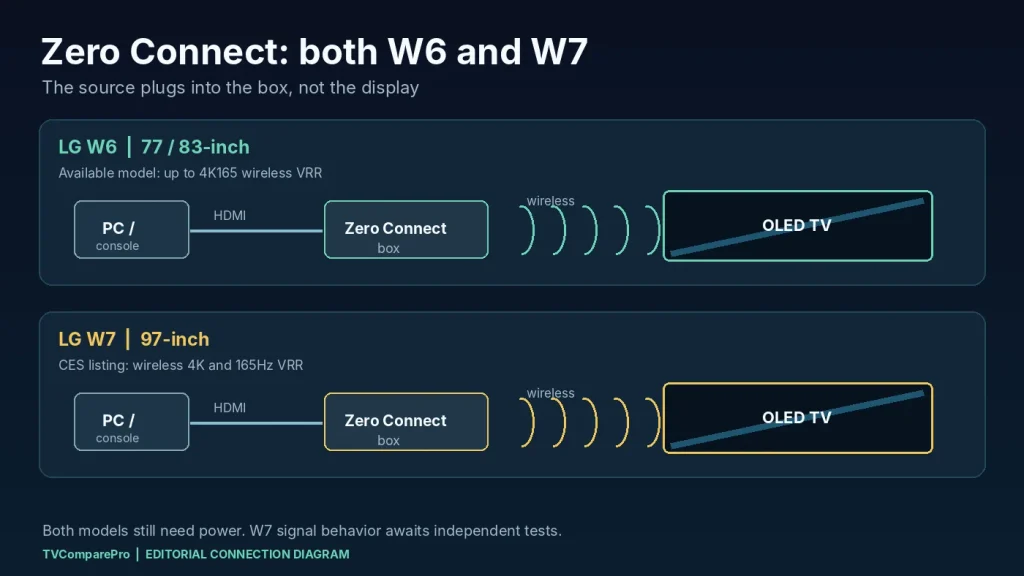
There is an important difference between a visually lossless video link and a perfect gaming link in every room. Obstacles, box position and the specific source signal can all influence the experience. LG lists practical placement conditions for W6. Until W7 undergoes the same kind of testing, I would avoid promising that the newer wireless system performs better.
For someone who wants every HDMI cable hidden away from the display, both models serve the same purpose. For a competitive PC gamer, the questions are more specific: how much latency does the entire signal path add, and does VRR stay stable while switching between 60, 120 and 165Hz modes?
Wallpaper Design: Bigger Doesn’t Necessarily Mean Thinner
The W6 is exceptionally slim. LG lists a body depth in the 9.9 mm range, with a wall-mount system designed to sit nearly flush. Early material covering the 97W7 points to a depth around 15.7 mm and a carbon-fiber rear structure. If that number remains in the final product specifications, W7 will actually be thicker than W6, not thinner.
That isn’t automatically a drawback. Fitting a vastly larger OLED panel into a wall-mounted structure without filling the room with cables is a different engineering problem from building an 83-inch TV. I would judge the finished W7 by its installed appearance, mounting requirements, weight distribution and how easy it is to access or replace the Zero Connect box.
The extra inches are likely to make a bigger difference to your room than a few millimeters of cabinet depth. Before choosing W7, measure the wall and your seating distance, not just the thickness on the product sheet.
Sound, Processing and Gallery+: Which Features Are Actually New?
LG’s CES entry for W7 mentions Bluetooth Ultra Low Latency input, virtual 11.1.2-channel sound and Gallery+ art features. Those are useful details, but they don’t tell us that W7 includes a physical 11.1.2 speaker array. Virtual processing and discrete speakers are not the same thing.
W6 already comes with LG’s Alpha 11 AI Processor Gen3, Dolby Vision support and the company’s Gallery+ ecosystem. For W7, I would wait for the full processor model, HDMI and audio-format tables before describing it as a complete generational upgrade.
At this price class, I’d also pay attention to the eARC implementation, supported lossless audio formats, lip-sync behavior and whether using an AVR changes the Zero Connect setup. A beautifully clean wall installation is less appealing if you have to compromise the audio system around it.
Where the 97-Inch G6 Fits Into the Story
The most revealing comparison for panel progress isn’t actually W7 versus W6. It’s 97W7 versus 97G6, because those are both 97-inch 4K OLEDs. The G6 is part of the 2026 range, but LG confirms that the 97-inch version supports VRR only up to 120Hz, unlike smaller G6 models that reach 165Hz.
That distinction matters. The 65-inch G6 supports 165Hz, yet the 97-inch G6 does not inherit the same panel generation or feature ceiling. On the new W7, LG is advertising 165Hz VRR in a 97-inch display. This is where the refresh-rate advance actually exists.
| 97-inch comparison | LG 97G6 | LG 97W7 |
|---|---|---|
| Size and resolution | 97-inch 4K OLED | 97-inch 4K OLED |
| Maximum VRR | 120Hz, official retail specification | 165Hz, CES award specification |
| Connections | HDMI inputs on the TV | Wireless Zero Connect architecture |
| Panel positioning | Previous 97-inch OLED implementation | New 97-inch panel with 4,000-nit peak claim |
| Available to buy | Yes | Not yet announced for retail |
It’s a useful technical reference, but it should stay a secondary comparison. If you’re considering a Wallpaper TV, W6 is the direct predecessor. If you specifically want to understand how much the 97-inch category is advancing, the G6 is the better point of reference.
What We Still Need From LG Before CES 2027
There are still some answers I’d want before treating the W7 as a buying recommendation. LG hasn’t provided a full retail data sheet with final market availability and pricing. And the CES award description isn’t a substitute for measured review data.
- HDR measurements: calibrated 2%, 10% and larger-window brightness, sustained luminance, EOTF tracking and color accuracy.
- Gaming: confirmed PC input formats, 4K165 stability, latency and VRR behavior over the final Zero Connect implementation.
- Panel details: exact 97-inch OLED stack, reflectance methodology and any differences from the 83-inch W6.
- Ownership: regional sizes, pricing, mounting requirements, shipping schedule and warranty terms.
Those are not reasons to dismiss the product. They’re simply the details that separate an impressive CES specification from the experience of owning a giant OLED.
Should You Buy a W6 Now or Wait for the W7?
Choose the W6 if 77 or 83 inches already fits your room
W6 is the known option. It already gives you the Wallpaper appearance, 4K165 VRR for compatible PCs, a dedicated Zero Connect box and a highly capable 2026 OLED panel. LG’s US launch pricing started at $5,499.99 for the 77-inch model; today’s store pricing can differ. I wouldn’t postpone a planned installation just for a 165Hz upgrade that W7 doesn’t actually introduce.
Wait for W7 details if you want a 97-inch Wallpaper OLED
The 97-inch format is the reason to pay attention. If your room can take it and the announced HDR figures are reflected in the finished product, W7 could be one of the most interesting large OLEDs of the coming cycle. But without a price, tested performance and a confirmed retail release date, I wouldn’t recommend buying on the strength of the 4,000-nit number alone.
For a wider view of how LG positioned its OLED models this year, see my LG C6, G6 and W6 lineup guide. And if the differences between OLED sizes are what interest you most, the LG C6 size guide explains why the same series name doesn’t always guarantee identical panel capabilities.
My Take: W7’s Size Is the News, Not 165Hz
The W6 already does the two things people often associate with W7: it can take a high-refresh PC signal, and it hides the source connections in a separate wireless box. That’s a strong starting point.
W7 changes the conversation by taking Wallpaper OLED to 97 inches and pairing it with a very ambitious HDR specification. That’s the development I’d keep an eye on. Just don’t confuse the 97G6’s 120Hz limitation with the W6’s capabilities. W6 and W7 both list up to 165Hz VRR; the real question is how the new 97-inch panel performs.