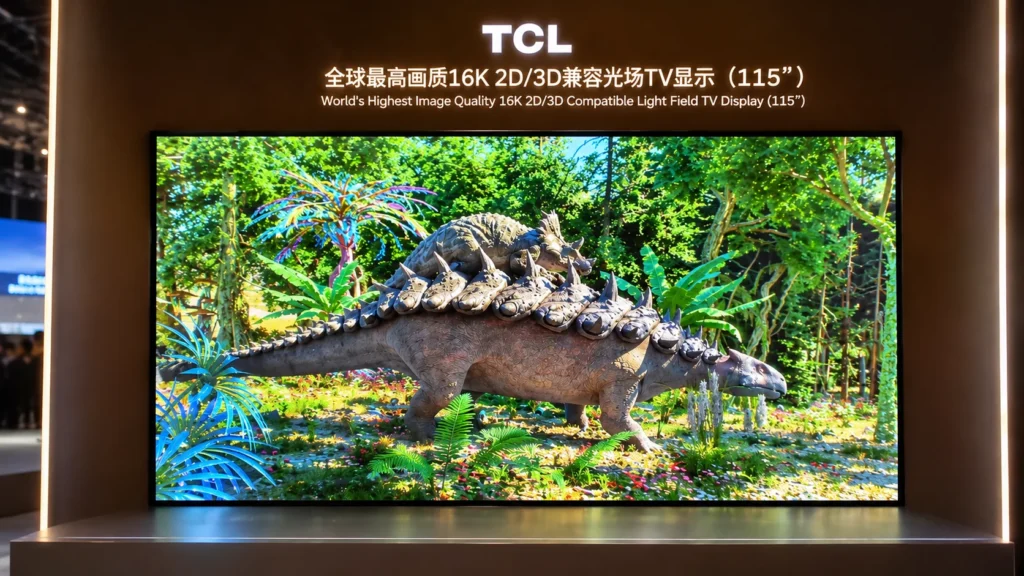

A screen this large is already hard to ignore. The TCL 115-inch 16K 3D display adds something more unusual: depth you can see without wearing glasses. And there’s a catch worth understanding before we start calling it an 8K 3D television. The panel is described as native 16K in 2D, while TCL says its light-field system can deliver up to 8K in 3D.
That sounds like a downgrade until you think about what glasses-free 3D has to do. Instead of sending one image straight at everyone on the sofa, it has to deliver different perspectives toward different viewing positions. The impressive part isn’t simply the 115-inch size. It’s TCL’s attempt to make that experience work for several people at once, while retaining an extremely high-resolution 2D mode.
TCL CSOT showed the display at its DTC 2026 conference in Wuhan, China, which began on November 13. It is a display-technology demonstration rather than a TV that has been given a retail model number, price or release date.
What TCL Actually Announced
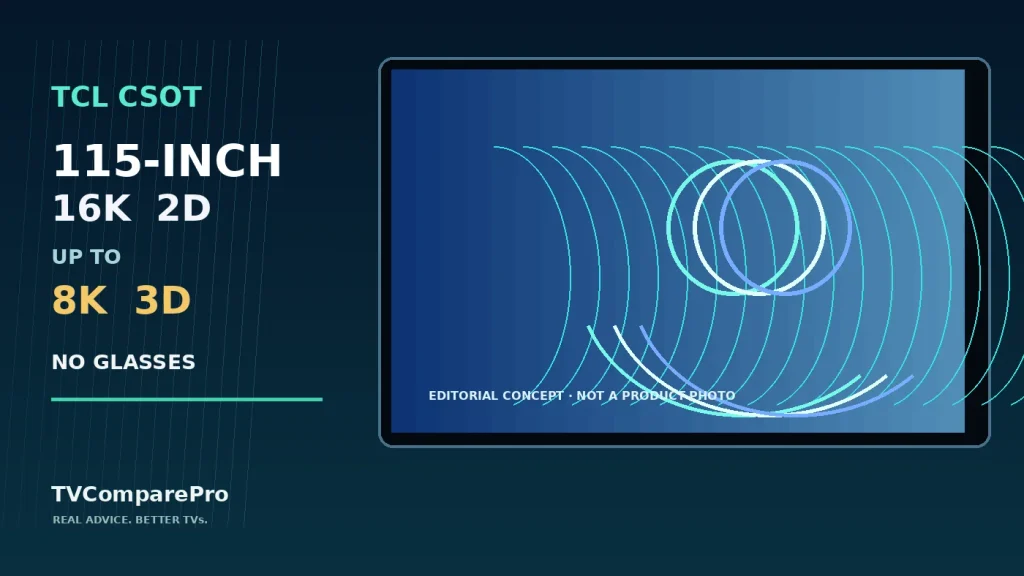
According to TCL CSOT, the prototype uses a proprietary light-field optical architecture. It is designed to switch between conventional 2D viewing and glasses-free 3D, with a claimed viewing angle of at least 90 degrees and support for multiple viewers at the same time.
| Specification | TCL’s 115-inch demonstration |
|---|---|
| Panel size | 115 inches |
| Native display resolution | 16K, according to TCL |
| Reported pixel matrix | 15,360 × 7,680, reported by Chinese technology media |
| Glasses-free 3D | Yes, using a proprietary light-field optical design |
| Claimed 3D light-field resolution | Up to 8K |
| Claimed 3D viewing angle | At least 90 degrees |
| Multiple viewers | Supported, according to TCL |
| Consumer price and availability | Not announced |
I would separate those last two resolution figures carefully. Native 16K describes the pixel structure of the display. TCL’s 8K figure describes what the company calls 3D light-field resolution. Those are related, but they are not interchangeable ways of counting what each eye actually sees.
Why Does TCL’s 16K Display Drop to 8K in 3D?
Most TVs show essentially the same flat image to anyone sitting in front of them. A glasses-free 3D display has a tougher job: it needs your left eye and right eye to receive different perspectives of the same scene, and ideally it needs those perspectives to keep changing naturally as you move.
Light-field displays approach this by controlling the direction in which light travels from the screen. A high-resolution panel provides the underlying image detail, while an optical system redirects information into multiple viewing directions. That creates a trade-off between spatial resolution (detail within an image) and angular resolution (how many useful perspectives the display can produce).
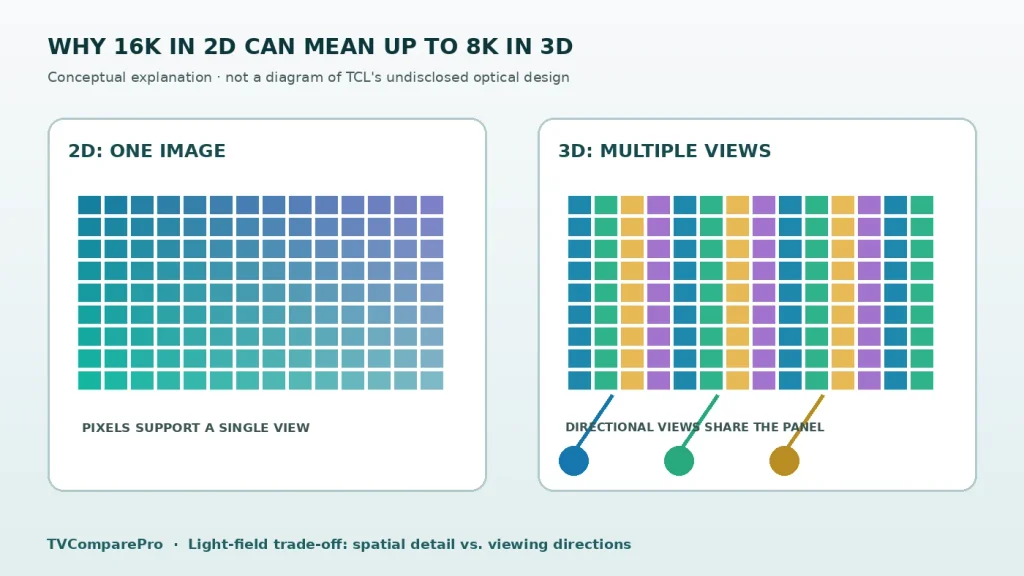
This is why the number printed on the panel specification is not necessarily the perceived resolution of a 3D view. TCL describes its result as up to 8K. It has not published enough detail about the number of distinct views, optical efficiency or its resolution-testing method to establish that every eye sees a conventional, full 8K image.
I also wouldn’t reduce the explanation to “16K divided by two eyes equals 8K.” Multi-view 3D is more complicated than a simple split-screen stereo image. The resolution available at each viewpoint depends on how the light field is generated.
What Does 15,360 × 7,680 Pixels Tell Us?
Chinese technology reports, including IT之家, describe the native matrix as 15,360 × 7,680. That works out to approximately 118 million addressable pixels. It’s an enormous amount of image data for a single display, even before the 3D optics are considered.
There is an important detail here: this reported matrix has a 2:1 aspect ratio. It is not the same as the 15,360 × 8,640 grid often used when talking about a 16:9 “16K UHD” image. For that reason, I would use TCL’s 16K designation without silently replacing its reported dimensions with a more familiar 16:9 number.
Neither figure tells us what video input formats the prototype accepts. A native 16K panel is not proof that it has a consumer HDMI input capable of receiving 16K video from a PC or streamer.
Can More Than One Person Watch Without Glasses?
This may be the most important part of TCL’s demonstration for home viewing. Earlier glasses-free 3D systems often worked best when the viewer remained in a fairly narrow position. A large living-room TV needs a much more forgiving experience: one person on the left end of the sofa and another on the right should both see convincing depth.
TCL says its system supports multiple people simultaneously across a viewing angle of at least 90 degrees. That’s promising, especially on a 115-inch screen, but it doesn’t yet tell us how uniform the effect looks across every seat. Brightness, double-image artifacts, motion between viewing zones and the distance from the screen would all matter in a proper evaluation.
The goal, at least, is clear. TCL isn’t pitching a tiny single-user 3D monitor here. It is exploring whether glasses-free 3D could work on the scale of a dedicated home theater.
Does the Screen Still Look Sharp in Normal 2D?
TCL says its proprietary image-enhancement system allows the display to switch between 3D and standard 2D without compromising 2D picture quality. That matters because a premium television would spend much of its life showing ordinary movies, sport, television and streamed content.
If the 3D optics leave visible texture, reduce light output or interfere with the image in 2D mode, buyers would notice it long before they found enough 3D movies to enjoy. The company’s claim is therefore important, although it is still a manufacturer claim rather than an independently measured result.
At this stage, I wouldn’t compare its contrast, color accuracy, peak brightness or viewing-angle consistency with an OLED or a premium Mini LED. TCL hasn’t supplied the measurements needed for a fair comparison.
How It Compares With TCL’s Smaller 65-Inch 3D Prototype
The 115-inch display didn’t appear out of nowhere. At IFA 2026, TCL CSOT had already shown a 65-inch 2D/3D-compatible display, rated by the company for 8K in 2D and 4K stereoscopic 3D. That makes the new 115-inch demonstration interesting for another reason: TCL has effectively doubled the headline resolution figures while moving to a dramatically larger panel.
| Feature | TCL 65-inch demonstration | TCL 115-inch demonstration |
|---|---|---|
| Where shown | IFA 2026 | DTC 2026 |
| Panel size | 65 inches | 115 inches |
| 2D resolution claim | 8K | 16K |
| 3D resolution claim | 4K stereoscopic 3D | Up to 8K light-field 3D |
| Glasses required | No | No |
| Retail TV announced | No | No |
Some TCL-related reports have cited a 140-degree stereoscopic viewing angle for the smaller screen, compared with at least 90 degrees for the 115-inch model. I wouldn’t call that a straightforward regression. Those figures may describe different optical criteria, and there are no published side-by-side viewing tests to resolve the comparison.
What the progression does suggest is that TCL CSOT is treating glasses-free 3D as an ongoing display-development effort rather than a single trade-show experiment.
How Is This Different From Samsung Odyssey 3D?
Samsung already sells the Odyssey 3D, a much smaller 27-inch 4K gaming monitor that uses eye tracking, view mapping and a lenticular optical layer to provide a glasses-free 3D experience. The accompanying software and supported content are an important part of that system.
TCL’s 115-inch demonstration is aimed at a different problem. Its headline claim is a wide-angle light-field image for several viewers, not a desktop 3D experience optimized around someone sitting in front of a monitor. Samsung has published more detail about its available gaming product; TCL has not yet explained the full software and input pipeline for its large prototype.
Both are examples of how glasses-free 3D might develop, but they should not be compared as if they were two retail TVs competing on brightness, input lag or gaming features.
Can It Play 3D Blu-rays, Streaming Movies or PC Games?
That is the first question I would ask if TCL eventually turns this panel into a living-room television. An impressive demonstration is one thing. A home product needs content and a clear way to display it.
There is currently no confirmed consumer compatibility list for the 115-inch prototype. TCL has not established whether it accepts frame-packed 3D Blu-ray, side-by-side 3D video, streaming conversions or a direct stereoscopic PC-gaming signal. Its announced 8K light-field output shouldn’t be confused with an advertised 8K gaming input.
Even if a future retail version could convert 2D video into 3D, the quality would depend heavily on the conversion algorithm. Real stereoscopic source material and generated depth are not the same. I’d want to see how it handles fine objects, fast motion, foreground edges and people moving across different depth planes.
For gaming, I’d also want real specifications for refresh rate, input latency, HDMI bandwidth and whether the 3D mode works with variable refresh rate. None of those should be assumed simply because the display has a spectacular resolution figure.
Is TCL Bringing This to CES 2027? What About Price?
For now, TCL has announced a technology demonstration at DTC 2026, not a 115-inch 3D television launch at CES 2027. The company has not confirmed a commercial model name, regional availability, production date or price for this display.
It’s easy to see why a 115-inch screen with a custom optical system could be expensive, but quoting a price today would be guesswork. We also don’t know the panel’s power consumption, weight or installation requirements, all of which become important at this size.
If TCL discusses this technology again at CES, I would look first for a working consumer interface and a repeatable demonstration with more than one viewer. Those would tell us much more about its readiness than another headline about pixel count.
What Would Make Glasses-Free 3D Worth Buying Again?
I can see the attraction. Putting on glasses before every movie was never particularly convenient, and a 115-inch screen with natural-looking depth would be hard to ignore. But a return to 3D TVs needs more than a sharper panel.
The decisive questions are simple: can several people sit comfortably wherever they like, does the 2D picture remain excellent, and is there enough compatible content to make the feature useful? If a future TCL TV answers those questions well, I think viewers will pay attention. If it only looks convincing from one carefully chosen position, the novelty will wear off much faster.
My view is that this prototype is worth following because of the multi-view light-field approach, not just its 16K specification. TCL has shown an ambitious direction for large-screen 3D. The next step is to prove it can deliver the same experience outside a controlled demonstration.