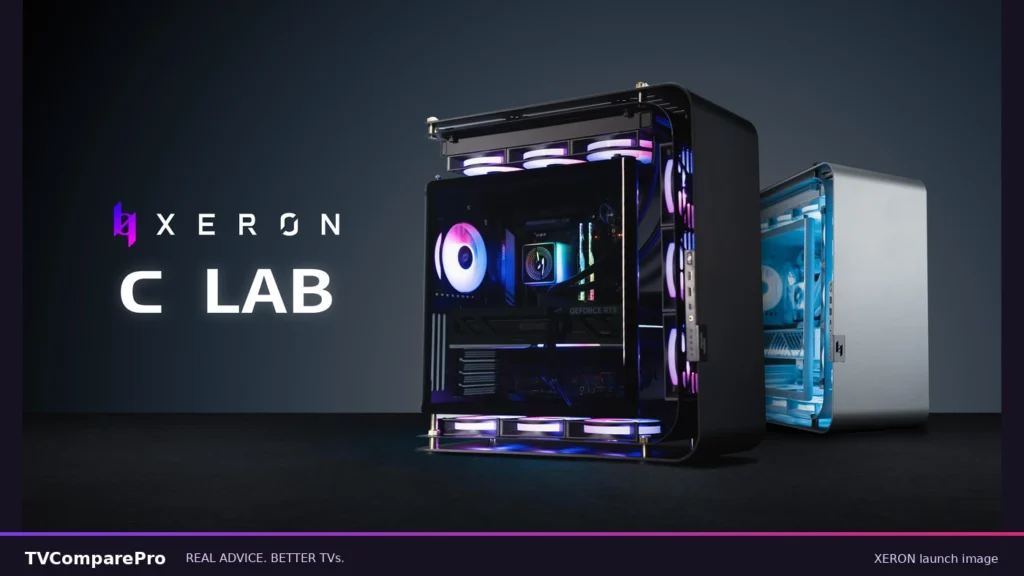
There is something rather appealing about a PC case that looks just as good empty as it does with the hardware installed. The XERON C LAB caught my attention for precisely that reason. Its curved aluminum frame gives the system a distinct silhouette, while the open-looking sides leave plenty of room to appreciate the components inside.
XERON announced the updated mid-tower chassis on November 24, 2026, with a recommended price of $249. Both black and white versions are expected to reach partner retailers in the first quarter of 2027. What interests me most is how well the design could work for a high-end gaming PC connected to a 4K OLED TV. There is plenty here to explore beyond the appearance, especially if you are considering a large graphics card and liquid cooling.
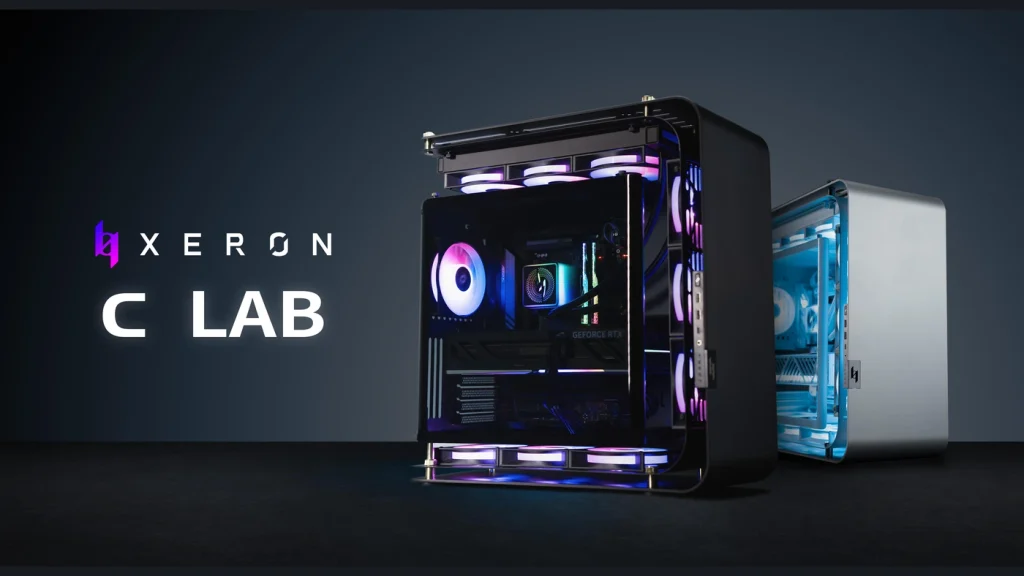
What makes the XERON C LAB different?
The most distinctive part is the C-shaped outer frame, made from 4mm aluminum. It wraps around an SGCC steel chassis rather than replacing the entire internal structure with aluminum. XERON also uses a formed sheet-metal construction intended to keep the panel alignment clean, and a 4mm tempered-glass side panel gives the main chamber a full view.
I like the idea of using the frame itself as the visual feature, instead of relying entirely on RGB lighting. The black version looks particularly well suited to a darker gaming room, while the white version lends itself to a lighter desktop setup. At almost 12kg before adding components, this is a substantial mid-tower rather than a compact living-room PC. It makes more sense as a visible part of the setup than something you would try to conceal behind the TV.
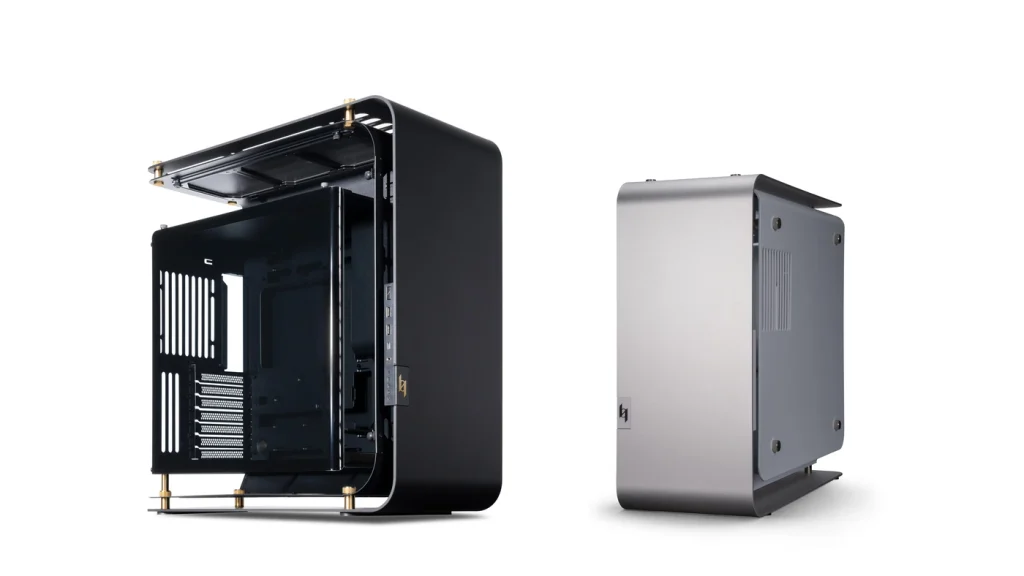
XERON C LAB specifications
Despite the unusual exterior, the internal layout is built around familiar desktop hardware. It supports standard ATX motherboards, smaller boards and compatible back-connect designs. Here are the key specifications I would look at before choosing the parts.
| Specification | Manufacturer rating |
|---|---|
| Case size (L × W × H) | 500 × 237 × 534 mm |
| Weight | 11.9 kg |
| Outer frame / body | 4mm aluminum / SGCC steel |
| Side panel | 4mm tempered glass |
| Motherboards | ATX, Micro-ATX, Mini-ITX; compatible back-connect designs |
| GPU length | Up to 425 mm; reduced with front cooling |
| CPU air cooler | Up to 165 mm tall |
| Radiators | Top 360 mm + front 360 mm simultaneously |
| 120mm fan mounts | Top 3, front 3, bottom 3, rear 1 |
| Power supply | ATX PS2, up to 160 mm long |
| Expansion slots / cable routing | 7 slots / 35 mm |
| Storage mount | 1 × 2.5-inch |
| Front I/O | USB-C 20Gbps, 2 × USB 3.0, 3.5mm audio, power |
| Colors / MSRP | Black or white / US$249 |
Specifications are from XERON’s launch materials. Retail configurations and included accessories should be checked when the case reaches stores.
Will an RTX 5090 fit inside the XERON C LAB?
For a 4K gaming build, the graphics card is usually the component I would choose first. The headline 425mm GPU clearance is generous, although the more useful numbers are 400mm with standard front fans and 370mm with a 30mm front radiator. That last figure is especially important if you intend to use liquid cooling.
I checked four specific graphics cards against the most restrictive of those published length limits. The figures below are simple dimensional comparisons, not a physical installation test.
| Graphics card | Card length | Remaining length at 370 mm |
|---|---|---|
| ASUS Prime RTX 5070 Ti OC | 304 mm | 66 mm |
| Sapphire NITRO+ RX 9070 XT OC | 330.8 mm | 39.2 mm |
| ASUS TUF RTX 5080 OC | 348 mm | 22 mm |
| ASUS ROG Astral RTX 5090 OC | 357.6 mm | 12.4 mm |
The XERON C LAB is an attractive choice for a premium 4K gaming PC. It offers plenty of room for large graphics cards, flexible cooling options and a clean, modern design.
My preferred starting point for a balanced 4K system would be an RTX 5070 Ti or RX 9070 XT, with the choice depending on the games, graphics settings and ray tracing requirements. An RTX 5080 or 5090 makes sense when the extra performance is worth the investment. The chassis does not determine the frame rate, of course, but having room to choose the GPU without immediately compromising the cooling layout is a welcome feature.
Dual 360mm radiators and a flexible airflow layout
Cooling is another reason the XERON C LAB stands out. XERON describes separate airflow zones for the CPU, graphics card and power supply, with ten 120mm mounting positions and support for a pair of 360mm radiators at the top and front. That provides several ways to approach a build.
For a conventional system with an air-cooled GPU, I would start with a top-mounted 360mm CPU AIO and use the front and bottom positions for intake where practical. A top exhaust and rear exhaust are a sensible starting arrangement, leaving the front GPU clearance less restricted than a front-mounted radiator would. The final fan directions would depend on the exact hardware and the openings available.
The second radiator position is especially appealing for a custom loop. I would still confirm radiator end-tank dimensions, fittings, tube paths and combined radiator-plus-fan thickness before ordering. Two nominally 360mm radiators are not necessarily the same physical size, and XERON’s launch materials do not provide a full clearance diagram for every possible combination.
For a PC beside the television, I would also pay attention to fan tuning. Ten mounting positions are useful flexibility, not a requirement to populate every one. A semi-open case can behave differently from a fully enclosed chassis, so temperature and noise measurements will be particularly interesting once the production case can be tested.
Motherboard, power supply and cable management
The back-connect motherboard support is a natural fit for a design with this much glass. A compatible board moves many connections behind the motherboard tray, and XERON specifies 35mm of cable-routing space. I would check the exact connector layout and tray cutouts before committing to a particular back-connect board.
One number worth remembering is the 160mm PSU limit. High wattage does not automatically mean a physically long power supply, but some enthusiast models are deeper than that. Check the full PSU dimensions as well as room for its modular plugs and cable bends. For a high-power graphics card, use a suitable PSU and its manufacturer-approved cabling, and follow the connector installation guidance.
The front USB-C port is rated at 20Gbps, which is useful for fast external storage when paired with a compatible motherboard header. The two USB 3.0 ports and audio connection cover the more familiar everyday peripherals. There is also a dedicated 2.5-inch drive position, while motherboard M.2 storage is a natural option for a modern gaming system.
Price, availability and my take
At $249, the XERON C LAB is clearly aimed at builders who care about the finished appearance of their PC as much as the components inside. The combination of the aluminum frame, full-view glass, back-connect support and dual 360mm radiator mounting gives it a clear identity. I can see it fitting particularly well into a premium gaming setup where the computer is meant to be seen.
For anyone planning a premium 4K HDR gaming PC, the XERON C LAB offers an appealing foundation. Its generous GPU clearance, flexible cooling options and support for back-connect motherboards provide plenty of room to build a powerful system while maintaining a clean, refined appearance.
Both versions are priced at $249 MSRP, with reseller availability expected in Q1 2027. This is a launch assessment based on the announced specifications, not a hands-on thermal or acoustic review. For now, the C LAB is a genuinely interesting addition to the premium ATX case market, and I am particularly looking forward to seeing what builders do with that unusual frame and cooling layout.