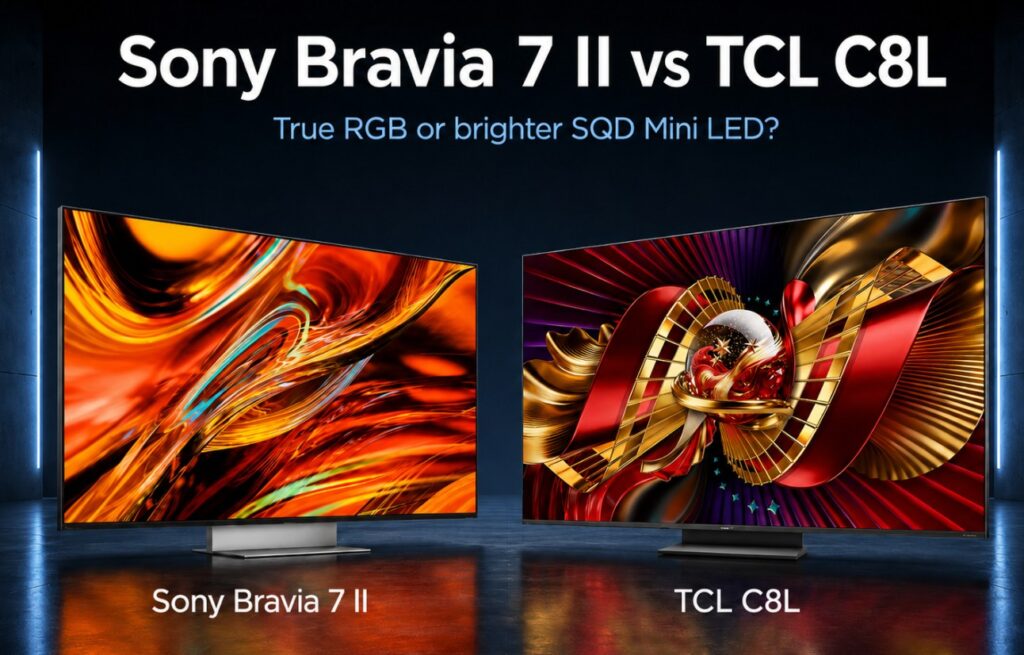

Choosing between Sony’s new True RGB television and TCL’s brighter SQD-Mini LED alternative looks easy on a showroom wall, but Sony Bravia 7 II vs TCL C8L becomes a much closer technical argument once you look at brightness, color volume, processor platform, HDMI layout, gaming response, and long-term value. Sony brings image control, motion processing, natural tone mapping, and the stronger cinematic reputation. TCL brings higher HDR output, wider gaming flexibility, four-HDMI-2.1 convenience on key C8L listings, stronger format support, and a more aggressive performance-per-money story.
That is the real comparison. It is not simply Sony quality against TCL value. It is a fight between two modern LCD directions: Sony’s True RGB backlight approach, tuned around controlled image expression, and TCL’s SQD-Mini LED system, tuned around brightness, color volume, and high-impact HDR.
This guide focuses mainly on the 65-inch buying decision, because that is the size where many buyers will compare these two TVs directly. Specifications, HDMI layouts, RAM/storage listings, brightness claims, and local dimming zones can vary by region, size, firmware, and retailer listing, so always confirm the exact local model before purchase.
Sony Bravia 7 II vs TCL C8L at a glance
| Category | Sony Bravia 7 II | TCL C8L / QM8L | Buyer meaning |
|---|---|---|---|
| Display technology | True RGB LED / RGB backlight control | SQD-Mini LED / Super QLED Mini LED | Sony focuses on controlled RGB light; TCL focuses on brightness, SQD color and value |
| Main picture character | Natural, controlled, cinematic | Bright, punchy, high-impact | Sony is calmer; TCL is more dramatic |
| Approx. HDR 10% window | Around 2,150 nits | Around 3,750 nits | TCL has the clear peak HDR advantage |
| SoC platform | MediaTek Pentonic 1000 | MediaTek Pentonic 800 | Sony uses the higher-tier SoC; TCL has the stronger HDMI/gaming layout |
| Processor branding | XR Processor with AI | TSR AiPQ Processor | Sony sells processing; TCL sells brightness and AI picture tuning |
| RAM / storage | Not usually listed clearly in consumer specs | 3GB RAM / 64GB storage on key C8L specification sheets | TCL is clearer for app and storage planning |
| HDMI 2.1 | 2× HDMI 2.1 | 4× HDMI 2.1 | TCL is much easier for multiple consoles, PC, and eARC |
| Input lag | Around 10ms | Around 9.8ms | Both are fast; TCL is slightly quicker |
| HDR formats | Dolby Vision, HDR10, HLG | Dolby Vision IQ, HDR10+, HDR10, HLG | TCL has broader HDR format support |
| Smart platform | Google TV | Google TV | Similar app ecosystem |
| Best for | Movies, natural image, Sony processing | Bright rooms, gaming setups, HDR impact, value | Choose by viewing style, not only brand |
The simple reading is this: Sony Bravia 7 II is the more refined and controlled TV, while TCL C8L is the brighter, more flexible, more aggressive performance buy. 🎯
TVComparePro may earn a commission from qualifying purchases through these links.
Core technical specifications
| Specification | Sony Bravia 7 II | TCL C8L / QM8L |
| Resolution | 4K Ultra HD | 4K Ultra HD |
| Display type | True RGB LED | SQD-Mini LED / Super QLED Mini LED |
| Backlight philosophy | RGB light control for purer color expression | Mini LED brightness with SQD color volume |
| Main processor brand | Sony XR Processor with AI | TCL TSR AiPQ Processor |
| SoC | MediaTek Pentonic 1000 | MediaTek Pentonic 800 |
| CPU | Quad-core Arm Cortex-A73 up to 2.0GHz | Quad-core Arm Cortex-A73 up to 1.8GHz |
| GPU | Arm Mali-G57 MC2 | Arm Mali-G57 MC1 |
| Memory interface | 64-bit LPDDR4/LPDDR4X-class SoC memory support | 64-bit DDR4-class SoC memory support |
| RAM / storage | Not consistently listed in public retail specs | 3GB RAM / 64GB storage on key C8L sheets |
| Operating system | Google TV | Google TV |
| Native refresh | 120Hz class | 144Hz class |
| Gaming refresh | 4K120, VRR, ALLM | 4K120/144Hz, VRR, ALLM, Game Bar, accelerator modes |
| HDMI | 2× HDMI 2.1 + 2× HDMI 2.0 | 4× HDMI 2.1 on TCL C8L / QM8L |
| HDR support | Dolby Vision, HDR10, HLG | Dolby Vision IQ, HDR10+, HDR10, HLG |
| Audio | Dolby Atmos, DTS, Sony acoustic tuning | Bang & Olufsen-branded audio on many C8L listings |
| Best hardware argument | Higher-tier SoC and Sony processing pipeline | More HDMI 2.1 ports, brighter HDR, larger app-storage listing |
Sony has the stronger processor platform on paper with MediaTek Pentonic 1000, especially if you care about SoC tier, CPU ceiling, memory interface, and Sony’s own XR processing layer. TCL answers differently. The C8L uses MediaTek Pentonic 800, but combines it with a more gaming-friendly HDMI layout, very high HDR brightness, SQD-Mini LED color, 144Hz-class panel support, and clearer RAM/storage listings.
So the processor table does not create a simple winner. Sony has the more premium SoC platform. TCL has the more flexible TV hardware package.
Processor and smart TV performance
The Sony Bravia 7 II uses the MediaTek Pentonic 1000 platform together with Sony’s XR Processor with AI. That matters because Sony is not only relying on raw Android/Google TV hardware. The brand’s real advantage is the image pipeline: upscaling, motion handling, object-based contrast, tone mapping, color control, and how lower-quality content is cleaned up before it reaches the panel.
The TCL C8L uses the MediaTek Pentonic 800 platform with TCL’s TSR AiPQ Processor. Pentonic 800 is still a serious premium 4K TV SoC, with a quad-core Cortex-A73 CPU, Mali-G57 MC1 GPU, and support for modern HDR and high-refresh display features. It is not as high-tier as Pentonic 1000 on paper, but it gives TCL the foundation it needs for 4K144 gaming, VRR, Google TV, and a four-HDMI-2.1 design on key C8L configurations.
Sony Bravia 7 II vs TCL C8L processor difference
The Sony Bravia 7 II vs TCL C8L processor difference is important, but it should not be read like a smartphone benchmark. A TV processor affects menus and app speed, but it also affects picture behavior. Sony’s advantage is the premium SoC plus XR picture processing. TCL’s advantage is that its hardware package is more gaming-forward, with stronger HDMI flexibility and a clearer storage configuration.
For daily Google TV use, both should feel modern. For heavy app installation, TCL’s 64GB storage listing is useful. For image processing, Sony’s XR system remains a major reason to buy the Bravia.
HDR brightness: the biggest TCL advantage
This is where TCL C8L makes its strongest first impression.
| Brightness area | Sony Bravia 7 II | TCL C8L / QM8L | Practical meaning |
|---|---|---|---|
| Approx. HDR 10% window | Around 2,150 nits | Around 3,750 nits | TCL is much brighter in peak HDR highlights |
| Manufacturer HDR claim | Not positioned mainly as a maximum-nit TV | Up to HDR 6,000 nits on selected larger C8L sizes | TCL has the more aggressive brightness ceiling |
| 65-inch brightness positioning | Premium Sony True RGB performance | Around 5,000-nit class manufacturer claim on 65-inch C8L listings | TCL is stronger for bright rooms |
| Bright-room use | Good, but more restrained | Excellent, especially for daylight and HDR sports | TCL is the safer bright-room choice |
| Accuracy philosophy | More cinematic and controlled | More powerful and punchy | Sony is restrained; TCL is dramatic |
The Bravia 7 II’s approximate 2,150-nit HDR 10% performance is already strong. This is not a dim TV. It gives Sony enough brightness for convincing HDR highlights, especially when combined with its controlled tone mapping and backlight behavior.
The TCL C8L is simply in a more extreme brightness class. Around 3,750 nits on a 10% HDR window gives it far more headroom for bright reflections, sunlight, fire, neon, HDR games, and animated content. In a bright living room, that extra output can matter immediately.
But brightness needs context. Sony may not hit TCL’s peak number, but it may preserve a more natural balance in films. TCL may look more spectacular, especially in HDR, but it can also look more aggressive if the picture mode is pushed too hard.
True RGB vs SQD-Mini LED
Sony and TCL are both trying to move LCD performance beyond traditional white/blue Mini LED systems, but they take different routes.
Sony’s True RGB system uses separate red, green, and blue light control to improve color purity and backlight precision. The goal is not only to make the TV brighter, but to create cleaner color expression with Sony’s processing wrapped around it. That matters for faces, skin tones, gradients, dark scenes, and films that should not look overcooked.
TCL’s SQD-Mini LED approach uses a more aggressive color-volume strategy. It is designed to deliver wide color at high brightness, which is exactly what HDR needs. HDR is not only about white highlights; it is about bright color staying rich instead of fading into pale light.
| Picture area | Sony Bravia 7 II | TCL C8L |
| Color philosophy | Controlled RGB light and Sony processing | SQD color volume and high brightness |
| HDR color | Natural, balanced | Brighter, denser, more spectacular |
| Movie tone | Cinematic and restrained | Dramatic and punchy |
| Animation / games | Rich but controlled | Very vibrant and high-impact |
| Best for | Accuracy-first viewers | Impact-first viewers |
The TCL is more likely to impress immediately in a store or a bright room. Sony is more likely to appeal over longer movie sessions, especially if you care about faces, motion, and tone.
Local dimming and black level behavior
Neither TV is OLED, so both still depend on local dimming zones. That means blooming can still appear around subtitles, small white logos, stars, loading screens, and bright objects against black backgrounds.
Sony’s advantage is control. The Bravia 7 II is designed to keep the image balanced even when the scene becomes difficult. It may not push highlights as aggressively as TCL, but it can look more disciplined in dark-room movie viewing.
TCL’s advantage is scale. The C8L can push far more brightness while still using Mini LED local dimming. In bright rooms or mixed lighting, that makes the TCL feel more powerful and more useful for everyday viewing.
| Local dimming area | Sony Bravia 7 II | TCL C8L |
| Backlight type | True RGB LED local dimming | SQD-Mini LED local dimming |
| Peak highlight control | Controlled, cinematic | Brighter, more impactful |
| Blooming risk | Low for LCD, but not OLED-free | Low for Mini LED, but higher brightness can reveal halos |
| Dark-room character | More refined | More dramatic |
| Bright-room character | Good | Excellent |
The Sony is the calmer dark-room TV. The TCL is the stronger bright-room TV.
Gaming and input lag
Gaming is one of the clearest areas where TCL becomes easier to recommend for many buyers.
| Gaming feature | Sony Bravia 7 II | TCL C8L / QM8L |
| Input lag | Around 10ms | Around 9.8ms |
| 4K120 console gaming | Yes | Yes |
| 4K144 PC gaming | No, 120Hz class focus | Yes, in compatible PC setups |
| VRR | Yes | Yes |
| ALLM | Yes | Yes |
| Game Bar | Sony gaming menu / PS5 integration | TCL Game Bar |
| HDMI 2.1 ports | 2 | 4 on key C8L listings |
| eARC impact | Can occupy one HDMI 2.1 port | Less limiting with four HDMI 2.1 inputs |
| Best gaming setup | PS5-first setup | PS5, Xbox, PC, eARC, multiple devices |
Both TVs are fast enough for serious gaming. Around 10ms on Sony and around 9.8ms on TCL are both good results. You are not buying TCL because Sony is slow. You are buying TCL because the wider HDMI layout and 144Hz support are more flexible.
If you have a PS5 and a soundbar, Sony is manageable. If you add Xbox Series X, gaming PC, and eARC, Sony’s two HDMI 2.1 ports start to feel tight. One of those ports may be needed for eARC, which leaves fewer high-bandwidth inputs for gaming.
TCL C8L is more modern for multi-device owners. Four HDMI 2.1 ports mean less cable juggling, fewer compromises, and a setup that feels ready for several years. 🕹️
Port-by-port I/O map
Exact port assignments can vary by country and screen size, but the buyer-relevant difference is straightforward.
| Port / connection | Sony Bravia 7 II | TCL C8L / QM8L | Buyer note |
| HDMI 2.1 | 2 ports | 4 ports on key C8L listings | TCL is better for multiple gaming devices |
| HDMI 2.0 | 2 ports | Not always needed if all four are HDMI 2.1 | Sony has more high-refresh limitations |
| eARC | Yes, on one HDMI port | Yes, port assignment varies | Sony loses more flexibility when eARC is used |
| USB | Yes | Yes | Useful for media playback and accessories |
| Ethernet | Yes | Yes | Stable streaming option |
| Wi-Fi / Bluetooth | Yes | Yes | Version depends on region |
| Optical audio | Usually available | Usually available | Useful for older audio systems |
| Tuner | Region-dependent | Region-dependent | Check local DVB/ATSC support |
For gaming and modern home cinema setups, TCL has the better port story. Sony can still work beautifully, but it requires more planning.
Movies and cinematic viewing
This is where Sony fights back hard.
The Bravia 7 II is the better choice if you care about a natural picture. Sony TVs usually handle skin tones, motion, upscaling, and mid-tone detail with a calmer hand. A movie should not always look like a demo reel, and Sony understands that better than most brands.
The TCL C8L is more spectacular. HDR movies look brighter, highlights hit harder, and colorful scenes have more energy. If you watch sci-fi, action, animation, fantasy, documentaries, and HDR streaming in a bright room, TCL can look more exciting.
But if you watch films at night and care about the director’s tone, Sony may feel more composed. It may not win the brightness chart, but it can win the mood of the scene.
Sports and daytime viewing
For sports, TCL C8L has the advantage. Brightness helps with football, Formula 1, tennis, hockey, and daytime broadcasts. The C8L’s extra SDR and HDR headroom makes it better suited to living rooms with windows, lamps, and reflections.
Sony’s motion processing is excellent, and that matters for sports too. The Bravia 7 II can keep movement natural without making the image look fake. But for pure daytime punch, TCL has the stronger practical case.
If your room is bright most of the day, choose TCL. If your room is controlled and you care more about motion tone than raw brightness, Sony remains strong.
Audio and daily usability
Sony and TCL both offer better audio stories than basic mid-range TVs, but neither replaces a good soundbar or AV receiver.
Sony’s audio system is built around picture-sound alignment and cinematic tuning. It is more about integration and natural voice placement. TCL C8L often uses Bang & Olufsen-branded audio, giving it a more premium spec-sheet identity and strong built-in sound for casual use.
For daily smart TV use, both run Google TV. That means app coverage is very similar: Netflix, Prime Video, Disney+, YouTube, Apple TV, local apps where supported, and Google Assistant/Gemini-style features depending on region and update status.
TCL may have the storage advantage on key C8L listings with 64GB storage. Sony may feel better in image-related menus and picture controls because its processing ecosystem is more mature.
Practical setup notes
For Sony Bravia 7 II, start with the most accurate cinema-style picture mode. Avoid pushing color and contrast too high immediately, because Sony’s main strength is balance. Use the brighter room-oriented mode only when daylight makes the accurate mode too restrained.
For TCL C8L, start with Movie, Cinema, or Filmmaker-style modes for SDR and HDR. Keep local dimming strong, but avoid maxing out every dynamic contrast setting. The TV already has huge brightness potential, so it does not need artificial sharpness or cartoonish color to look impressive.
For gaming, use Game Mode on both TVs. On Sony, make sure your console is connected to an HDMI 2.1 port. On TCL, use a full HDMI 2.1 port and confirm VRR/4K120 or 4K144 status in the Game Bar.
For Dolby Vision, do not automatically pick the brightest mode. Use a darker Dolby Vision mode at night and a brighter one during the day. The correct setting depends on your room, not only the TV.
What Sony does better
Sony Bravia 7 II is better for people who want a more cinematic image. Its biggest strengths are processing, motion, tone mapping, facial detail, and natural color. It is the TV for viewers who want the picture to feel controlled rather than exaggerated.
The MediaTek Pentonic 1000 platform also gives Sony a strong SoC foundation. Combined with Sony’s XR Processor with AI, the Bravia 7 II has a serious processing argument even when TCL wins the brightness chart.
Sony is also a strong choice for PS5-focused users who only need one high-bandwidth gaming input and value Sony’s console integration. If your setup is simple, the HDMI limitation matters less.
What TCL does better
TCL C8L is better for bright rooms, HDR impact, gaming flexibility, and value. It is much brighter on the approximate 10% HDR window comparison, has more HDMI 2.1 freedom, supports HDR10+ as well as Dolby Vision, and offers a strong storage configuration on key listings.
The C8L also has the more versatile gaming package. Around 9.8ms input lag, 4K120/144Hz support, VRR, ALLM, and four HDMI 2.1 inputs make it easier to recommend for modern setups.
TCL is the more practical choice if your TV is used by everyone in the house: sports in daylight, streaming at night, gaming on weekends, YouTube, movies, and multiple devices connected at once. ⚡
Common buying mistakes
One mistake is assuming Sony loses because TCL is brighter. That is too simple. Sony may look better with movies, faces, motion, and low-quality content.
Another mistake is assuming Sony’s stronger SoC automatically makes it the better TV. Processor power matters, but HDMI layout, brightness, panel behavior, local dimming, and price matter too.
A third mistake is ignoring HDR format support. Sony has Dolby Vision, but TCL supports Dolby Vision IQ and HDR10+, which can matter if you watch content across many services and discs.
A fourth mistake is ignoring HDMI. Two HDMI 2.1 ports can be enough for a simple setup, but they become restrictive with eARC, PS5, Xbox, and PC.
The final mistake is buying only by brand. Sony and TCL are not playing the same game here. Sony sells refinement. TCL sells impact and value.
Which one makes more sense?
Sony Bravia 7 II vs TCL C8L comes down to your room and your priorities.
Choose Sony Bravia 7 II if you want the more refined cinematic TV. It has the stronger premium processing identity, the higher-tier MediaTek Pentonic 1000 platform, natural motion, controlled tone mapping, and the kind of image that suits movies, series, and carefully mastered content.
Choose TCL C8L if you want the brighter and more flexible TV. It has the stronger HDR brightness number, more HDMI 2.1 freedom, better support for multi-device gaming, HDR10+ support, and a more aggressive value story. For bright rooms and mixed use, it is the easier recommendation.
For movie-first buyers, Sony has the emotional edge. For bright-room buyers, gamers, and value-focused premium shoppers, TCL C8L is the stronger practical choice.