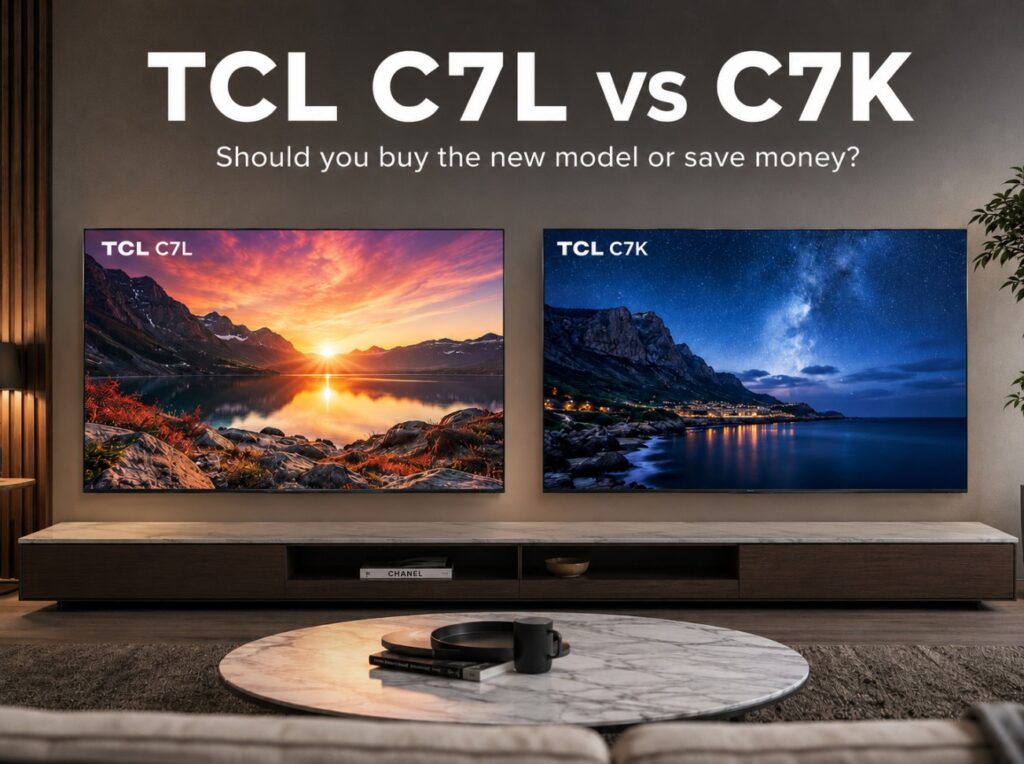

Choosing between TCL’s newer value Mini LED model and the already-proven discounted option can be surprisingly difficult, which is why TCL C7L vs C7K is a more useful comparison than a simple “newer model wins” answer. The C7K became popular because it brought strong brightness, Mini LED local dimming, 144Hz gaming, Google TV, Dolby Vision, HDR10+, and serious value into one package. The C7L now arrives as the newer SQD-Mini LED successor, with a stronger 65-inch brightness claim, slightly more dimming zones, and TCL’s updated panel/backlight positioning.
But the older C7K is not suddenly irrelevant.
The C7L is the cleaner choice if the price gap is small. The C7K remains very attractive if it is discounted heavily, because it already has review data, real-world brightness measurements, and a proven value record. The right decision depends on size, price, HDMI needs, brightness expectations, and whether you care more about a current-generation model or a better deal. 📺
Menu names, screen sizes, brightness claims, dimming zones, HDMI behavior, audio systems, and firmware can vary by country, retailer, and model code. Always check the exact local listing before buying.
Why the 65-inch size is the best reference point
The 65-inch size is the best reference point for most buyers because it sits in the middle of the range: large enough to show the benefit of Mini LED brightness and local dimming, but still realistic for normal living rooms and budgets.
A 55-inch model can be excellent in smaller rooms, but it does not always show the full advantage of a high-brightness Mini LED backlight. A 75-inch or larger model can look more dramatic, but price, wall space, and seating distance start to matter more. At 65 inches, the C7L vs C7K comparison is cleaner, easier to understand, and more useful for everyday buyers.
| Size | Buyer relevance |
|---|---|
| 55-inch | Good for smaller rooms, but less representative of the full Mini LED advantage |
| 65-inch | Best mainstream reference size for price, brightness, and dimming comparison |
| 75-inch | Better for large living rooms and stronger HDR impact |
| 85-inch+ | More niche, more expensive, and more dependent on room size |
| 98/115-inch | Specialist large-screen territory, not the typical buying decision |
For this article, the 65-inch models are the main practical reference, while the full size range is still included where the specifications matter.
Core comparison table
| Category | TCL C7L | TCL C7K |
|---|---|---|
| Role | Newer SQD-Mini LED successor | Previous QD-Mini LED value model |
| Best buyer | Wants the newer model if prices are close | Wants proven value if discounted |
| Display type | SQD-Mini LED LCD | QD-Mini LED LCD |
| Resolution | 4K Ultra HD | 4K Ultra HD |
| Main 65-inch reference | 1,152 dimming zones / up to HDR 3,000 nits claim / over 2,200 nits measured in HDR Filmmaker-Cinema | 1,008 dimming zones / HDR 2,600 nits claim / around 1,700–1,900 nits in HDR Filmmaker or accurate-mode tests |
| Smart platform | Google TV | Google TV |
| Processor branding | TSR AiPQ Processor | AiPQ Pro Processor |
| SoC class | MediaTek Pentonic 700 | MediaTek Pentonic 700-class where listed |
| CPU reference | 4× Arm Cortex-A73, up to 1.4GHz on Pentonic 700 | 4× Arm Cortex-A73, up to 1.4GHz on Pentonic 700 |
| GPU reference | Arm Mali-G52 MC1 on Pentonic 700 | Arm Mali-G52 MC1 on Pentonic 700 |
| Native refresh rate | 144Hz | 144Hz |
| Game Accelerator | Up to 288Hz in supported lower-resolution scenarios | Up to 288Hz in supported lower-resolution scenarios |
| HDMI | 4 total: 2× HDMI 2.1, 1× HDMI 2.0, 1× HDMI 1.4/eARC on the reviewed 65-inch unit | 4 total; commonly 2× HDMI 2.1 + 2 standard HDMI |
| HDR | Dolby Vision, HDR10+, HDR10, HLG | Dolby Vision IQ, HDR10+, HDR10, HLG |
| Audio | 2.1-channel 40W Bang & Olufsen system on the reviewed 65-inch unit | Bang & Olufsen-tuned audio on many listings, configuration varies by size/region |
| Main advantage | Newer SQD-Mini LED, stronger 65-inch brightness data, current-generation positioning | Real review history and likely stronger discounts |
The short version is simple: C7L is the cleaner new buy; C7K is the better bargain if the discount is large.
TVComparePro may earn a commission from qualifying purchases through this link.
Technical specifications: TCL C7L vs C7K
| Specification | TCL C7L | TCL C7K |
|---|---|---|
| TV type | 4K SQD-Mini LED LCD | 4K QD-Mini LED LCD |
| Backlight | Mini LED local dimming | Mini LED local dimming |
| Color positioning | Super Quantum Dot / SQD-Mini LED | Quantum Dot / QD-Mini LED |
| Panel family | WHVA / HVA 2.0 Pro-type panel, region-dependent | CrystGlow HVA / VA-type panel family |
| Main 65-inch dimming zones | 1,152 zones | 1,008 zones |
| 65-inch brightness claim | Up to HDR 3,000 nits | Around HDR 2,600 nits |
| 65-inch measured brightness | Over 2,200 nits in HDR Filmmaker/Cinema mode | Around 1,700–1,900 nits in HDR Filmmaker / accurate-mode 10% test |
| Smart platform | Google TV | Google TV |
| Processor name | TSR AiPQ Processor | AiPQ Pro Processor |
| SoC family | MediaTek Pentonic 700 | MediaTek Pentonic 700-class in related listings |
| CPU | 4× Arm Cortex-A73, up to 1.4GHz on Pentonic 700 reference spec | 4× Arm Cortex-A73, up to 1.4GHz on Pentonic 700 reference spec |
| GPU | Arm Mali-G52 MC1 on Pentonic 700 reference spec | Arm Mali-G52 MC1 on Pentonic 700 reference spec |
| RAM / storage | 3GB RAM / 64GB storage on the reviewed 65-inch unit | Often 3GB RAM with 32GB or 64GB storage depending on region/listing |
| Memory support | Up to 64-bit DDR4 at 3200Mbps on Pentonic 700 reference spec | Up to 64-bit DDR4 at 3200Mbps on Pentonic 700 reference spec |
| Max display support | 4K up to 144Hz on Pentonic 700 reference spec | 4K up to 144Hz on Pentonic 700 reference spec |
| ME/MC support | 4K120 on Pentonic 700 reference spec | 4K120 on Pentonic 700 reference spec |
| Native refresh | 144Hz | 144Hz |
| VRR / ALLM | Supported | Supported |
| Game Accelerator | Up to 288Hz in supported lower-resolution scenarios | Up to 288Hz in supported lower-resolution scenarios |
| HDMI | 4 total: 2× HDMI 2.1, 1× HDMI 2.0, 1× HDMI 1.4/eARC on the reviewed 65-inch unit | 4 total; commonly 2× HDMI 2.1 + 2 standard HDMI |
| Audio | 2.1-channel 40W Bang & Olufsen system on the reviewed 65-inch unit | Bang & Olufsen-tuned audio on many listings, configuration varies by size/region |
| HDR formats | Dolby Vision, HDR10+, HDR10, HLG | Dolby Vision IQ, HDR10+, HDR10, HLG |
| Best role | New-generation value Mini LED with stronger 65-inch brightness data | Discounted high-performance Mini LED with proven review history |
The processor story is not the biggest reason to upgrade. Both sit around the same Pentonic 700-class platform, so the real differences are in backlight tuning, panel generation, dimming-zone scaling, brightness behavior, HDMI layout, price, and model-year support.
SoC, CPU, and GPU: what actually changes?
TCL uses different marketing names for picture processing, but the underlying hardware story is less dramatic than the model-year change might suggest. In related TCL technical references, both C7L and C7K sit around the MediaTek Pentonic 700-class smart TV platform.
The Pentonic 700 reference platform includes:
| Component | Pentonic 700 reference detail |
|---|---|
| CPU type | Arm Cortex-A73 |
| CPU cores | 4 cores |
| Maximum CPU frequency | 1.4GHz |
| GPU | Arm Mali-G52 MC1 |
| Memory support | Up to 64-bit DDR4 at 3200Mbps |
| Display support | 4K up to 144Hz |
| ME/MC support | 4K120 |
| HDR platform support | Dolby Vision IQ, HDR10+, HDR10, HLG and related formats, implementation-dependent |
That makes both TVs strong enough for Google TV, HDR streaming, 4K/144Hz gaming support, motion processing, and modern video decoding. But if you expected C7L to bring a major CPU/GPU jump over C7K, that is not the main story.
The meaningful upgrade is the display package: SQD-Mini LED branding, newer WHVA / HVA 2.0 Pro positioning, a slightly higher zone count in key sizes, stronger measured 65-inch HDR behavior, and current-generation refinement.
Dimming zones by size
| Size | TCL C7L dimming zones | TCL C7K dimming zones |
|---|---|---|
| 50-inch | Not widely positioned in the same C7L range | 336 zones |
| 55-inch | 800 zones | 720 zones |
| 65-inch | 1,152 zones | 1,008 zones |
| 75-inch | 1,352 zones | 1,248 zones |
| 85-inch | 1,624 zones | 1,568 zones |
| 98-inch | 2,176 zones | 2,048 zones |
| 115-inch | Not always part of the same C7L discussion | 2,880 zones |
The C7L has a small but real zone-count advantage in the mainstream sizes. At 65 inches, it moves from 1,008 zones on C7K to 1,152 zones on C7L. At 75 inches, the jump is from 1,248 to 1,352 zones.
That is useful, but not a revolution. Zone count helps, but the final picture also depends on algorithm quality, blooming control, HDR tone mapping, panel behavior, and firmware.
Brightness: TVComparePro data
Brightness is one of the biggest reasons buyers look at these two TVs in the first place, but it also happens to be the area where raw numbers need the most context.
On paper, the TCL C7L takes a clear step forward in the 65-inch size. TCL lists the 65-inch C7L at up to HDR 3,000 nits, while the 65-inch C7K is typically positioned around HDR 2,600 nits, with some larger C7K sizes reaching up to 3,000 nits depending on region and model.
The more useful difference is that the C7L now has early review data to support its stronger positioning. A reviewed 65-inch C7L has already been measured at over 2,200 nits in HDR Filmmaker/Cinema mode. That gives the newer model more than just a stronger spec sheet.
The C7K, meanwhile, remains easier to judge because it already has broader review coverage and previously published TVComparePro data. In more accurate HDR modes, it is usually discussed around the 1,700–1,900-nit range, while brighter picture presets can push it much higher, sometimes close to 2,800 nits.
| Brightness area | TCL C7L | TCL C7K |
|---|---|---|
| Manufacturer claim, 55-inch | Up to HDR 2,700 nits | Around HDR 2,600 nits |
| Manufacturer claim, 65-inch | Up to HDR 3,000 nits | Around HDR 2,600 nits |
| Manufacturer claim, larger sizes | Up to HDR 3,000 nits | Up to HDR 3,000 nits on selected larger sizes |
| HDR Filmmaker / Cinema measurement | Over 2,200 nits on reviewed 65-inch unit | Around 1,700–1,900 nits in published HDR Filmmaker / accurate-mode 10% tests |
| Brighter picture mode measurements | Likely to vary by mode, firmware, and sample | Up to around 2,800 nits in Standard or Vivid-style brighter modes |
| TVComparePro previously listed range | New review data now supports a stronger 65-inch brightness profile | Around 1,500–1,700 nits in more conservative HDR contexts, up to around 2,800 nits in brighter modes |
| Practical reading | Stronger than C7K in more accurate HDR use on current 65-inch review data | Still very bright and highly competitive, especially in brighter picture modes |
The practical takeaway is straightforward: the C7L looks like the stronger 65-inch HDR TV in more accurate viewing modes, while the C7K remains very competitive when pushed in brighter presets and when priced aggressively.
That does not mean the C7L completely leaves the C7K behind. Picture mode, firmware, screen size, and panel sample still matter. But the newer model now has enough real measurement support to look like a genuine refinement rather than a simple badge update.
Why C7L now looks brighter in real HDR, not just on paper
The earlier assumption was simple: C7L looked stronger on paper because TCL listed the 65-inch model at 3,000 nits versus 2,600 nits for the C7K. The newer review data makes the case stronger. A 65-inch C7L measuring over 2,200 nits in HDR Filmmaker/Cinema mode is a meaningful result for this class and suggests that TCL improved more than the spec sheet alone.
C7K still has a strong case because it is proven, bright, and likely to be cheaper. But C7L now looks like the better technical TV if the price difference is reasonable.
| Advantage | Better model |
|---|---|
| Newer display positioning | C7L |
| 65-inch brightness claim | C7L |
| 65-inch measured HDR Filmmaker/Cinema result | C7L |
| 65-inch dimming-zone count | C7L |
| Brighter aggressive picture modes | C7K can still be very strong |
| Discount value | C7K |
| Current-generation confidence | C7L |
If the price gap is small, the C7L is the more sensible modern choice. If the C7K is heavily discounted, the older model still has a serious case.
Practical setup notes before choosing C7L or C7K
In real buying terms, the C7K is the easier TV to trust because we know more about how it behaves. It has measured brightness data, real-world impressions, and enough time in the market for buyers to understand its strengths and weaknesses.
The C7L is the more attractive choice if you are buying for the next several years and want the current-generation model. The 65-inch version, in particular, looks like the most important comparison point because it gets the stronger 3,000-nit claim, a higher dimming-zone count than the equivalent C7K, and now early review data above 2,200 nits in HDR Filmmaker/Cinema mode.
For most people, the right decision is not emotional. Compare the actual selling price. If the C7L is only a little more expensive, buy the newer model. If the C7K is clearly cheaper, it may still be the smarter buy.
What actually changes from C7K to C7L?
| Area | What changes |
|---|---|
| Display branding | C7K uses QD-Mini LED; C7L moves to SQD-Mini LED |
| 65-inch dimming zones | C7K has 1,008 zones; C7L has 1,152 zones |
| 65-inch brightness claim | C7K is around 2,600 nits; C7L is up to 3,000 nits |
| 65-inch measured HDR Filmmaker/Cinema brightness | C7L has early review data above 2,200 nits |
| Panel positioning | C7L moves into WHVA / HVA 2.0 Pro-style newer lineup language |
| Processor | Similar Pentonic 700-class platform |
| Gaming | Similar 144Hz and 288Hz accelerator direction |
| HDMI | Both should be treated as 4 HDMI total with 2 main full-bandwidth gaming ports |
| Value | C7K can win if discounted |
| Long-term confidence | C7L wins as the current model |
This is an evolutionary upgrade. It is meaningful, especially at 65 inches, but it does not make the C7K irrelevant.
TCL C7L vs C7K for gaming
Both TVs are strong gaming options. They support the key features most console and PC gamers care about: 144Hz panel class, VRR, ALLM, low-latency gaming modes, and Game Accelerator up to 288Hz in supported lower-resolution scenarios.
| Gaming feature | TCL C7L | TCL C7K |
|---|---|---|
| Native refresh | 144Hz | 144Hz |
| 4K120 console gaming | Supported on HDMI 2.1 ports | Supported on HDMI 2.1 ports |
| 4K144 PC gaming | Supported on main HDMI 2.1 ports where enabled | Supported on main HDMI 2.1 ports where enabled |
| VRR | Supported | Supported |
| ALLM | Supported | Supported |
| Game Accelerator 288 | Supported in lower-resolution scenarios | Supported in lower-resolution scenarios |
| HDMI 2.1 count | 2 full-bandwidth ports on current available spec sheets | Commonly 2 full-bandwidth ports |
| Best gaming case | Newer model if price is close | Better if discounted |
For PS5, Xbox Series X, and PS5 Pro, either TV should be more than capable. For PC gaming, check the exact HDMI behavior and 4K144 support on the local listing.
Port-by-port I/O map
TCL C7L expected HDMI layout
| Port | Expected role | Best use |
|---|---|---|
| HDMI 1 | HDMI 2.1 / possible eARC assignment on the reviewed unit | Soundbar/AVR or high-bandwidth gaming source |
| HDMI 2 | HDMI 2.1 | PS5, Xbox, gaming PC |
| HDMI 3 | HDMI 2.0 | Streamer, cable box, older console |
| HDMI 4 | HDMI 1.4 | Basic HDMI device / legacy source |
| eARC | Check exact local port assignment | Audio return to soundbar or AVR |
One practical warning: on the reviewed 65-inch C7L unit, eARC is assigned to one of the HDMI 2.1 ports. If you connect a soundbar or AVR through eARC, you may have only one free full-bandwidth HDMI 2.1 input left for a console or gaming PC.
TCL C7K expected HDMI layout
| Port | Expected role | Best use |
|---|---|---|
| HDMI 1 | Full-bandwidth HDMI 2.1 / 4K144 / VRR | PS5, Xbox, gaming PC |
| HDMI 2 | Full-bandwidth HDMI 2.1 / 4K144 / VRR | Second high-bandwidth source |
| HDMI 3 | Standard HDMI / possible eARC assignment depending on region | Soundbar, AVR, streamer |
| HDMI 4 | Standard HDMI | Cable box, older console, extra streamer |
| eARC | Check exact local port assignment | Audio return to soundbar or AVR |
This is important: C7L should not be described as a four-full-bandwidth-HDMI-2.1 TV. The safe wording is four HDMI inputs total, with two main full-bandwidth HDMI 2.1 gaming ports.
Movies and HDR
For movies and HDR streaming, the C7K is the known quantity. It can look very bright, punchy, and dramatic for the money, especially in modes that push the panel harder. Its challenge is that accurate modes may measure lower than the manufacturer claim, which is normal for many Mini LED TVs.
The C7L has the better new-generation story. The move to SQD-Mini LED, slightly higher 65-inch zone count, stronger 65-inch brightness claim, and early HDR Filmmaker/Cinema measurement above 2,200 nits make it the more attractive current model.
| Movie / HDR priority | Better fit |
|---|---|
| Proven long-term review history | C7K |
| Newer display generation | C7L |
| 65-inch headline brightness | C7L |
| 65-inch measured HDR Filmmaker/Cinema brightness | C7L |
| Discounted HDR value | C7K |
| Current model-year confidence | C7L |
| Dolby Vision / HDR10+ support | Both |
If you want the safest known value, C7K still has an argument. If you want the newer TV with stronger 65-inch HDR evidence, C7L makes more sense.
Sports and daytime viewing
Sports are a strong use case for both models. Mini LED brightness, VA/HVA contrast, 144Hz refresh, and large-screen availability make both TVs useful for football, tennis, racing, and general live TV.
| Sports factor | TCL C7L | TCL C7K |
|---|---|---|
| Daytime brightness | Stronger at 65-inch based on claim and early measurement | Proven strong in reviews |
| Motion | 144Hz panel | 144Hz panel |
| Large-screen value | Good if launch pricing is fair | Very good if discounted |
| Sports in bright rooms | Stronger technical case at 65-inch | Already proven strong |
| Best reason to buy | Newer panel/backlight story | Better price if discounted |
For sports buyers, C7K remains very appealing if the price drops hard. C7L becomes more attractive if the two models sit close in price.
55-inch, 65-inch, or 75-inch: which size makes most sense?
The 65-inch model is the cleanest comparison, but other sizes still matter.
| Size | Best buyer logic |
|---|---|
| 55-inch | Choose C7L if you want newer tech; C7K if cheaper |
| 65-inch | Best mainstream comparison; stronger C7L brightness and zone data matters here |
| 75-inch | Better for seeing Mini LED scale and HDR impact |
| 85-inch+ | Buy based on room size, delivery, and discount |
| 98/115-inch | Specialist large-screen territory; compare exact local specs carefully |
At 65 inches, the C7L gets a clearer technical edge: more dimming zones, a higher brightness claim, and early HDR Filmmaker/Cinema measurement support. At larger sizes, the decision becomes more dependent on price, room size, and availability.
Who should buy TCL C7L?
Choose TCL C7L if:
- the price is close to C7K
- you want the newer model
- you care about SQD-Mini LED branding
- you want the 65-inch 3,000-nit headline claim
- you value the early 65-inch HDR Filmmaker/Cinema measurement above 2,200 nits
- you prefer buying current-generation stock
- you want slightly more dimming zones in key sizes
- you want a TV that fits better into TCL’s newer lineup
The C7L is the better long-term choice if the price gap is small.
Who should buy TCL C7K?
Choose TCL C7K if:
- it is heavily discounted
- you want broader review history
- you care about proven brightness measurements
- you want strong Mini LED HDR at a lower price
- you do not mind buying the previous generation
- you want very strong gaming without paying new-model pricing
The C7K remains the better value choice if the discount is big.
Common buying mistakes
Assuming C7L is automatically much better
It is newer and stronger at 65 inches, but not a completely different class of TV.
Ignoring real review data for C7K
C7K has actual brightness measurements. That makes it easier to judge today.
Treating manufacturer brightness claims as review numbers
A 3,000-nit claim does not mean every HDR scene reaches 3,000 nits.
Forgetting that picture mode changes brightness
C7K can measure very differently in accurate modes and brighter Standard or Vivid-style modes.
Buying based only on dimming zones
Zone count matters, but processing, panel type, tone mapping, and price matter too.
Ignoring HDMI needs
Both models should be treated as having two main full-bandwidth HDMI 2.1 gaming inputs unless your local listing confirms otherwise.
Which one makes more sense?
For most buyers, the answer depends on price more than branding. If the TCL C7L is only slightly more expensive, it is the cleaner recommendation because it is newer, has SQD-Mini LED positioning, slightly higher dimming-zone counts in key sizes, a stronger 65-inch brightness claim, and early review data above 2,200 nits in HDR Filmmaker/Cinema mode.
If the TCL C7K is heavily discounted, it may still be the smarter buy. It is proven, bright, gaming-ready, and already has real review data behind it.
The most useful rule is simple: buy C7L when the price gap is small; buy C7K when the discount is large.
Internal links
Still deciding between TCL’s value and premium Mini LED tiers? Read our TCL P8L vs C7L comparison to see which model offers the better balance of brightness, gaming and price.