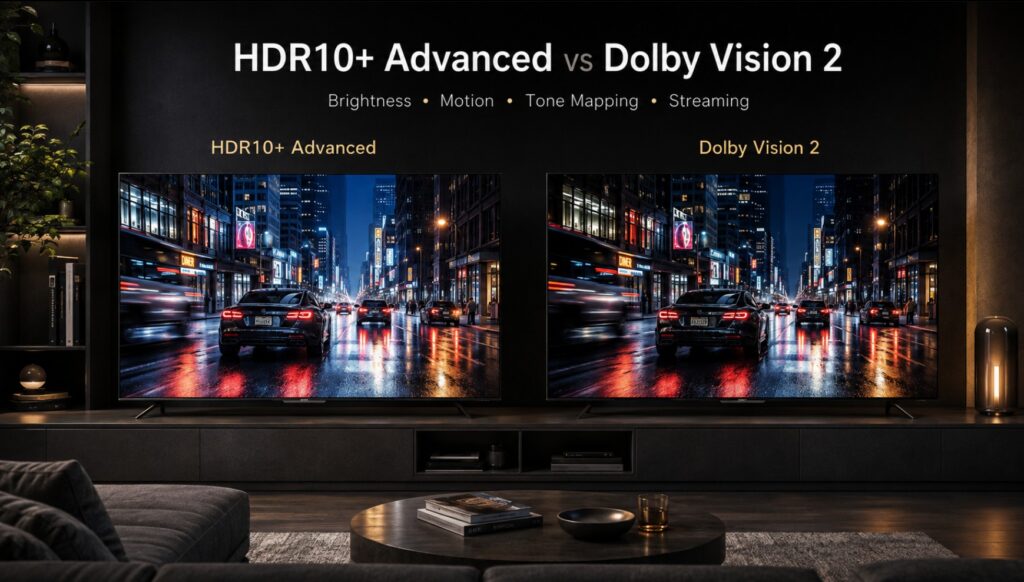

The next HDR format battle has moved beyond CES demos. HDR10+ Advanced vs Dolby Vision 2 is now a real buying question because both technologies have started reaching consumer TVs in 2026.
Prime Video began delivering HDR10+ Advanced on supported titles in August, initially on compatible Samsung 2026 televisions. Just days later, Dolby and Hisense started rolling out Dolby Vision 2 to selected 2026 Hisense models. For the first time, buyers can look beyond promises and ask a more useful question: which format is actually more likely to improve the way you watch movies, sports and games?
There is no simple picture-quality winner yet. We do not have enough independent side-by-side measurements of retail TVs running both new systems. What we can compare is how each format works, what features are already active, which TVs support them and how much those differences should matter when buying a TV.
HDR10+ Advanced vs Dolby Vision 2 at a glance
Both formats are trying to solve similar problems. Modern TVs are much brighter than they were when the original HDR standards arrived, but simply having more peak brightness does not guarantee better HDR.
The new systems want to use that extra display capability more intelligently.
| Feature | HDR10+ Advanced | Dolby Vision 2 |
|---|---|---|
| Dynamic metadata | Yes | Yes |
| Improved tone mapping | Yes | Yes |
| Better use of bright modern TVs | Enhanced Overall Brightness | New Image Engine and bi-directional tone mapping |
| Dark-scene optimization | AI-assisted tone mapping can preserve shadow detail | Precision Black and Content Intelligence |
| Local brightness control | Local Tone Mapping metadata | Advanced tone mapping through the Dolby Vision 2 engine |
| Motion control | Intelligent Motion Smoothing | Authentic Motion on advanced implementations |
| Content recognition | Genre-based Optimization | Content Intelligence |
| Ambient adaptation | Supported through relevant HDR10+ adaptive functions and gaming tools | Light Sense 2 on Dolby Vision 2 Max |
| Sports optimization | Genre and motion-based processing | Dedicated sports optimization |
| Gaming | HDR10+ Gaming plus Advanced cloud-gaming features | Sports and Gaming Optimization |
| Premium tier | One Advanced format | Dolby Vision 2 and Dolby Vision 2 Max |
| Backward compatibility | HDR10+ Advanced content can fall back to HDR10+ or HDR10 | Works with existing Dolby Vision content on compatible Dolby Vision 2 TVs |
| Current 2026 lead TV brand | Samsung | Hisense |
| First major streaming rollout | Prime Video | Existing Dolby Vision library benefits now, with Peacock, CANAL+ and iQIYI preparing expanded DV2 support |
The similarities are striking, but the way the two ecosystems approach the problem is not identical.
What HDR10+ Advanced actually changes
HDR10+ Advanced builds on the dynamic metadata already used by HDR10+. Its biggest change is that it gives newer, brighter televisions more information about how to use their available luminance.
Enhanced Overall Brightness provides extended statistical metadata so a compatible TV can make greater use of its brightness without simply lifting the entire image.
That distinction matters. If a TV can produce very bright highlights, the goal is not to make every dark scene look like daytime. The format can provide more detailed guidance about where that additional brightness is useful.
Local Tone Mapping provides finer control over different portions of the image, while Advanced Color Control adds dynamic color-gamut information. Genre-based Optimization allows the display to react differently to a film, sports event, animation or another content type.
Samsung’s current Prime Video implementation also uses AI-driven tone mapping to maintain shadow detail while allowing brighter content such as sports and action scenes to make fuller use of the panel.
📺 On a very bright OLED, Mini LED or Micro RGB television, this is potentially more useful than simply increasing the maximum HDR number on the specification sheet.
Intelligent Motion Smoothing is more interesting than it sounds
Motion processing is one of the more controversial parts of both new formats.
Many TV owners disable motion interpolation because aggressive settings make films look unnaturally smooth. But completely disabling it can expose 24fps judder, particularly on fast OLED panels.
HDR10+ Advanced tries to make motion processing more selective.
Its Intelligent Motion Smoothing feature uses metadata to tell the compatible TV when motion processing is useful instead of applying the same amount to an entire movie or show. Samsung says the system can preserve a cinematic presentation for films while using smoother motion where it makes sense for sports or action content.
That sounds subtle, but if implemented well it could address one of the most irritating compromises in modern TV setup: choosing between visible judder and excessive soap-opera motion.
What Dolby Vision 2 changes
Dolby Vision 2 is a larger rethink of the Dolby Vision processing pipeline.
The new system combines three major elements: Content Intelligence, a new Image Engine and Authentic Motion.
Content Intelligence can use information about the content, the display and the viewing environment to determine how the picture should be presented. Dolby specifically highlights Precision Black for dark scenes, Light Sense for room-light adaptation, and dedicated optimization for sports and games.
The new Image Engine adjusts brightness, contrast and color scene by scene. Dolby also describes bi-directional tone mapping, which gives creators more control over how a master can use the much greater brightness and color capability of modern premium TVs.
This is important because HDR mastering and television capability have been moving apart. A high-end 2026 TV can do things that were unrealistic for consumer panels a few generations ago. Dolby Vision 2 is designed to let the content pipeline use more of that performance without asking the TV manufacturer to guess what the creator wanted.
Dolby Vision 2 Max is the part enthusiasts should watch
Dolby has split the platform into two device tiers.
Dolby Vision 2 provides the new Image Engine and core Content Intelligence features for mainstream compatible televisions.
Dolby Vision 2 Max adds features intended for the most capable displays. These include Authentic Motion, Light Sense 2 and additional controls for enthusiasts.
Authentic Motion is particularly unusual. Instead of leaving motion interpolation entirely to a television setting, it allows motion treatment to be guided creatively on a shot-by-shot basis for content authored to use it.
🎬 That could mean reducing obvious judder in a difficult camera pan without turning the next dialogue scene into artificially smooth video.
The important limitation is that the most advanced behavior needs compatible content. A Dolby Vision 2 Max badge does not mean every old movie suddenly receives creator-authored Authentic Motion.
Which format handles dark scenes better?
This is one area where Dolby is making a particularly direct consumer promise.
Precision Black is designed to address complaints that Dolby Vision content can appear too dark, especially in real living rooms rather than controlled cinema environments. Light Sense 2 can also take room lighting into account on Dolby Vision 2 Max TVs.
That does not mean Dolby Vision 2 simply raises shadow levels. The goal is to reveal usable detail while preserving the intended black level and contrast.
TVComparePro already has a separate guide for viewers dealing with Netflix Dolby Vision that looks too dark. Dolby Vision 2 is interesting because some of the problems users currently solve manually may increasingly be handled inside the format and TV processing pipeline.
HDR10+ Advanced approaches brightness and shadow handling differently. Enhanced Overall Brightness and AI-driven tone mapping give the TV more information to use its luminance while maintaining detail in dark areas.
Until we have controlled measurements on comparable retail TVs, saying one is objectively better at dark scenes would be premature.
HDR10+ Advanced and Dolby Vision 2 motion compared
| Situation | HDR10+ Advanced | Dolby Vision 2 |
| 24fps films | Metadata can control Intelligent Motion Smoothing | Authentic Motion can guide motion on a shot-by-shot basis |
| Sports | Genre and motion optimization | Content Intelligence plus sports optimization |
| Fast action | Dynamic motion adjustment | Content-aware motion processing |
| User concern | Avoid excessive smoothing | Avoid both unwanted judder and soap-opera effect |
| Main limitation | Requires compatible content and TV implementation | Full Authentic Motion benefits require compatible authored content |
Neither technology makes panel response time irrelevant. OLED, Mini LED and RGB Mini LED displays still have their own motion characteristics.
Which TVs actually support them in August 2026?
This is where the comparison becomes more useful than it was at the start of the year.
HDR10+ Advanced is already appearing in Samsung’s 2026 range, with Prime Video providing the first global streaming rollout on supported titles. Samsung’s S99H listings in markets including the UK and Romania explicitly list HDR10+ Advanced. Samsung also warns that availability can differ by model and region.
There is an interesting regional detail: some Romanian S95H listings currently show HDR10+ Adaptive and Gaming without listing Advanced, while S99H listings explicitly include Advanced. That is a good reason to check the exact model code instead of assuming every television with a similar name has the same feature set.
Dolby Vision 2 has now started rolling out on Hisense’s 2026 UX, UR9, UR8 and U7 family, called U7 Pro in some European and other markets. Hisense TVs running both Google TV and VIDAA are included in the rollout.
TCL plans support on its 2026 X QD-Mini LED and C series through firmware updates, while Philips has announced support across OLED811, OLED911 and OLED951. Dolby says TCL and Philips Dolby Vision 2 TVs are expected to be shipping by the end of 2026.
| Brand or service | Status in August 2026 |
| Samsung | HDR10+ Advanced on select 2026 models |
| Prime Video | HDR10+ Advanced streaming launched globally on supported titles |
| Hisense | Dolby Vision 2 rollout underway on selected 2026 TVs |
| TCL | Dolby Vision 2 planned for 2026 X and C series through OTA |
| Philips | Dolby Vision 2 planned for selected 2026 OLED models |
| Peacock | Preparing expanded Dolby Vision 2 support |
| CANAL+ | Committed to Dolby Vision 2 |
| iQIYI | Committed to Dolby Vision 2 |
If you are comparing current models, the TVComparePro TV Comparison Tool can help separate the HDR format badge from more important hardware differences such as panel type, brightness, local dimming and refresh rate.
Samsung buyers have a simple decision
If you buy a Samsung TV, Dolby Vision 2 is not currently part of the equation. Samsung continues to use HDR10, HDR10+ and its own HDR ecosystem.
A 2026 Samsung with HDR10+ Advanced can therefore make sense for someone who watches a lot of Prime Video and wants Samsung’s newest HDR processing.
The Samsung S95H and S99H comparison is particularly relevant because HDR10+ Advanced support itself can vary with the regional version.
One practical detail deserves attention. Samsung’s UK launch information says HDR10+ Advanced is not supported when Filmmaker Mode is enabled. That does not mean Filmmaker Mode is bad, but viewers who normally leave it enabled should not assume they are receiving every Advanced feature at the same time.
⚠️ This is also why a logo on a specification sheet should never replace checking the exact picture mode, firmware and app.
Hisense has the strongest Dolby Vision 2 position today
Hisense currently has the most concrete Dolby Vision 2 advantage because compatible TVs are already receiving the feature.
Dolby says its first supported Hisense models can apply the new Image Engine and Content Intelligence to existing Dolby Vision titles. More advanced capabilities will become more important as streaming providers begin authoring content specifically for Dolby Vision 2.
That makes Dolby Vision 2 more than a future checkbox, although the ecosystem is still young.
What about gaming?
Neither format should determine a gaming-TV purchase by itself.
HDR10+ Advanced extends HDR10+ Gaming and adds specific support for cloud gaming, including adaptation to ambient viewing conditions. Dolby Vision 2 includes Sports and Gaming Optimization, with features such as white-point and motion adjustments designed for those content types.
🎮 For PS5 Pro or Xbox Series X today, VRR quality, input lag, 4K120 support, HDR calibration and panel performance still matter more than either new logo.
Game adoption will also depend heavily on console and developer support, so it is too early to buy a TV solely for HDR10+ Advanced Gaming or Dolby Vision 2 gaming.
Practical setup notes
Before deciding that one format looks better, make sure you are actually comparing the formats rather than two different TV modes.
Check the exact TV model and firmware first. Then verify that the streaming title supports the new format, use the television’s playback information where available, and avoid comparing one TV in Vivid mode with another in a more accurate cinema mode.
Prime Video users should also remember that account tier and device capability can affect the available stream. The Prime Video Ultra guide explains why 4K and premium audio availability may depend on the subscription and market.
For HDR comparisons, keep energy-saving modes consistent and avoid changing several picture controls at once.
Which one matters more when buying a TV?
As of August 2026, Dolby Vision 2 has the broader announced TV-brand momentum. Hisense is already rolling it out, while TCL and Philips have also committed to the platform.
HDR10+ Advanced currently has a narrower new-TV rollout, but it has a major advantage of its own: Samsung’s enormous installed base and a live global streaming launch through Prime Video. The wider HDR10+ ecosystem is also open and operates without per-device royalties, which can make adoption attractive to manufacturers and content providers.
For a Samsung buyer, HDR10+ Advanced matters more because Dolby Vision 2 is not part of that TV ecosystem.
For a Hisense buyer choosing one of the compatible 2026 models, Dolby Vision 2 is already a real feature and potentially a meaningful advantage.
For TCL and Philips buyers, verify whether the firmware enabling Dolby Vision 2 has actually reached your exact model and region before treating it as an active feature.
For everyone else, panel quality still wins. Better blacks, brighter highlights, cleaner local dimming, accurate color and good motion will have a greater impact than choosing a weaker TV simply because it supports the newer HDR logo. ✅
HDR10+ Advanced and Dolby Vision 2 are both becoming more interesting, but 2026 is still the beginning of this format generation. The winner will depend as much on streaming services, content creators and TV manufacturers as it does on the underlying technology.