
RGB Mini LED color crosstalk is a new kind of picture artifact that comes with one of the most ambitious LCD backlight upgrades in years. Instead of asking the backlight only how bright a region should be, RGB Mini LED can also change the balance of red, green and blue light behind that region. The payoff is exceptional color volume. The complication is that neutral objects can sometimes borrow color from whatever sits beside them.
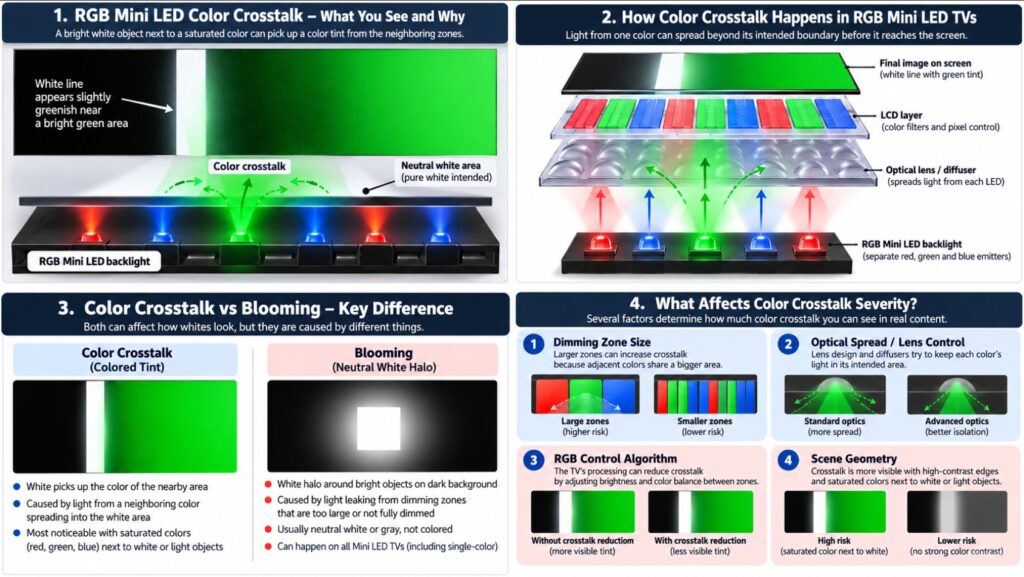
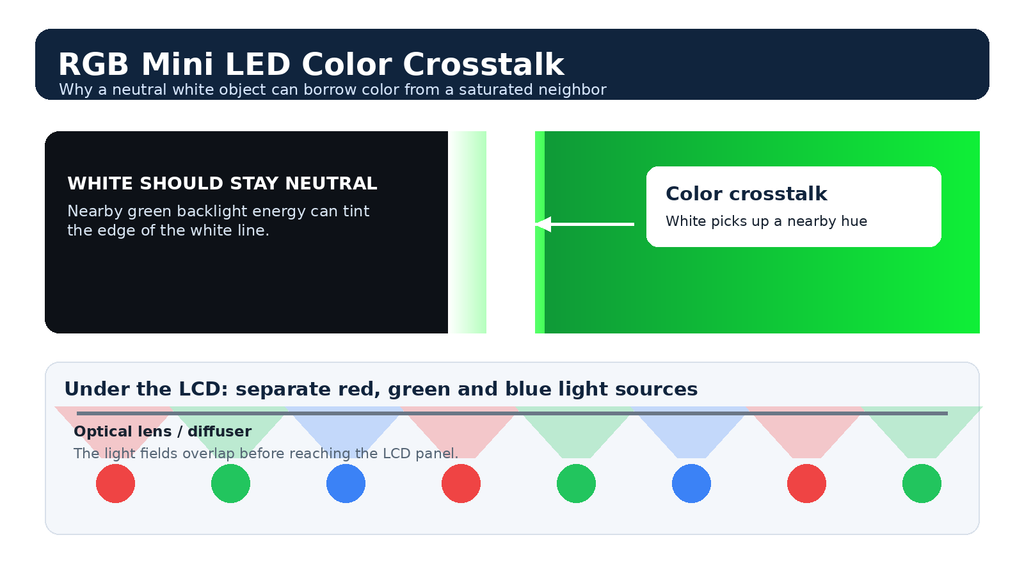
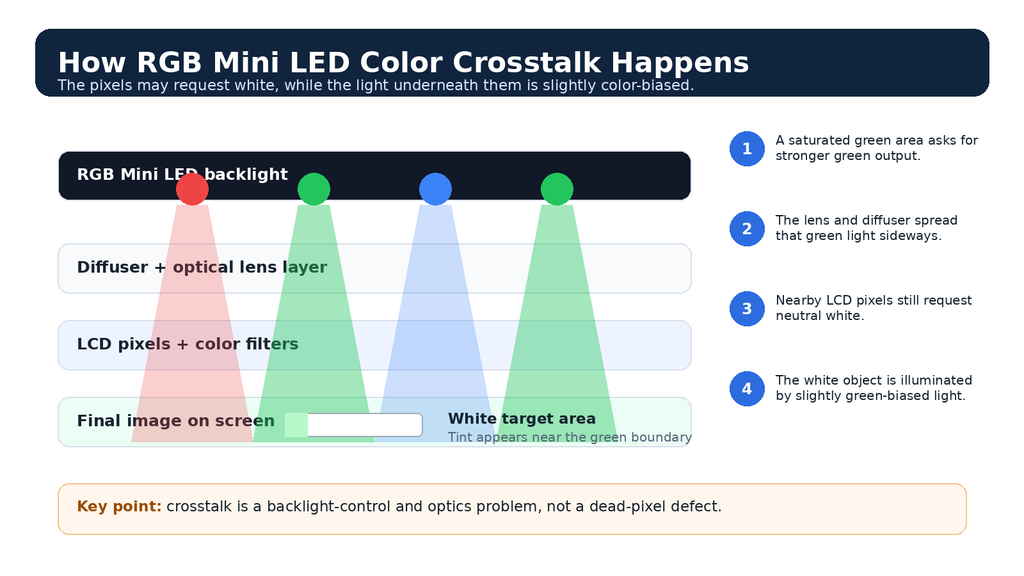
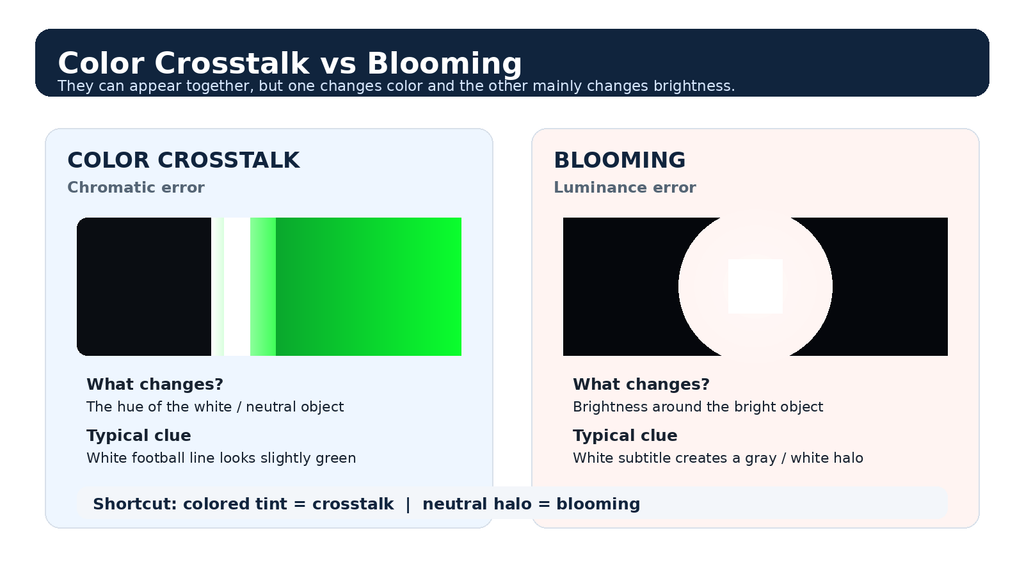
The easiest example is a white football line on vivid green grass. The LCD pixels are still trying to draw white, but the backlight under the edge of that line can be slightly green-biased. The line then looks faintly green rather than perfectly neutral. White subtitles over red, blue or green backgrounds can show the same effect.
Brands use names such as RGB Mini LED, RGB-Mini LED and Micro RGB for closely related ideas, but the underlying challenge is similar: the television has to control where the light goes, how bright it is and what color that light should be before it reaches the LCD layer. 🎯
What RGB Mini LED color crosstalk actually is
On a conventional Mini LED LCD, the backlight mostly changes luminance from zone to zone. Color is then shaped farther up the optical stack by the LCD pixels, filters and, on many TVs, a quantum-dot layer.
RGB Mini LED adds another control axis. A red object can be illuminated by a backlight region that is strongly biased toward red. A green object can receive much more green light. That can make saturated HDR colors brighter and purer than they would be with a more conventional backlight.
But the backlight zones are still much larger than individual pixels, and the light must pass through lenses, diffuser layers and the LCD panel before you see the final image. Light does not stop at an invisible pixel boundary. When a saturated green area sits directly beside a white object, some of the green-biased illumination can spread into the region where the image is asking for neutral white.
This is why white is such a useful stress test. White needs a balanced mixture of red, green and blue. If one component becomes too strong underneath it, the error is immediately visible as a tint rather than as a simple brightness change.
Color crosstalk vs blooming: they are not the same problem
Both artifacts come from a zone-based backlight, so they are easy to mix up. The visual mistake is different.
| Artifact | What you see | Main cause | Typical example |
|---|---|---|---|
| Color crosstalk | A neutral object takes on a nearby color tint | Colored backlight energy crosses the intended spatial boundary | White field line looks slightly green |
| Blooming | A bright object creates a light halo around it | A dimming zone lights a larger area than the bright object | White subtitle creates a gray or white halo on black |
| Viewing-angle color shift | Hue or gamma changes when you move off-axis | LCD viewing-angle behavior | Skin tones or gray areas change from side seats |
| Backlight bleed | Persistent bright patches near an edge or corner | Panel and backlight uniformity | A cloudy corner remains visible on a dark screen |
Blooming is primarily a luminance error. Crosstalk is a chromatic error. A TV can therefore have deep blacks and very little conventional haloing while still allowing a saturated color to contaminate a nearby white object.
Why current RGB Mini LED TVs behave so differently
The label on the box tells you that the backlight can generate separate red, green and blue light. It does not tell you how aggressively the television uses that capability in complicated scenes.
| 2026 implementation | Observed behavior | What it means for crosstalk |
|---|---|---|
| Samsung R95H Micro RGB | Uses RGB control aggressively in mixed content | Excellent color volume, but whites can inherit a nearby tint. On some transitions, the tint can take a moment to clear. |
| Hisense UR9 / UR9S | Strong RGB color output with very saturated HDR | Crosstalk can become visible when a bright saturated region touches white or near-white detail. |
| Sony Bravia 9 II / Bravia 7 II | More adaptive RGB behavior, with the backlight becoming more neutral in difficult scenes | That can reduce visible crosstalk, but it also means the TV does not chase maximum RGB color separation in every frame. |
| TCL RM9L | Uses dedicated micro-lens optics and RGB control algorithms intended to tighten light control | The mitigation helps, but independent testing still finds visible crosstalk in some scenes, especially white detail beside saturated colors. |
This is the important point: crosstalk is not a simple yes-or-no feature of RGB Mini LED. It is an engineering trade-off. One manufacturer can favor the widest possible color volume, while another can deliberately sacrifice some of that advantage in a difficult frame to keep neutral objects cleaner.
The color-volume numbers can look better than mixed real content
RGB Mini LED also creates a measurement trap that is worth understanding.
A synthetic color-volume pattern may show a red patch without any white or green object beside it. In that situation the TV can heavily favor the red emitters and produce extremely pure, saturated red light. Run separate green and blue patches and the measured gamut or color-volume result can look spectacular.
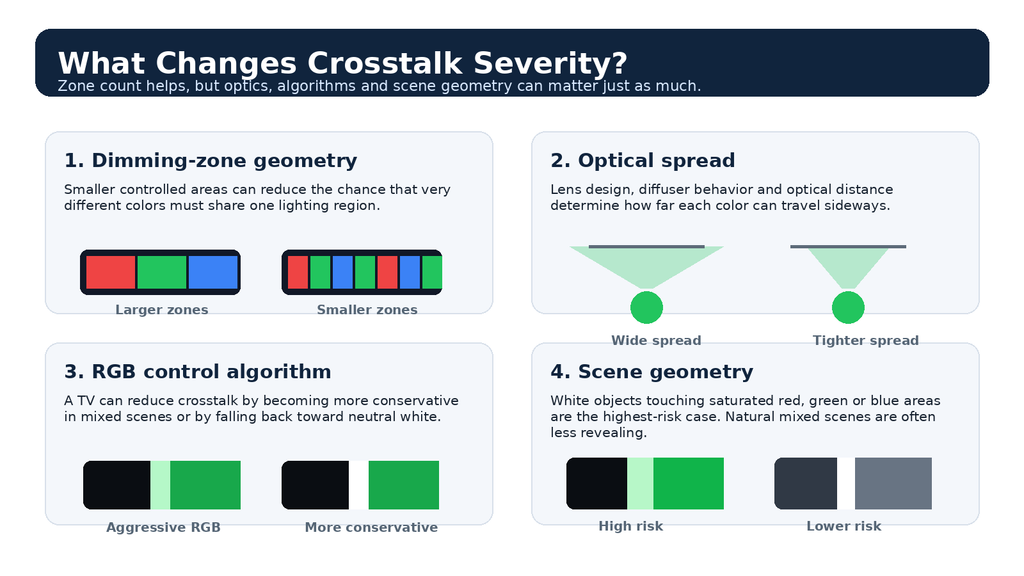
Real content is rarely that cooperative. A single movie frame can contain blue sky, white clouds, skin tones, green foliage, black clothing and a bright sign at the same time. Nearby zones now need different color mixtures, and the TV may have to activate all three emitters, pull one primary back, or move toward a more neutral backlight to prevent visible contamination.
That means a best-case synthetic color-volume number is not automatically the amount of RGB advantage you will see in every scene. The more useful question is how much of that color advantage survives when saturated color and neutral objects share the same frame. 🔬
Where you are most likely to notice crosstalk
| Content | Crosstalk risk | Why |
|---|---|---|
| Football / soccer | High | Bright white field markings sit directly on a large saturated green area |
| Sports scoreboards | Medium to high | White text and icons often touch strong team colors |
| Game HUDs | Medium | Static white icons can sit beside saturated neon environments |
| Subtitles | Variable | White text can cross red, green or blue backgrounds |
| Movies and TV drama | Usually lower | Natural scenes contain more mixed gradients and fewer perfect color boundaries |
| Test patterns | Very high | They are intentionally designed to expose the weakness |
This distinction matters. A torture clip can make the artifact look catastrophic even if it appears only occasionally in ordinary viewing. On the other hand, someone who watches football every weekend is repeatedly looking at one of the most revealing real-world patterns: crisp white lines over green. ⚽
Why more dimming zones do not automatically fix it
More zones usually help because each controlled area becomes smaller, but zone count is only one part of the system. RGB Mini LED also depends on lens geometry, optical distance, diffuser behavior, panel characteristics and the algorithm deciding how each zone should mix red, green and blue.
A television with more zones but wider optical spread can still contaminate nearby neutral detail. Another TV with fewer zones but tighter optics and a more conservative algorithm may keep those same white areas cleaner.
The processor also has an escape route that a specification sheet will not show: it can stop pushing one primary so hard and use a more neutral mixture in a difficult scene. That reduces the RGB color advantage, but it can make the final image more accurate.
Can firmware or picture settings reduce RGB Mini LED color crosstalk?
Yes, to a point. The artifact has both hardware and software causes.
Firmware can change how aggressively the backlight separates red, green and blue in mixed scenes. Local-dimming modes can also change the balance between maximum color volume and neutral accuracy. Some TVs even expose a control that lets the backlight behave more like a neutral white source in difficult content.
What firmware cannot do is redesign the lens, shrink the physical zone or change the optical distance inside the television. That is why a software update can improve crosstalk without guaranteeing that it disappears completely.
Practical setup notes
If you think your RGB Mini LED TV is showing crosstalk, start with an accurate Movie, Filmmaker or Professional-style picture mode rather than a showroom preset. Make sure the firmware is current, then use one real scene that reliably shows the tint.
Compare the available local-dimming or RGB backlight modes one at a time. Do not compensate for a local green or red tint by changing the TV’s global Tint or white-balance controls. That can make the entire image inaccurate while leaving the local backlight problem mostly intact.
For sports, inspect white field markings, score graphics and advertising boards. For games, look at white HUD elements near strong neon colors. For films, use subtitles over saturated backgrounds. If the effect appears only in a torture pattern and disappears in everything you actually watch, sacrificing black level or HDR impact just to eliminate the pattern may make the TV look worse overall. 🛠️
Should color crosstalk stop you buying RGB Mini LED?
Not by itself. RGB Mini LED can deliver exceptional brightness, wide color and very strong HDR impact, especially in large bright rooms where a premium LCD still makes a lot of sense.
But buyers should stop thinking of the technology as conventional Mini LED with three colored LEDs added. It creates a different control problem. The TV now has to manage luminance and chroma spatially before the image even reaches the LCD pixels.
If you mostly watch films and varied streaming content, mild crosstalk may be hard to notice. If you watch a lot of football, use the TV as a PC display, or are especially sensitive to white objects changing color, this behavior deserves more attention than a headline BT.2020 percentage or peak-brightness figure.
The most interesting lesson from the first serious RGB Mini LED generation is that the winner is unlikely to be determined by zone count alone. Optics, processing and the decision to know when not to push maximum RGB separation are becoming just as important as the backlight technology itself.