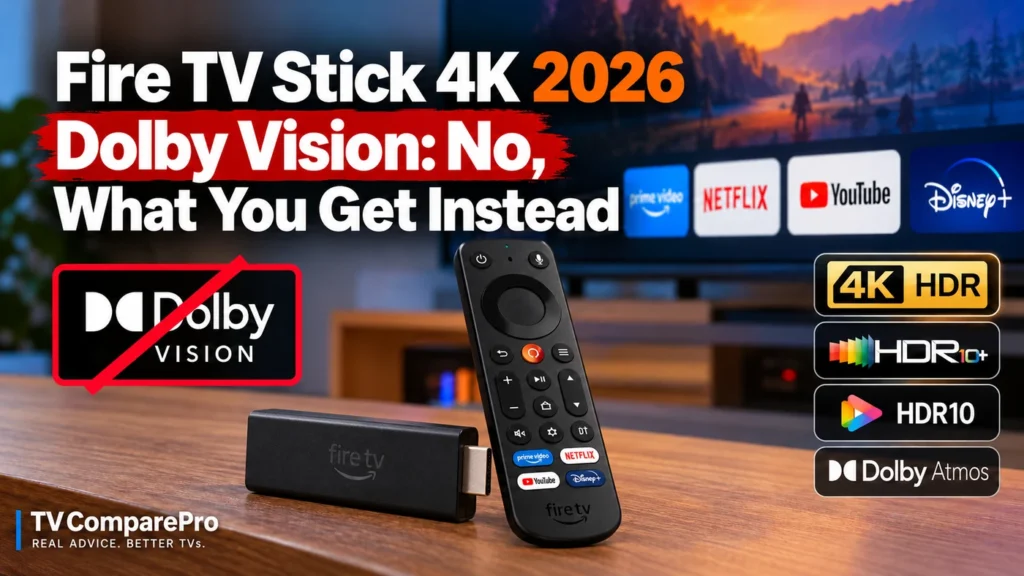

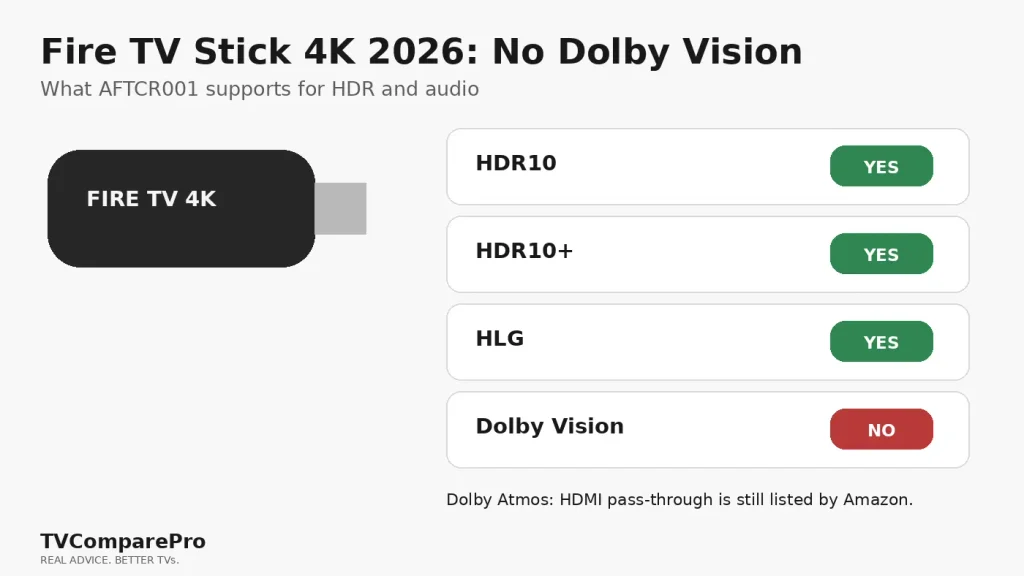
One of the biggest changes this year is Fire TV Stick 4K 2026 Dolby Vision support, which Amazon has removed from the standard model. The AFTCR001 model supports HDR10, HDR10+ and HLG, but Amazon does not list Dolby Vision for it. That is a real downgrade from the older Fire TV Stick 4K hardware and the current 4K Plus and 4K Max.
The audio story is more nuanced. Amazon still lists HDMI pass-through for Dolby Atmos, so Atmos has not disappeared completely. The bigger change is that this is a different kind of Fire TV Stick: it runs Vega OS 2.0, has 1 GB of RAM, adds Direct Power from a compatible TV USB port and uses Amazon’s redesigned remote. 📺
Fire TV Stick 4K 2026 Dolby Vision support: the short answer
No. Fire TV Stick 4K 2026 Dolby Vision is not supported on the new AFTCR001 model. Amazon’s own launch material lists HDR10, HDR10+ and HLG for the new stick, while Dolby Vision is specifically called out as one of the premium features of the Fire TV Stick 4K Max.
The previous standard 4K model supported Dolby Vision, so the reused name is easy to misread. If you searched Fire TV Stick 4K 2026 Dolby Vision because your older stick showed the Dolby badge, the generation change is why the answer is now different.
| Feature | Fire TV Stick 4K 2026 | What it means |
|---|---|---|
| Maximum video output | Up to 4K 60fps | Normal 4K streaming is unchanged |
| HDR10 | Yes | Baseline HDR works on compatible TVs |
| HDR10+ | Yes | Dynamic HDR remains available on compatible content and TVs |
| HLG | Yes | Supported for compatible live and broadcast-style HDR |
| Dolby Vision | No | Dolby Vision streams must use another supported HDR path |
| Dolby Atmos | HDMI pass-through | Compatible Atmos audio can be passed to downstream equipment |
| Operating system | Vega OS 2.0 | It is no longer an Android-based Fire OS stick |
Why losing Dolby Vision is unusual for a Fire TV Stick 4K
The name makes this change easy to miss. Amazon sold a Fire TV Stick 4K in 2023 that supported Dolby Vision, HDR10, HDR10+ and HLG. That Android-based hardware later became the Fire TV Stick 4K Plus in Amazon’s reorganized lineup.
The new 2026 model takes the plain Fire TV Stick 4K name again, but it is not a simple refresh of that device. It uses a different MediaTek platform, Vega OS instead of Fire OS and only 1 GB of RAM instead of 2 GB.
So Fire TV Stick 4K 2026 Dolby Vision being absent is not a small line-item change. It is part of a clearer split in Amazon’s lineup: the standard 4K stick is aimed at mainstream streaming, while Dolby Vision, fuller Dolby audio support, more storage and faster hardware are pushed toward the higher tiers.
Fire TV Stick 4K 2026 vs 4K Plus vs 4K Max
This comparison makes Amazon’s new lineup much easier to understand. The 4K Plus keeps the older Android-based platform and Dolby Vision, while the 4K Max remains the more capable option for home theater setups. That makes Fire TV Stick 4K 2026 Dolby Vision support one of the clearest differences between the new standard model and Amazon’s higher-tier sticks.
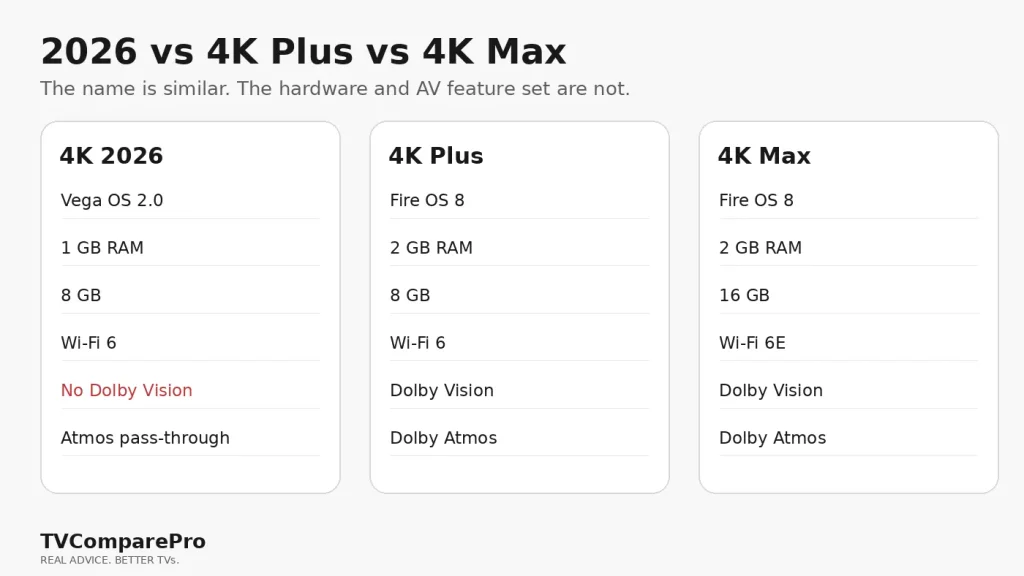
| Spec | 4K 2026 | 4K Plus 2025 | 4K Max 2023 |
|---|---|---|---|
| Build model | AFTCR001 | AFTMA08C15 | AFTKRT |
| OS | Vega OS 2.0 | Fire OS 8 | Fire OS 8 |
| CPU | 4-core up to 1.7 GHz | 4-core up to 1.7 GHz | 4-core up to 2.0 GHz |
| RAM | 1 GB | 2 GB | 2 GB |
| Storage | 8 GB | 8 GB | 16 GB |
| Wi-Fi | Wi-Fi 6 | Wi-Fi 6 | Wi-Fi 6E |
| Dolby Vision | No | Yes | Yes |
| HDR10+ | Yes | Yes | Yes |
| Dolby Atmos | HDMI pass-through | Fuller Dolby audio support | Fuller Dolby audio support |
The RAM number deserves attention, but it is not proof that the stick is slow. Amazon says apps launch more than 35% faster and content starts nearly 20% sooner in its own testing, but those claims compare the device with a similarly priced rival, not directly with the 4K Plus. The safe takeaway is simply that newer does not automatically mean more powerful.
Dolby Atmos is not completely gone
This is where several quick spec comparisons can be misleading. Amazon markets the 4K Max as having premium Dolby Atmos support, but the technical specification for AFTCR001 still lists HDMI audio pass-through for Dolby Atmos, alongside Dolby Digital, Dolby Digital+, DTS, DTS-HD and MPEG-H. So while Fire TV Stick 4K 2026 Dolby Vision is a firm no, the audio side needs a more precise answer.
That means the Fire TV Stick 4K 2026 Dolby Vision downgrade does not translate into a simple “no Dolby” verdict for audio. A compatible stream can be passed through HDMI to another device in the chain for decoding.
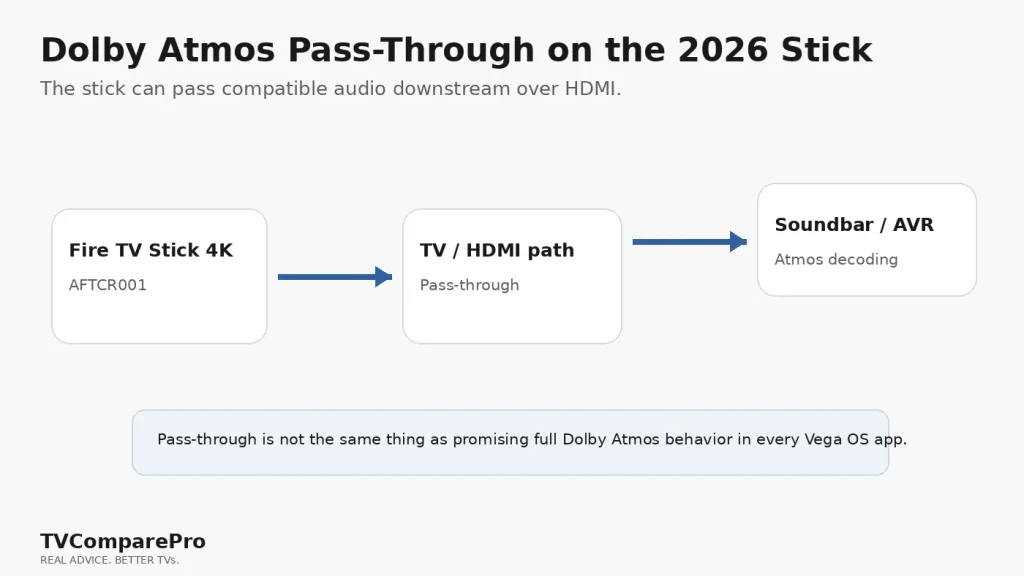
The distinction matters in a real home theater. A stick plugged directly into a Dolby Atmos-capable AVR or into a TV that can forward the signal over eARC has a different audio path from a stick relying on its own decoding features. App behavior can also vary, so I would not promise an Atmos badge in every service until the new Vega apps have been tested more broadly.
Does the lack of Dolby Vision matter on your TV?
Sometimes a lot. Sometimes almost not at all. The practical impact of Fire TV Stick 4K 2026 Dolby Vision being absent depends heavily on what HDR formats your television can actually display.
Samsung is the easy case. Samsung TVs do not use Dolby Vision, and the new Fire TV Stick 4K still supports HDR10+. If you are pairing it with a recent Samsung OLED or Mini LED, losing Dolby Vision does not remove a format your TV could have displayed anyway.
Owners of Dolby Vision-capable LG, Sony, TCL or Hisense TVs have more reason to care. If a particular streaming app or movie offers Dolby Vision but not HDR10+ on that device, playback will use another supported HDR format rather than Dolby Vision. 🎬
| Your TV | How much does no Dolby Vision matter? | Why |
|---|---|---|
| Samsung with HDR10+ | Low | Samsung does not use Dolby Vision, while HDR10+ remains supported |
| LG or Sony with Dolby Vision | Medium to high | Dolby Vision titles cannot use the DV playback path through this stick |
| TCL / Hisense supporting DV and HDR10+ | Content-dependent | HDR10+ can reduce the loss when the app and title also provide it |
| HDR10-only TV | Very low | The TV could not display Dolby Vision in the first place |
This is also why Fire TV Stick 4K 2026 Dolby Vision searches are more useful than a generic “is the new Fire Stick good?” review. The answer changes depending on the HDR formats your television can actually use.
Vega OS 2.0 is arguably the bigger change
Longtime Fire TV users may notice the loss of Dolby Vision first, but the switch to Vega OS 2.0 changes far more about how the 2026 model actually works.
AFTCR001 runs Vega OS 2.0. Fire OS is Android-based; Vega OS uses a different app model. Amazon says more than 2,000 apps have been added since the first Vega Fire TV launched, including Netflix, Disney+, YouTube, Prime Video, Spotify, Xbox and VLC.
Mainstream streaming is well covered, but enthusiasts should not assume ordinary Android APK compatibility. Apps need a Vega-compatible route.
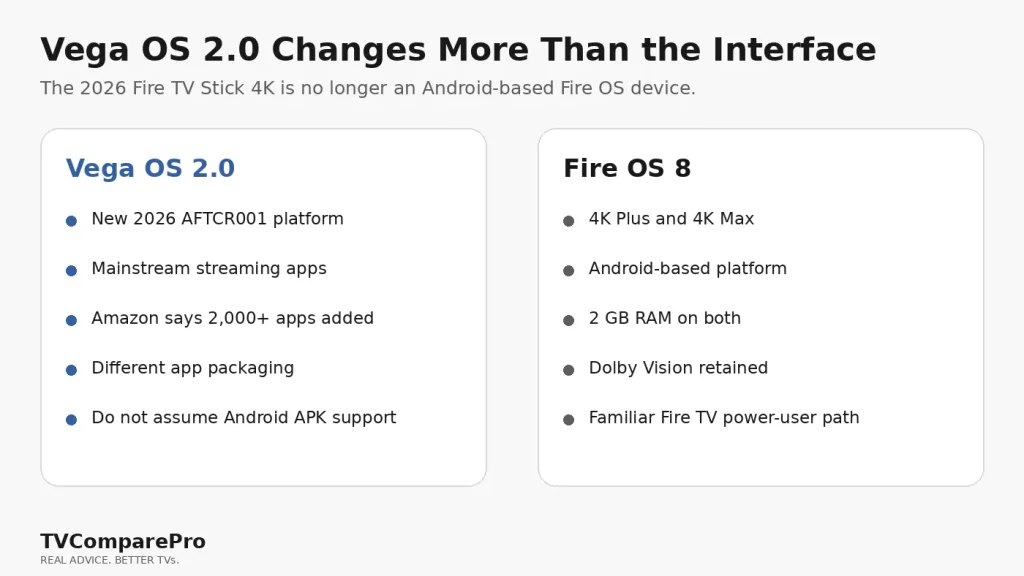
So a buyer replacing a 2023 Fire TV Stick 4K may lose two things at once: Dolby Vision and the familiar Android-style app flexibility. That makes the upgrade decision less obvious than the “2026” badge suggests.
Direct Power is a genuinely useful upgrade
Amazon’s Direct Power lets the stick run from a compatible TV USB port using the included short cable. If the TV reports insufficient power, Amazon recommends a 5V 1A external adapter instead. For wall-mounted TVs, travel and cleaner wiring, this is a genuinely useful change. 🔌
Practical setup notes
Before changing any TV settings, it is worth checking the exact model number. Fire TV Stick 4K 2026 Dolby Vision support is not available on AFTCR001, so the missing Dolby Vision badge is expected behavior rather than a picture-setting problem.
- Check the build model. AFTCR001 identifies the new Fire TV Stick 4K 3rd Gen 2026. Do not rely on the retail name alone.
- Do not troubleshoot missing Dolby Vision. The 2026 model does not support it. Use HDR10 or HDR10+ where available.
- For Dolby Atmos, verify the whole HDMI chain. The TV, soundbar or AVR still needs to accept the format being passed through.
- Use Direct Power only when the TV USB port supplies enough power. An insufficient-power warning is a reason to use an external adapter.
- Check app availability before replacing a Fire OS device. Vega OS has a growing catalog, but Android APK compatibility should not be assumed.
Which Fire TV Stick makes more sense?
| Buyer | Best fit | Reason |
|---|---|---|
| Samsung TV owner who mainly streams | 4K 2026 | HDR10+ matters more than Dolby Vision on Samsung |
| LG / Sony owner who wants Dolby Vision | 4K Plus or 4K Max | Both retain Dolby Vision |
| Home theater enthusiast | 4K Max | Stronger Dolby support, 16 GB and Wi-Fi 6E |
| Fire OS / Android power user | 4K Plus or 4K Max | They retain the familiar Fire OS platform |
| Simple 4K streaming and clean wiring | 4K 2026 | Vega OS, Wi-Fi 6 and Direct Power keep the setup simple |
What this means for Fire TV buyers
The Fire TV Stick 4K 2026 Dolby Vision story is really about Amazon redefining what its standard 4K tier includes. This is not the old 4K Stick with a new remote. It is a Vega OS device with 1 GB of RAM, Direct Power and a more basic HDR feature set.
The lack of Dolby Vision is easy to live with on a Samsung TV and much harder to ignore on a Dolby Vision-focused home theater. Dolby Atmos pass-through softens the audio downgrade, but it does not turn the new stick into a cheaper 4K Max.
If all you want is Netflix, Prime Video, Disney+ and YouTube in 4K, the new stick still covers the basics well. If you care about Dolby Vision, Fire OS flexibility or the strongest home-theater support, the 4K Plus and 4K Max remain the more complete choices.
That is the important distinction behind Fire TV Stick 4K 2026 Dolby Vision: newer does not automatically mean more capable in every part of the AV chain. ✅