
There is a big difference between cancelling a factory and abandoning a screen size. The LG 111-inch OLED TV is still a possibility after LG Display cancelled its long-delayed investment in a new 10.5-generation OLED factory in South Korea. The reason I am not writing off the 111-inch format is a separate manufacturing project in Guangzhou, China.
That project targets OLED modules as large as 111 inches. It does not mean LG Electronics has announced a television, and it certainly does not give us a release date. What it does offer is a more plausible route beyond the 97-inch OLED ceiling without committing to an entirely new fabrication facility.
Is the LG 111-Inch OLED TV cancelled?
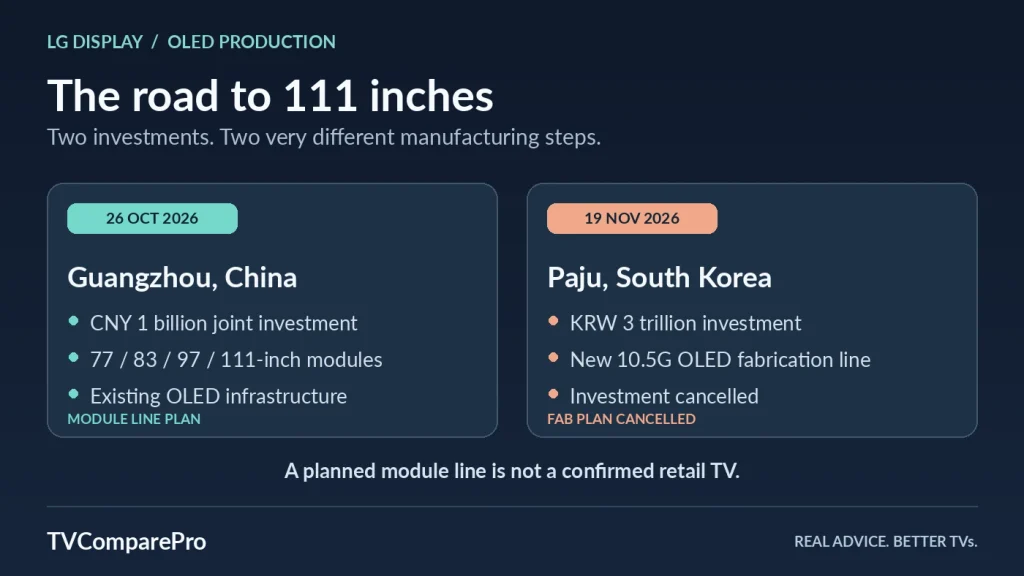
No cancellation of a specific 111-inch consumer television has been announced. On November 19, 2026, LG Display confirmed in a regulatory filing that it would abandon its planned investment of KRW 3 trillion in a 10.5G OLED production facility in Paju. The project dates back to July 2019.
The company’s explanation was largely economic. Demand for OLED TVs has grown more slowly than anticipated, the transition away from LCD has taken longer, and OLED gaming monitors have become a more important business. LG Display considers better use of its existing production capacity a more sensible approach than building the planned factory.
For someone waiting for a television larger than 97 inches, the significance is not that OLED production is ending. It is that the economics of manufacturing very large panels may remain difficult for longer.
What the Guangzhou OLED investment actually covers
On October 26, Guangzhou Development District Holding Group announced a joint capital injection of CNY 1 billion with LG Display. The planned module lines cover 77-, 83-, 97- and 111-inch sizes. The investment was described as an upgrade of the existing OLED operation, rather than the construction of a new panel fabrication plant.
This distinction matters. A fabrication line makes the active OLED panel, including the transistor backplane and light-emitting layers. A module line takes a fabricated panel and integrates the components needed to make it a usable display assembly. That assembly is still not a finished television with its own processor, speakers, inputs, software and enclosure.
The Guangzhou project addresses a downstream manufacturing requirement for ultra-large OLED displays. It does not, by itself, prove that 111-inch panels are being made in commercial volumes or that a television brand has committed to selling them. The project also covers commercial display applications, so a consumer TV is only one potential destination.
| Project | What is known |
|---|---|
| Paju 10.5G OLED fab | New fabrication investment cancelled |
| Guangzhou module lines | Planned upgrade for 77, 83, 97 and 111 inches |
| 111-inch consumer TV | No retail model announced |
| Mass production and retail launch | No confirmed dates |
Why a 111-inch OLED could be so expensive
Display factory generations describe the size of the glass substrate used in production, not a generation of picture quality. A larger substrate can make it easier to arrange large panels efficiently, which is why the abandoned 10.5G investment is relevant.
UBI Research estimates that a 2,200 × 2,500 mm Gen 8.5 substrate could theoretically accommodate three 65-inch panels, two 77-inch panels or just one 111-inch panel in the layouts it describes. Actual industrial layouts and yields depend on process constraints and the manufacturer’s production strategy.
A 111-inch 16:9 screen alone is approximately 2,457 mm wide. In purely geometric terms, that leaves only about 43 mm against the 2,500 mm edge of a Gen 8.5 sheet, before accounting for production margins. That calculation helps illustrate why fitting the screen on the glass and manufacturing it profitably are two very different things.
Large panels also expose more area to potential defects. If a panel fails quality control, more processed material is at stake. Then there are the practical challenges of handling, reinforcement, shipping and installation. Reusing a factory may avoid the expense of building another one, although it does not automatically make each ultra-large OLED cheap to manufacture.
111-inch vs 97-inch OLED: how much bigger is it?
Fourteen inches sounds like a modest step when both televisions are already enormous. Screen area tells a different story. Assuming both displays use a 16:9 aspect ratio, the jump from 97 to 111 inches increases the viewing area by approximately 30.9%.
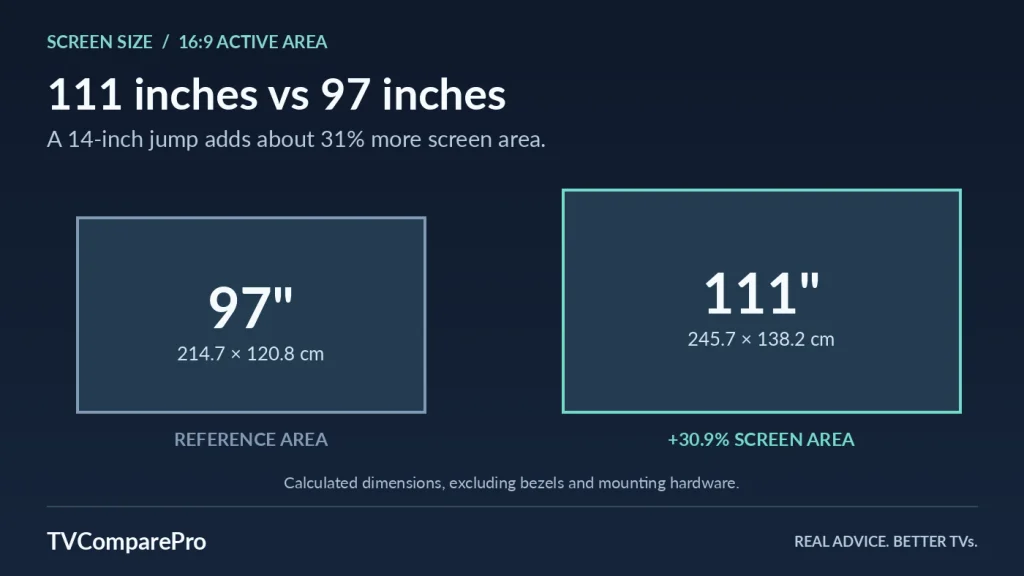
| Screen size | Width | Height | Area vs 97-inch |
|---|---|---|---|
| 83″ | 183.7 cm | 103.4 cm | -26.8% |
| 97″ | 214.7 cm | 120.8 cm | Reference |
| 111″ | 245.7 cm | 138.2 cm | +30.9% |
| 115″ | 254.6 cm | 143.2 cm | +40.6% |
These are calculated active-screen dimensions, not the dimensions of an actual TV chassis. A hypothetical 111-inch television would require at least 2.46 metres of wall width before allowing room for bezels, mounting clearance or speakers.
At a viewing distance of three metres, a 111-inch screen would occupy roughly 45 degrees of your horizontal field of view, compared with about 39 degrees for a 97-inch screen. For films, that is a meaningful increase in immersion. For gaming, especially competitive shooters with information near the edges of the screen, I would also consider whether that wider field is comfortable at my seating distance.
Will it use Primary RGB Tandem OLED?
There is no confirmed OLED stack, peak HDR brightness, resolution or refresh rate for a 111-inch model. The planned manufacturing capability cannot tell us whether the finished panel will use LG Display’s latest Primary RGB Tandem architecture.
LG’s own G6 specifications offer a useful reminder of why diagonal-specific details matter: the 97-inch G6 supports up to 120Hz, while its smaller G6 counterparts can reach 165Hz. I would not assume the largest television in a family inherits every feature of the smaller versions.
If a 111-inch OLED reaches the market, I would pay particular attention to sustained HDR brightness, power management, near-black uniformity and how the panel behaves with large bright scenes. A spectacular peak brightness claim on a small test window would not tell me how well a display of this size handles a bright sports broadcast or a snowy game environment.
Resolution deserves the same caution. At 111 inches, a 4K panel would have about 40 pixels per inch, compared with roughly 45 pixels per inch on a 97-inch 4K display. Whether the difference is noticeable depends heavily on viewing distance and content. Neither 4K nor 8K has been confirmed for the proposed 111-inch format.
111-inch OLED vs 115-inch Mini LED
The most interesting competition may be the 100-inch-plus LCD market rather than another OLED. A 115-inch Mini LED screen has only about 7.3% more area than a 111-inch OLED, assuming matching aspect ratios.
With OLED, each pixel emits its own light. That is particularly appealing in a dark home cinema where subtitles, stars and small highlights sit against black backgrounds. Mini LED televisions use a backlight with local dimming zones, so their performance depends on the backlight, dimming algorithm and panel characteristics. A good Mini LED may offer greater sustained brightness for daytime viewing and bright HDR scenes, although the actual results depend on the specific models.
At these sizes, the purchase is about more than technology. Installation cost, transport access, brightness in your room and the amount of wall space you can dedicate to the screen are all important. I would compare real products and measurements before assuming an ultra-large OLED is worth any particular price premium.
LG 111-inch OLED TV release date and price
As of November 25, 2026, there is no confirmed release date, retail price or model number. The Guangzhou module project is a manufacturing plan, not a product launch calendar. Even if the line becomes operational, the panel still needs commercial qualification and a television manufacturer willing to build a product around it.
I would expect the first retail models, if they arrive, to sit in the premium segment rather than compete on price with mass-market 100-inch LCD TVs. That is an editorial expectation based on manufacturing constraints, not an announced price. A precise estimate would be speculation without a model and production schedule.
Should you wait for a 111-inch OLED?
I would not postpone a planned home cinema purchase solely because of the 111-inch module announcement. The 97-inch G6 is an actual product with documented specifications. LG’s 97-inch Wallpaper OLED plans are also worth watching if a slim wall-mounted design is important to you.
LG 83-Inch C6H OLED (2026)
If you don’t want to wait for a 111-inch OLED, the 83-inch LG C6H offers a large-screen 4K OLED experience for movies, HDR and gaming.
Check Price on AmazonTVComparePro may earn a commission from qualifying purchases through this link.
The 111-inch format is exciting because it brings OLED closer to the screen sizes already associated with premium Mini LED and projection systems. For now, however, the sensible milestone to watch is a confirmed consumer model with a panel specification and a shipping date, rather than another manufacturing investment announcement.
For more on the ultra-large display market, see my LG W7 vs W6 comparison and analysis of the TCL 115-inch 16K 3D display.