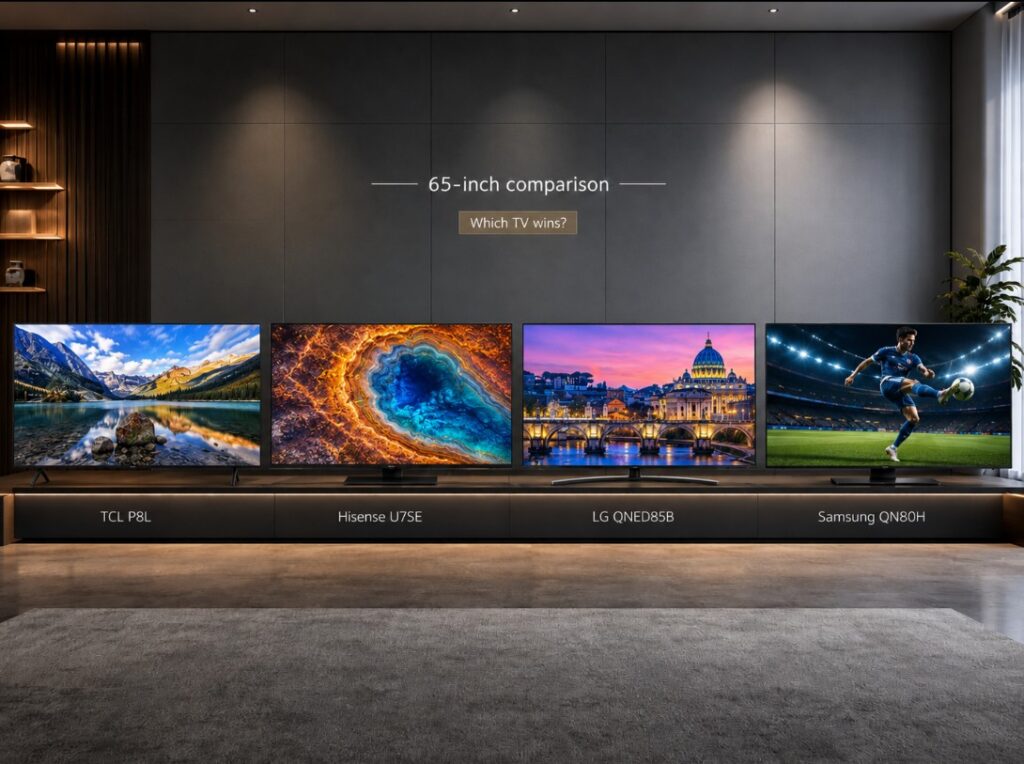

Four Mini LED televisions are fighting for buyers who want strong HDR at 65 inches, and TCL P8L vs Hisense U7SE is the closest value battle of the group. The LG QNED85B adds more advanced processing and a polished webOS experience, while the Samsung QN80H asks considerably more for stronger upscaling, four high-bandwidth HDMI inputs and mature gaming features.
This comparison covers only the 65-inch versions of all four televisions:
- TCL 65P8L;
- Hisense 65U7SE;
- LG 65QNED85B;
- Samsung 65QN80H.
That restriction is important. Panel type, dimming-zone count, audio hardware, brightness and HDMI specifications can change between screen sizes and regional versions.
All prices are shown in US dollars. For European models without a direct US equivalent, prices were converted from current European street prices rather than launch prices.
65-inch comparison at a glance
| 65-inch TV | Current street price found | Maximum peak HDR figure | Backlight and panel | Native refresh | Smart platform |
|---|---|---|---|---|---|
| TCL P8L | Around $675–$745 | Up to around 1,200 nits | QD-Mini LED, HVA panel | 144Hz | Google TV |
| Hisense U7SE | Around $830–$910 | Up to around 1,400 nits | Hi-QLED Mini LED | 144Hz | VIDAA |
| LG QNED85B | Around $1,080–$1,200 | Around 1,000 nits reported | QNED Mini LED | 120Hz, VRR up to 144Hz | webOS 26 |
| Samsung QN80H | Around $1,300–$1,400 | Around 1,150 nits measured | Neo QLED Mini LED Full Array | Up to 144Hz | One UI Tizen |
The headline result is immediately clear: the TCL is considerably cheaper than all three alternatives.
The Hisense U7SE is its closest real rival. LG and Samsung are step-up choices rather than exact price equivalents.
How to read the peak HDR brightness figures
Maximum peak brightness is not the same as normal full-screen brightness.
A television may reach its maximum figure only:
- in a small bright highlight;
- for a limited period;
- in a brighter picture mode;
- with a particular test-window size;
- when local dimming is set aggressively;
- under controlled test conditions.
The figures used here represent the highest credible HDR figures available for the four 65-inch models.
| Model | Maximum HDR figure used | Type of figure |
| TCL 65P8L | Around 1,200 nits | Maximum regional product claim |
| Hisense 65U7SE | Around 1,400 nits | Maximum product claim |
| LG 65QNED85B | Around 1,000 nits | Maximum specification reported for the model |
| Samsung 65QN80H | Around 1,150 nits | Rounded measurement from the 65-inch model |
The Samsung value is the most directly comparable to real testing because it comes from an actual 65-inch unit.
The TCL and Hisense numbers represent maximum claimed capabilities. They do not guarantee that a full movie scene will remain at that level.
LG does not clearly publish one universal brightness number on its main product page. The maximum figure we found for the 65-inch QNED85B is around 1,000 nits.
Current 65-inch prices in dollars
Television pricing changes quickly, so this article uses current new-retail street prices rather than official launch prices. 💵
| Model | Lowest price found | Typical current range used |
| TCL 65P8L | Around $675 | $675–$745 |
| Hisense 65U7SE | Around $830 | $830–$910 |
| LG 65QNED85B | Around $1,080 | $1,080–$1,200 |
| Samsung 65QN80H | Around $1,300 | $1,300–$1,400 |
The price differences are significant:
- Hisense costs approximately $150–$235 more than TCL.
- LG costs approximately $335–$525 more than TCL.
- Samsung costs approximately $555–$725 more than TCL.
Samsung therefore costs almost twice as much as the least expensive TCL offer.
The question is not simply which television is technically best. It is whether the additional processing, connectivity and software polish justify those price gaps.
Processor, RAM and internal storage
Television manufacturers normally promote processor names but rarely disclose RAM and storage as clearly as phone or computer brands.
That makes unsupported memory comparisons risky.
| Model | Picture processor | RAM | Internal storage |
| TCL P8L | TCL AiPQ Processor | 3GB reported for common 65P8L variants | 32GB reported for common variants |
| Hisense U7SE | Hi-View AI Engine | Not officially disclosed | Not officially disclosed |
| LG QNED85B | Alpha 8 AI Processor 4K Gen3 | Not officially disclosed | Not officially disclosed |
| Samsung QN80H | NQ4 AI Gen2 Processor | Not officially disclosed | Not officially disclosed |
TCL’s reported 3GB RAM and 32GB storage give it the clearest hardware advantage for users who install many Google TV apps.
Regional TCL variants can still differ, so buyers should check the complete model code and local product listing before purchase.
For Hisense, LG and Samsung, inserting unverified numbers would create a false sense of precision. Their manufacturers do not provide exact RAM and usable storage figures for these models.
Raw memory is also not the only factor controlling performance. Google TV, VIDAA, webOS and Tizen manage background apps differently.
Which television has the strongest processor?
The practical processing hierarchy is:
- Samsung QN80H
- LG QNED85B
- TCL P8L
- Hisense U7SE
This ranking focuses on upscaling, compression cleanup, motion processing and automatic picture optimisation rather than menu speed alone.
Samsung NQ4 AI Gen2 Processor
Samsung’s NQ4 AI Gen2 uses 20 neural networks to optimise:
- resolution;
- texture;
- brightness;
- contrast;
- depth;
- motion;
- colour;
- dialogue;
- sound placement.
It is the most advanced processor in this comparison.
The measurements we found also show good low-resolution upscaling and strong HDR gradient handling. Samsung is therefore the safest option for:
- lower-bitrate television channels;
- compressed sports streams;
- older DVDs;
- 720p and 1080p content;
- users who want automatic processing without constant adjustment.
The processor does not eliminate every compression artefact. Aggressive cleanup can sometimes smooth fine texture, but Samsung still has the strongest overall processing package here.
LG Alpha 8 AI Processor 4K Gen3
LG’s Alpha 8 Gen3 is the closest challenger.
LG says it provides:
- five times faster neural processing than its previous comparison processor;
- around 10% stronger graphics performance;
- approximately 20% higher memory throughput.
These are LG’s own generational comparisons, not direct benchmarks against TCL, Hisense or Samsung.
The Alpha 8 manages:
- AI Super Upscaling;
- AI Picture Pro;
- Dynamic Tone Mapping Pro;
- AI HDR Remastering;
- scene analysis;
- object and face recognition;
- brightness adjustment;
- AI Sound Pro.
LG should perform especially well with mixed-quality streaming, sports and conventional television broadcasts.
TCL AiPQ Processor
TCL’s AiPQ platform handles:
- 4K upscaling;
- contrast optimisation;
- colour management;
- HDR tone mapping;
- motion processing;
- local dimming control;
- gaming detection.
The P8L is positioned below TCL’s higher C-series models, so its AiPQ implementation should not be treated as equivalent to the processing available on the C8L or flagship TCL televisions.
Even so, it offers enough processing power for:
- 4K streaming;
- Dolby Vision;
- HDR10+;
- 144Hz gaming;
- Google TV applications;
- everyday upscaling.
Its main weakness should appear with very poor broadcast feeds or heavily compressed streaming, where Samsung and LG are more likely to retain a cleaner image.
Hisense Hi-View AI Engine
The Hisense Hi-View AI Engine controls:
- upscaling;
- scene detection;
- HDR enhancement;
- sports optimisation;
- noise reduction;
- motion processing;
- colour adjustment.
VIDAA is a lighter operating system than Google TV, so the U7SE can still feel quick in menus despite its less ambitious processing position.
Its main limitation is not basic speed. It is that Samsung and LG place more emphasis on complex low-quality source cleanup and automatic image reconstruction.
TCL P8L vs Hisense U7SE: the closest value battle
The TCL P8L vs Hisense U7SE comparison is the most important part of this article because these are the two televisions closest in price and hardware.
Both offer:
- Mini LED backlighting;
- quantum-dot colour;
- native 144Hz refresh;
- Dolby Vision;
- HDR10+;
- VRR;
- ALLM;
- FreeSync support;
- an integrated subwoofer;
- advanced gaming menus.
Where TCL P8L is stronger
The TCL costs less and includes an HVA panel.
An HVA panel normally provides stronger native contrast when viewed directly from the centre. That can help with:
- black levels;
- shadow detail;
- dark films;
- black letterbox bars;
- night-time gaming.
TCL also uses Google TV, which generally offers broader app availability and more flexibility for local media players.
The reported 32GB storage is another important advantage for long-term use.
Where Hisense U7SE is stronger
Hisense claims a higher maximum peak brightness:
- TCL: up to around 1,200 nits;
- Hisense: up to around 1,400 nits.
Hisense also includes:
- Dolby Vision IQ;
- HDR10+ Adaptive;
- FreeSync Premium Pro;
- a dedicated 20W subwoofer;
- an ambient-light sensor;
- AI sports processing.
The U7SE may therefore produce more intense highlights and stronger built-in bass.
Its exact panel structure can vary by market or production variant, so buyers should not assume every 65U7SE uses the same LCD panel type.
TCL or Hisense?
Choose TCL for:
- lower price;
- stronger direct-view contrast;
- Google TV;
- more reported storage;
- wider app support;
- dark-room value.
Choose Hisense for:
- higher claimed HDR brightness;
- stronger built-in bass;
- Dolby Vision IQ;
- HDR10+ Adaptive;
- bright-room viewing;
- FreeSync Premium Pro.
At a difference of only $100, the Hisense becomes a serious competitor. At a difference closer to $200 or more, the TCL offers better value.
TCL P8L picture quality
The TCL P8L combines:
- HVA LCD panel;
- QD-Mini LED backlight;
- quantum-dot colour;
- local dimming;
- 144Hz native refresh;
- maximum claimed HDR brightness around 1,200 nits.
This is a strong specification for a television starting below $700.
Contrast and black levels
The HVA panel is one of the P8L’s most important advantages.
Even before local dimming is active, it should produce deeper native blacks than a lower-contrast IPS- or ADS-type LCD panel.
Local dimming can improve:
- black backgrounds;
- bright highlights;
- stars;
- lamps;
- fire;
- reflections;
- night scenes.
The P8L remains an affordable Mini LED model, so blooming will not disappear completely.
Possible weaknesses include:
- halos around white subtitles;
- light spreading around small objects;
- lifted blacks when viewed from the side;
- less precise dimming than TCL C7L or C8L;
- brightness variations around game HUD elements.
HDR performance
A maximum claim of around 1,200 nits gives the P8L enough theoretical headroom for impactful HDR.
Real scenes will normally be lower, especially when large parts of the screen are bright.
The television should still provide:
- brighter sunlight;
- stronger reflections;
- more visible specular highlights;
- improved colour volume;
- clearer separation between SDR and HDR.
The result will depend heavily on local dimming, tone mapping and picture mode.
Colour
Quantum-dot colour should help the P8L maintain richer reds, greens and blues as brightness increases.
That matters for:
- animated films;
- nature documentaries;
- games;
- bright sports uniforms;
- HDR effects;
- colourful streaming content.
TCL’s colour performance is one reason the P8L can compete above its price level.
Hisense U7SE picture quality
The Hisense U7SE uses Hi-QLED Mini LED technology and claims maximum peak HDR brightness of around 1,400 nits.
That gives it the highest headline brightness figure in this comparison.
HDR advantages
The Hisense supports:
- Dolby Vision IQ;
- HDR10+ Adaptive;
- HDR10;
- HLG;
- Filmmaker Mode;
- Dolby Vision Gaming;
- HDR10+ Gaming.
Dolby Vision IQ and HDR10+ Adaptive can use the room-light sensor to adjust HDR presentation.
This is particularly useful in a bright room, where a dark reference HDR presentation can become difficult to see.
Local dimming
The 65-inch model is listed with roughly 260 local dimming zones in common European specifications.
That is not a huge number for a 65-inch Mini LED TV, but it should still provide useful contrast control.
The effectiveness of those zones depends more on the algorithm than the raw number alone.
Hisense may prioritise brightness more aggressively, which can produce:
- stronger highlights;
- brighter subtitles;
- more visible blooming;
- higher average picture brightness.
TCL may produce deeper native blacks when viewed directly in front, depending on the exact Hisense panel variant.
LG QNED85B picture quality
The LG QNED85B costs considerably more than the TCL and Hisense.
Its strongest advantages are:
- Alpha 8 Gen3 processing;
- Mini LED backlighting;
- Dynamic QNED Colour Pro;
- Precision Dimming;
- Dolby Vision;
- Dynamic Tone Mapping Pro;
- AI HDR Remastering.
Maximum HDR brightness
The maximum specification we found places the QNED85B at around 1,000 nits.
That puts it below the headline claims of TCL and Hisense, although direct comparisons remain difficult because test methods can vary.
LG’s strength is expected to come more from:
- tone mapping;
- colour control;
- upscaling;
- processing consistency;
- software integration.
Contrast and panel behaviour
LG does not clearly identify one universal panel type across every regional 65QNED85B variant.
As a result, contrast and viewing-angle behaviour should be checked for the exact local model.
If the local variant uses a wider-angle LCD structure, it may perform better for family seating but produce weaker native blacks than TCL’s HVA panel.
The Mini LED backlight must then work harder to create convincing dark-room contrast.
Is LG worth the price increase?
LG costs approximately $335–$525 more than TCL.
The extra money primarily buys:
- stronger processing;
- four flexible HDMI inputs;
- polished webOS;
- Magic Remote navigation;
- advanced AI features;
- longer-term platform support.
It does not guarantee that HDR will be brighter than TCL or Hisense.
Samsung QN80H picture quality
The Samsung QN80H uses:
- Quantum Mini LED Full Array;
- Neo QLED colour;
- NQ4 AI Gen2 Processor;
- Supreme Mini LED Dimming;
- Motion Xcelerator 144Hz;
- HDR10+ Adaptive;
- HDR10+ Gaming.
Maximum HDR brightness
The 65-inch QN80H reached approximately:
- 1,150 nits in Movie Mode;
- 1,150 nits in Filmmaker Mode.
The values are rounded because small differences between individual readings are not meaningful for normal buyers.
This gives Samsung genuine four-figure peak HDR performance.
It also shows that the Samsung’s maximum measured brightness is broadly comparable to TCL’s 1,200-nit product claim.
HDR presentation
Samsung tends to produce a dynamic and colourful HDR image.
Strengths include:
- bright highlights;
- strong colour volume;
- good gradients;
- effective tone mapping;
- clear bright-room presentation;
- strong processing of mixed-quality content.
Weaknesses can include:
- visible blooming in difficult dark scenes;
- narrow viewing angles;
- local dimming reacting behind rapidly moving objects;
- no Dolby Vision support.
Samsung relies on HDR10+ instead of Dolby Vision.
This is a major consideration for buyers who watch a lot of Dolby Vision content or use Dolby Vision gaming on Xbox.
HDR format comparison
| HDR format | TCL P8L | Hisense U7SE | LG QNED85B | Samsung QN80H |
| Dolby Vision | Yes | Yes | Yes | No |
| Dolby Vision IQ | Varies by region/mode | Yes | Dolby Vision support | No |
| HDR10 | Yes | Yes | Yes | Yes |
| HDR10+ | Yes | Yes | No | Yes |
| HDR10+ Adaptive | Not clearly confirmed | Yes | No | Yes |
| HLG | Yes | Yes | Yes | Yes |
| Filmmaker Mode | Yes | Yes | Yes | Yes |
Hisense has the broadest advertised HDR package.
TCL is the strongest value option because it supports both Dolby Vision and HDR10+.
LG supports Dolby Vision but not HDR10+.
Samsung supports HDR10+ but omits Dolby Vision. 🎬
Gaming comparison
All four TVs support modern gaming, but they differ in HDMI flexibility and HDR format support.
| Gaming feature | TCL P8L | Hisense U7SE | LG QNED85B | Samsung QN80H |
| 4K120 | Yes | Yes | Yes | Yes |
| 4K144 | Yes | Yes | Yes through VRR/PC | Yes |
| VRR | Yes | Yes | Yes | Yes |
| ALLM | Yes | Yes | Yes | Yes |
| FreeSync | Premium | Premium Pro | Premium | Premium Pro |
| Dolby Vision Gaming | Yes on supported paths | Yes | Yes, up to 4K120 | No |
| HDR10+ Gaming | Yes/market dependent | Yes | No | Yes |
| Four gaming-capable HDMI inputs | No | No | Yes | Yes |
| Gaming interface | Game Master | Game Bar | Game Optimiser | Game Bar/Gaming Hub |
TCL P8L for gaming
TCL offers the strongest gaming value.
It supports:
- native 144Hz;
- 4K120 consoles;
- 4K144 PC gaming;
- VRR;
- ALLM;
- FreeSync Premium;
- Game Master;
- Game Bar;
- reduced-resolution Game Accelerator modes.
The main limitation is HDMI planning. Not every port necessarily offers the same bandwidth.
Hisense U7SE for gaming
Hisense has the most complete advertised HDR gaming package.
It combines:
- 144Hz;
- FreeSync Premium Pro;
- Dolby Vision Gaming;
- HDR10+ Gaming;
- VRR;
- ALLM;
- Game Mode Pro.
The Hisense is especially attractive for Xbox and PC gaming.
LG QNED85B for gaming
LG is the easiest model for users with several devices.
Its HDMI layout supports combinations such as:
- PS5;
- Xbox Series X;
- gaming PC;
- eARC soundbar.
LG also supports Dolby Vision gaming at 4K120, HGiG, VRR, ALLM and FreeSync Premium.
Samsung QN80H for gaming
Samsung provides:
- four HDMI 2.1 inputs;
- 4K144;
- VRR;
- FreeSync Premium Pro;
- ALLM;
- low input lag;
- Gaming Hub;
- Game Bar;
- PC gaming modes.
The measurements we found indicate extremely low gaming latency.
Its biggest omission remains Dolby Vision Gaming.
Gaming winners
- Best gaming value: TCL P8L
- Best HDR gaming formats: Hisense U7SE
- Best multi-device connectivity: LG QNED85B
- Best PC flexibility and processing: Samsung QN80H 🎮
Smart-platform comparison
TCL P8L: Google TV
Google TV provides:
- broad app availability;
- Google Cast;
- Google Assistant;
- strong Android integration;
- multiple local media players;
- wide streaming-service support.
The reported 32GB storage is especially valuable on Google TV because apps, system updates and cached data can consume space over time.
Hisense U7SE: VIDAA
VIDAA is fast, simple and relatively lightweight.
Its main disadvantage is regional app support. Buyers should verify that all local streaming services are available before purchase.
The interface may feel faster than Google TV during simple navigation, but it offers less flexibility for specialist applications.
LG QNED85B: webOS 26
webOS offers:
- Magic Remote control;
- Google Cast;
- AirPlay;
- LG ThinQ;
- personalised profiles;
- AI features;
- smart-home integration;
- Game Optimiser.
It is one of the most polished TV operating systems, although the exact RAM and storage allocation is not publicly disclosed.
Samsung QN80H: One UI Tizen
Samsung combines:
- SmartThings;
- Google Cast;
- AirPlay;
- Gaming Hub;
- Samsung TV Plus;
- AI recommendations;
- smart-home controls;
- long-term software support.
Tizen is powerful but can feel more promotional than Google TV or VIDAA.
Built-in audio
| Model | Built-in audio |
| TCL P8L | ONKYO 2.1 system, approximately 40W |
| Hisense U7SE | 2 × 10W speakers plus 20W subwoofer |
| LG QNED85B | 20W, 2.0-channel |
| Samsung QN80H | Approximately 30W with object-tracking processing |
Hisense and TCL provide the strongest physical audio systems.
Hisense U7SE
The dedicated 20W subwoofer should give Hisense the deepest bass.
It is the best choice for buyers who do not plan to purchase a soundbar immediately.
TCL P8L
TCL’s ONKYO 2.1 system is also stronger than the basic audio included with most televisions in this class.
It should provide better weight and dialogue than LG’s 20W system.
Samsung QN80H
Samsung relies more heavily on processing, dialogue enhancement and object-tracking effects.
It should create better sound placement than TCL or Hisense but will not necessarily produce deeper bass.
LG QNED85B
LG has the weakest physical audio specification.
AI Sound Pro can create a broader virtual presentation, but a soundbar will still be beneficial.
Built-in audio winner: Hisense U7SE. 🔊
Which 65-inch TV should you buy?
Buy the TCL P8L when:
- you want the lowest price;
- you prefer Google TV;
- strong native contrast matters;
- Dolby Vision and HDR10+ both matter;
- you want 144Hz gaming;
- you need more app storage;
- you do not want to add a soundbar immediately.
Buy the Hisense U7SE when:
- you want the highest claimed peak brightness;
- it costs no more than about $100–$150 above TCL;
- built-in bass matters;
- you want Dolby Vision IQ;
- you want HDR10+ Adaptive;
- FreeSync Premium Pro is important;
- VIDAA includes all your required apps.
Buy the LG QNED85B when:
- processing matters more than maximum brightness;
- you prefer webOS;
- you like the Magic Remote;
- you need four gaming-capable HDMI inputs;
- you connect multiple consoles and a soundbar;
- Dolby Vision gaming matters;
- you accept paying considerably more.
Buy the Samsung QN80H when:
- you want the strongest upscaling;
- you watch compressed broadcasts or sports;
- you need four HDMI 2.1 inputs;
- SmartThings and Gaming Hub are important;
- you do not need Dolby Vision;
- its price falls closer to the LG.
Category winners
| Category | Winner |
| Lowest price | TCL P8L |
| Best value | TCL P8L |
| Maximum claimed HDR brightness | Hisense U7SE |
| Strongest measured processing | Samsung QN80H |
| Best app flexibility | TCL P8L |
| Best smart-TV polish | LG QNED85B |
| Best built-in audio | Hisense U7SE |
| Best multi-device gaming setup | LG QNED85B |
| Best HDR format support | Hisense U7SE |
| Best dark-room value | TCL P8L |
The winner
Overall winner: TCL P8L
The TCL P8L wins this 65-inch comparison because it delivers the strongest balance of price, display technology, gaming features, smart-platform flexibility and built-in sound.
At approximately $675–$745, it provides:
- QD-Mini LED;
- HVA contrast;
- up to around 1,200 nits claimed peak HDR brightness;
- native 144Hz refresh;
- Dolby Vision;
- HDR10+;
- VRR and ALLM;
- FreeSync Premium;
- Google TV;
- reported 3GB RAM;
- reported 32GB storage;
- ONKYO 2.1 audio.
The Hisense U7SE is the closest competitor and wins on maximum claimed brightness, HDR format breadth and bass performance. It becomes the better purchase when its price is very close to TCL and VIDAA has every app you need.
LG offers the best combination of processor quality, webOS and HDMI flexibility, but its price is around $400 higher than the TCL without delivering higher maximum HDR brightness.
Samsung has the strongest processor and the most complete measured gaming performance, but it costs roughly twice as much as the cheapest TCL offer and still lacks Dolby Vision.
For most buyers seeking a 65-inch Mini LED television below $1,000, the TCL P8L is the most complete package and the strongest value. 🏆