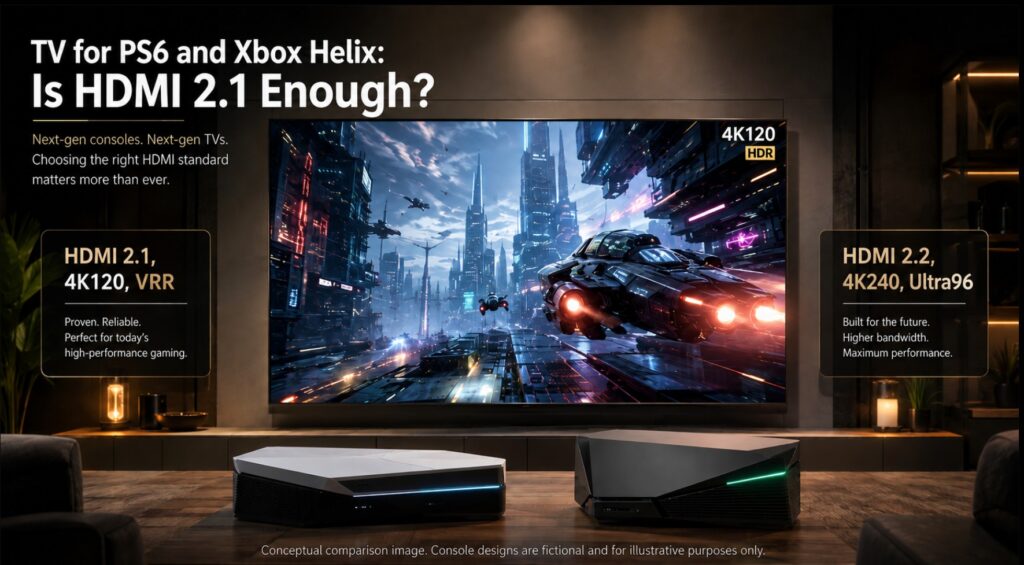

Buying a premium gaming television now is harder than it looks because current models already offer refresh rates far beyond today’s consoles. A TV for PS6 and Xbox Helix must handle PS5, PS5 Pro and Xbox Series X properly, while leaving enough headroom for hardware that Sony and Microsoft have not fully revealed.
The practical answer is less dramatic than the arrival of a new HDMI standard may suggest. A well-designed HDMI 2.1 TV is still a sensible purchase if it has a native 120Hz panel, reliable 4K120 input, VRR, ALLM, low input lag and strong HDR. These are the features that matter for PS5, PS5 Pro and Xbox Series X today, and neither Sony nor Microsoft has confirmed that PS6 or Project Helix will require anything beyond them.
As of August 2026, no consumer TV has launched with HDMI 2.2. The earliest realistic window for the first HDMI 2.2 TVs and monitors is 2027, although manufacturers have not yet confirmed specific models, prices or retail dates. HDMI 2.2 could eventually become useful for 4K240, higher-bandwidth color formats and improved audio-video synchronization, but for now it represents future headroom rather than a reason to avoid current HDMI 2.1 OLED and Mini LED TVs
What we know about PS6 and Project Helix
Sony has confirmed investment in the next generation of the PlayStation platform, but it has not published a PS6 specification sheet. The name, HDMI version, launch date and final display modes remain unofficial.
Microsoft has revealed more. Project Helix is its next-generation Xbox console, built around a custom AMD system-on-chip. Microsoft says it is being designed for the next generation of DirectX and FSR, will play Xbox console and PC games, and delivers an order-of-magnitude leap in ray-tracing capability. Alpha hardware is planned for developers in 2027.
That information is important, but it still does not confirm 4K240 or HDMI 2.2. ⚠️
Current consoles compared with the latest PS6 and Helix rumors
Current console specifications are official. The PS6 configuration and most detailed Helix component figures are still leaks, so they may change before production.
| Specification | PS5 | PS5 Pro | Xbox Series X | PS6 latest rumor | Project Helix latest information |
|---|---|---|---|---|---|
| CPU | Custom 8-core Zen 2 CPU with 16 threads, variable frequency up to 3.5GHz | Custom 8-core Zen 2 CPU with 16 threads. It retains the PS5 CPU architecture and can use a High CPU Frequency Mode of approximately 3.85GHz | Custom 8-core Zen 2 CPU at 3.8GHz or 3.6GHz with SMT | Reportedly 7 active Zen 6c gaming cores, from an 8-core block with one core disabled, plus 2 low-power Zen 6 cores for operating-system tasks | Custom AMD SoC officially confirmed; current rumors suggest up to 3 full Zen 6 performance cores plus 8 Zen 6c cores |
| GPU | Custom RDNA 2 GPU, 36 Compute Units at up to 2.23GHz and 10.3 TFLOPS | AMD RDNA-based GPU rated at 16.7 TFLOPS, with 67% more Compute Units and up to 45% faster rendering than PS5 | Custom RDNA 2 GPU, 52 Compute Units at 1.825GHz and 12 TFLOPS | Reportedly RDNA 5 with 54 physical Compute Units, 52 active CUs and an estimated clock of approximately 2.6 to 3.0GHz | Next-generation custom AMD graphics officially confirmed; rumors suggest 68 RDNA 5 Compute Units running at approximately 2.5GHz or higher |
| Ray tracing | First-generation console hardware ray tracing based on RDNA 2 | Sony says ray casting can run at double, and sometimes triple, the speed of the base PS5 in supported games | Hardware-accelerated DirectX Raytracing based on RDNA 2 | Rumored to deliver approximately 6 to 12 times the base PS5 ray-tracing performance in selected workloads | Microsoft officially promises an order-of-magnitude leap in ray-tracing performance and capability, but exact game performance remains unknown |
| Reconstruction | Game-specific temporal reconstruction and upscaling | PSSR machine-learning reconstruction, including the upgraded PSSR version developed through Sony and AMD’s Project Amethyst work | Game-specific temporal upscaling, with FSR available when implemented by developers | Expected to use a more advanced successor to PSSR based on Sony and AMD neural-rendering technology | Next-generation FSR, neural rendering and intelligence integrated into the graphics and compute pipeline are officially confirmed |
| Memory | 16GB GDDR6 with 448GB/s bandwidth | 16GB GDDR6 with approximately 576GB/s bandwidth, plus 2GB DDR5 dedicated to the operating system and background processes | 16GB GDDR6 on a 320-bit bus, split into 10GB at 560GB/s and 6GB at 336GB/s | Rumored 30GB or 40GB GDDR7 on a 160-bit bus, with approximately 640GB/s bandwidth | Rumored 36GB or 48GB GDDR7 on a 192-bit bus; final bandwidth has not been confirmed |
| Storage | Original model: 825GB custom SSD with 5.5GB/s raw bandwidth | 2TB custom SSD | 1TB custom NVMe SSD with 2.4GB/s raw and 4.8GB/s compressed throughput | A new custom NVMe SSD is expected, but capacity and speed remain unknown | A high-speed NVMe SSD is expected, but capacity and performance have not been announced |
| Display target | Up to 4K120 in compatible games, with VRR support | Up to 4K120 in compatible games, with VRR, PSSR and 8K output support | Up to 4K120, with VRR, ALLM and FreeSync support | 4K120 is the most realistic baseline; 4K240 may be possible as an output format but remains unconfirmed | Native 4K120 has been discussed as a likely target; higher-refresh output and 4K240 remain unconfirmed |
| HDMI | HDMI 2.1 with support for 4K120, VRR and 8K output on compatible displays | HDMI 2.1 with support for 4K120, VRR and 8K output on compatible displays | HDMI 2.1 with support for 4K120, VRR and ALLM | HDMI 2.2 is expected by some reports, but Sony has not confirmed the connection standard | HDMI 2.2 is considered likely for the launch period, but Microsoft has not included it in the official Project Helix information |
The current PS6 rumors point to a more traditional console-focused design, built around a single efficient APU and a tightly controlled hardware and software environment. Project Helix appears to follow a broader console and PC strategy, which may explain reports of a larger GPU, a wider memory bus and a combination of full Zen 6 and compact Zen 6c CPU cores. That could give Microsoft more raw performance and flexibility, especially for PC games, but it would not guarantee better results in every title. Sony can optimize games around one fixed PlayStation platform, while Microsoft must support a wider range of Xbox and PC workloads.
TFLOPS also become less useful across GPU generations. A future RDNA 5 Compute Unit may perform more work than an RDNA 2 unit, while neural reconstruction can improve the final image without increasing the native rendering resolution.
Why more power does not automatically require HDMI 2.2
The console builds the frame. HDMI carries the finished signal.
PS5 Pro is the clearest current example. Sony increased rendering performance, ray tracing and reconstruction, but the console still works inside the familiar 4K60 and 4K120 display environment. A game may render below 4K, use PSSR to rebuild detail, then output a 4K signal.
PS6 and Helix will probably rely even more on reconstruction. Better textures, denser worlds and stronger ray tracing can arrive without moving beyond 4K120. 🎮
What HDMI 2.2 adds
HDMI 2.1 supports 4K120, VRR, ALLM and eARC, with certified Ultra High Speed cables rated up to 48Gbps.
HDMI 2.2 raises the maximum cable bandwidth to 96Gbps and introduces the Ultra96 cable. It can carry formats such as uncompressed 4K240 with full chroma and high bit depth. It also adds Latency Indication Protocol for better timing across sources, TVs, receivers and soundbars.
| Feature | HDMI 2.1 generation | HDMI 2.2 generation |
|---|---|---|
| Maximum cable bandwidth | 48Gbps | 96Gbps |
| Main gaming format | 4K120 with HDR and VRR | More room for 4K240 |
| Audio return | eARC | eARC retained |
| Timing | Existing synchronization methods | Latency Indication Protocol |
| Cable | Ultra High Speed HDMI | Ultra96 HDMI |
Ultra96 can also identify 64Gbps and 80Gbps products, so the label does not guarantee a 96Gbps port. The HDMI 2.2 Ultra96 cable guide covers certification and cable claims. 🔌
Would 4K240 matter on a console?
A 240Hz output does not mean every game runs at native 4K and 240fps. Large worlds, advanced physics and heavy ray tracing will remain expensive.
The first uses could be menus, esports titles, older games, lightweight releases or reconstructed output with frame generation. Project Helix may also use higher refresh rates for PC games. Cinematic titles are more likely to prioritize stable 4K60, better ray tracing or 120fps performance modes.
This is why 4K120 with VRR remains the safest TV for PS6 and Xbox Helix requirement until final specifications appear.
How the newest TVs would handle PS6 and Xbox Helix
The latest premium TVs already exceed current console output, but none below is confirmed as a full-bandwidth HDMI 2.2 model.
| TV | Confirmed display and gaming specification | Expected future-console behavior |
|---|---|---|
| LG C6 | OLED, 120Hz native, VRR up to 165Hz, G-SYNC, FreeSync Premium and Dolby Vision gaming up to 4K120 | Excellent for 4K120; limited to its 165Hz display ceiling |
| Samsung S95H | OLED, up to 4K165 on all four HDMI inputs, VRR and FreeSync Premium Pro | Strong multi-device option; no Dolby Vision |
| TCL C8L | SQD-Mini LED, native 144Hz, full 4K144 path and separate 288Hz accelerator | Strong at 4K120 or 144; 288Hz is not full-quality 4K288 |
| Hisense U8Q | Mini LED, 4K165, VRR, HDR10+ Gaming and Dolby Vision IQ | Strong bright-room option; check local HDMI details |
| Sony BRAVIA 9 II | True RGB LED, native 120Hz, 4K120 and VRR on HDMI 3 and 4 | Covers current console modes but caps higher output at 120Hz |
A TV for PS6 and Xbox Helix does not need the highest refresh figure. Sony stops at 120Hz, yet its HDR control, processing and motion can matter more in 60fps games than a 165Hz badge.
The LG C6, G6 and W6 overview and Samsung S95H and S99H review notes cover model and regional differences.
LG C5 and its rivals remain sensible choices
Discounted 2025 models can provide nearly everything a future console is likely to need.
| Current value model | Confirmed gaming specification | Main limitation |
|---|---|---|
| LG C5 | OLED, 120Hz native, VRR up to 144Hz, four 48Gbps HDMI 2.1 ports, Dolby Vision gaming up to 4K120 | No hypothetical 4K240 display mode |
| Samsung S90F | OLED, 4K144 on all four HDMI inputs, VRR and FreeSync Premium Pro | No Dolby Vision; panel details vary by size and region |
| Sony BRAVIA 8 II | QD-OLED, native 120Hz, two full-bandwidth HDMI 2.1 inputs, one shared with eARC | Two high-bandwidth inputs and no mode above 120Hz |
| TCL C8K | QD-Mini LED, native 144Hz, 4K144 signal path and 288Hz accelerator | Port layout and brightness claims vary by region and size |
| Hisense U7Q Pro | Mini LED, 4K165 and VRR | Check the local HDMI layout, HDR formats and VIDAA app availability |
The LG C5 is easy to recommend for several devices because all four HDMI ports support 48Gbps features. Samsung offers similar four-port flexibility at 144Hz. Sony has fewer gaming inputs but adds PlayStation-focused Auto HDR Tone Mapping and Auto Genre Picture Mode.
TCL and Hisense can deliver brighter Mini LED HDR for the money, but regional differences need closer checking. The TV Comparison Tool helps compare the exact size and market version. 📺
Practical setup notes
Before replacing a good TV:
- Connect the console directly to a gaming-capable HDMI input.
- Enable the TV’s Enhanced or 4K120 input mode.
- Use the supplied cable or a certified Ultra High Speed HDMI cable.
- Enable 120Hz and VRR in the console settings.
- Confirm the received signal in the TV’s Game Bar.
- Add the soundbar or receiver only after the direct connection works.
- Use eARC if the audio device cannot pass the full video signal.
The PS5 Pro TV settings guide provides a practical baseline. If the TV falls back to 60Hz, see why 4K120 drops to 60Hz.
Should you buy now or wait?
Buy now if you need a TV and can get a strong HDMI 2.1 model with stable 4K120, VRR, good HDR and enough high-bandwidth ports. Keep an existing 4K120 TV unless official PS6 or Helix specifications reveal a feature you genuinely need.
Waiting makes more sense if you also use a powerful PC, specifically want 4K240, or replace televisions only once every eight to ten years.
For most players, the best TV for PS6 and Xbox Helix is not automatically a future HDMI 2.2 model. It is a balanced TV that already works properly with PS5 Pro and Xbox Series X.
Is HDMI 2.1 enough for a TV for PS6 and Xbox Helix?
For most buyers, yes. HDMI 2.1 should remain enough for normal use because 4K120, VRR and strong HDR are likely to stay central to console gaming. HDMI 2.2 may unlock extreme refresh modes and more bandwidth, but those are not confirmed requirements.
Choose a TV for PS6 and Xbox Helix based on the gaming experience you can verify today. Treat 4K240 and HDMI 2.2 as future headroom, not as reasons to dismiss every current OLED or Mini LED TV.