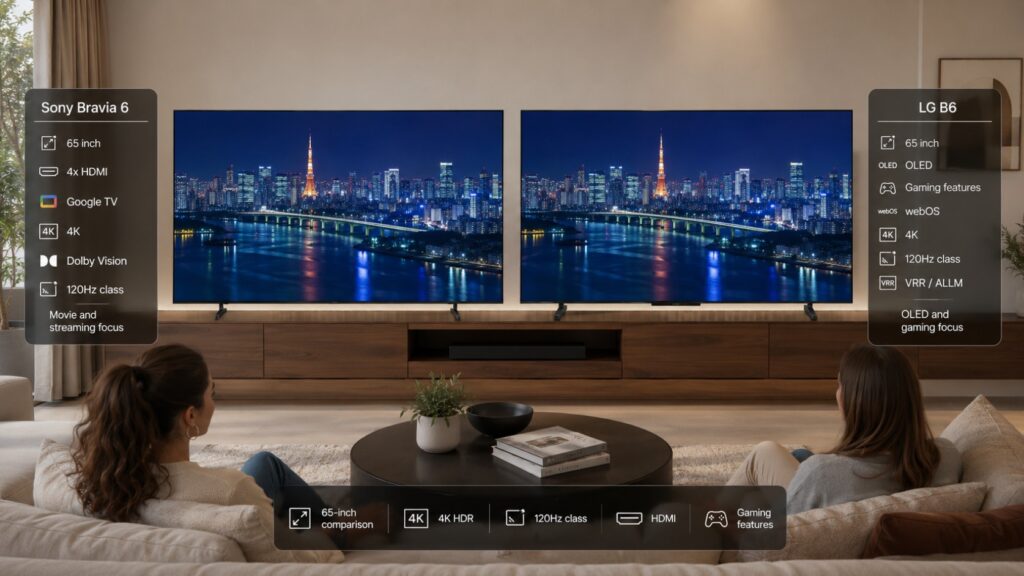

Sony has changed something important with its new affordable OLED. Instead of restricting serious gaming connectivity to two inputs, it has finally moved to four HDMI 2.1 ports. That makes Sony Bravia 6 vs LG B6 a much closer technical comparison than previous Sony versus LG entry-OLED battles.
Both TVs use 4K OLED panels with a native 120Hz refresh rate. Both support 4K120, VRR, ALLM and Dolby Vision. But the similarities stop being simple once you look underneath.
The LG B6 uses the new OLED SE panel, a cost-optimized WOLED design that pushes LG’s entry OLED much closer to premium HDR performance. Sony has not confirmed the exact panel generation inside Bravia 6, although the evidence points strongly toward WOLED and possibly the same OLED SE class.
Sony has another surprise: Bravia 6 does not list an XR Processor.
Instead, the hardware strongly points toward a different SoC strategy that may also explain those four HDMI 2.1 ports.
Sony Bravia 6 vs LG B6 specifications
| Specification | Sony Bravia 6 | LG B6 |
|---|---|---|
| Display technology | OLED | OLED SE |
| Panel architecture | WOLED strongly indicated | WOLED |
| Subpixel architecture | Expected WRGB if OLED SE, not confirmed | WRGB |
| Exact OLED generation | OLED SE likely, not confirmed | OLED SE |
| Resolution | 3840 x 2160 | 3840 x 2160 |
| Native refresh rate | 120Hz | 120Hz |
| Pixel-level dimming | Yes | Yes |
| 10% HDR brightness | Not established yet | Approximately 800 nits |
| HDMI ports | 4 HDMI 2.1 | 4 HDMI 2.1 |
| 4K120 | Yes | Yes |
| VRR | Yes, HDMI 1-4 | Yes, up to 120Hz |
| ALLM | Yes, HDMI 1-4 | Yes |
| NVIDIA G-SYNC | Not listed | Yes |
| AMD FreeSync Premium | Not listed | Yes |
| HGiG | Not listed | Yes |
| QMS | Not listed | Yes |
| QFT | Not listed | Yes |
| Dolby Vision | Yes | Yes |
| HDR10 | Yes | Yes |
| HLG | Yes | Yes |
| HDR10+ | No | No |
| Picture processor | No XR Processor listed | Alpha 8 AI Processor 4K Gen3 |
| Likely underlying SoC | MediaTek Pentonic 800, unconfirmed | LG platform |
| Smart platform | Google TV | webOS 26 |
| Wi-Fi | Wi-Fi 6 / 6E depending on region | Wi-Fi 5 on checked EU model |
| Bluetooth | 5.2 | 5.3 |
| USB | 2 | 1 |
| Speaker output | 20W | 20W |
| Speaker configuration | 2 full-range + 2 tweeters | 2.0-channel down-firing |
| Dolby Atmos | Yes | Yes |
| DTS:X | Yes | Not listed |
| Sizes | 48, 55, 65, 77, 83 inches | 48, 55, 65, 77, 83 inches |
The headline specification is not the OLED panel. It is Sony’s connectivity.
Check Current 65-Inch Prices
These two OLEDs can move quite far apart in price, so check the current listings before deciding whether the Sony premium makes sense.
TVComparePro may earn a commission from qualifying purchases through these links.
Sony’s 2026 entry OLED with four HDMI 2.1 ports, Google TV and DTS support.
Check price on Amazon →OLED SE model with four HDMI 2.1 ports and a broader PC gaming feature set.
Check price on Amazon →Bravia 6 has four HDMI 2.1 ports, and Sony explicitly confirms 4K120, VRR and ALLM. Its detailed specification page goes further and lists VRR and ALLM on HDMI 1, 2, 3 and 4.
That is a major change for Sony.
LG B6 uses OLED SE, but OLED SE is still WOLED
OLED SE can sound like a completely new OLED technology. It is not.
The LG B6 uses OLED SE, which is a new cost-optimized panel built on LG Display’s established WOLED architecture.
Think of it like this:
| Term | What it means |
|---|---|
| OLED | Self-emissive display technology |
| WOLED | LG Display OLED architecture using a white OLED light source and color filtering |
| WRGB | Red, green, blue and additional white subpixel structure |
| OLED SE | New cost-optimized WOLED panel generation |
| QD-OLED | Different OLED architecture using quantum dots |
| Tandem OLED | More advanced multi-stack OLED architecture used higher in the market |
OLED SE therefore does not replace WOLED. It is a type of WOLED panel.
The design still uses self-emissive pixels, pixel-level light control and the WRGB structure associated with LG Display’s television OLED panels.
The important change is how OLED SE is built to lower cost while extracting more useful light.
A traditional polarizer is removed from the panel construction and replaced by a different reflective-film approach. Removing that layer allows more of the generated light to reach the viewer and also reduces manufacturing cost.
The trade-off is reflection handling.
Without the same conventional polarizer arrangement, OLED SE can be more reflective in a bright room. That means the B6’s higher brightness does not automatically make it the better daytime TV.
In a darker room, however, OLED SE still gives you the reason people buy OLED in the first place: individual pixels that can switch off completely.
What panel does Sony Bravia 6 actually use?
Sony is much less specific.
Current hardware information points strongly toward WOLED, and OLED SE is a very credible candidate given Bravia 6’s market position, sizes and launch timing.
But there is an important distinction between “likely” and “confirmed.”
| Panel detail | Sony Bravia 6 |
|---|---|
| OLED | Confirmed |
| WOLED | Strongly indicated |
| OLED SE | Likely, not officially confirmed |
| QD-OLED | No current indication |
| Primary RGB Tandem OLED | No |
| 120Hz | Confirmed |
| Exact subpixel structure | Not officially disclosed |
| Exact panel supplier | Not officially disclosed |
If Bravia 6 is eventually confirmed as OLED SE, this comparison becomes even more interesting.
Sony and LG would effectively be starting from the same panel class but building two very different televisions around it.
LG would pair OLED SE with its own Alpha 8 Gen3 processing and a very complete gaming stack.
Sony would pair it with Google TV, Sony picture tuning and what appears increasingly likely to be a MediaTek-based hardware platform.
We found the LG B6 at approximately 800 nits in HDR
After checking the available 10% HDR measurements, we found the LG B6 landing at approximately 800 nits on a 10% HDR window.
That is the useful figure to take from the available data rather than treating one particular picture mode or panel sample as universal.
| HDR characteristic | LG B6 | Sony Bravia 6 |
|---|---|---|
| 10% HDR brightness | Approximately 800 nits | Not established |
| Perfect OLED black | Yes | Yes |
| Pixel-level contrast | Yes | Yes |
| Dolby Vision | Yes | Yes |
| HDR10 | Yes | Yes |
| HLG | Yes | Yes |
| HDR10+ | No | No |
| Dynamic tone mapping | Dynamic Tone Mapping Pro | Sony implementation |
| Ambient brightness adjustment | Yes | Yes |
Approximately 800 nits is a good result for a TV positioned at the bottom of LG’s OLED range.
It means small HDR highlights such as reflections, lamps, headlights, sparks and specular effects can have meaningful impact against an OLED-black background.
It does not turn the B6 into a G6-class OLED or a very bright Mini LED TV.
OLED SE still has to manage heat and power when a large percentage of the panel becomes bright, so the visual advantage is strongest in mixed scenes with smaller highlights.
Sony is the unknown here.
If Bravia 6 uses OLED SE, similar raw panel potential would make sense, but Sony can drive the panel differently. Tone mapping, power management, calibration and panel control can all change the final result.
Until Bravia 6 has enough reliable measurement data, I would leave its brightness field blank rather than guess.
No XR Processor on Bravia 6 is a bigger deal than it sounds
Sony’s detailed Bravia 6 specification contains one unusually interesting line:
Processor: No
Obviously, there is a processor inside the television.
A Google TV cannot decode AV1 video, run streaming apps, process HDMI signals, operate VRR and generate an image without a system-on-chip.
What Sony appears to be saying is that Bravia 6 does not use one of the branded XR processors promoted on its more expensive TVs.
That separates it clearly from models such as Bravia 8 II.
| Processing | Sony Bravia 6 | LG B6 |
|---|---|---|
| XR Processor | No listed XR processor | N/A |
| Main branded processor | None listed | Alpha 8 AI Processor 4K Gen3 |
| Color processing | Triluminos Pro | Alpha 8 processing |
| Dynamic contrast | Dynamic Contrast Enhancer | Dynamic Tone Mapping Pro |
| AI HDR remastering | Not listed | Yes |
| AI upscaling | Exact implementation not detailed | Alpha 8 AI Super Upscaling 4K |
| Light sensor | Yes | Yes |
| Filmmaker Mode | Not listed on checked Sony specification | Yes |
This prevents one common buying mistake.
Buying Bravia 6 does not automatically mean you are buying Bravia 8 II picture processing with a cheaper panel.
The hardware strategy is different.
Pentonic 800 could explain Sony’s four HDMI 2.1 ports
MediaTek Pentonic 800 is currently the most convincing candidate for Bravia 6’s main SoC.
Sony has not confirmed that chip, so it should not appear in a specification table as a confirmed component.
Technically, however, the match is difficult to ignore.
Pentonic 800 supports:
- 4K display output up to 165Hz
- 4K120 MEMC
- VRR
- AV1 decoding
- VVC decoding
- Dolby Vision
- DTS:X
- modern Wi-Fi platforms
- AI picture-processing functions
- HDMI FRL
- up to four high-speed video/audio input interfaces
Now compare that hardware profile with Bravia 6.
Sony has moved from the familiar two-port gaming limitation to four HDMI 2.1 inputs, plus 4K120, VRR on all four, ALLM on all four, AV1, DTS:X and Wi-Fi 6/6E depending on region.
That makes Pentonic 800 a very logical explanation.
There is an important limitation, though.
A Pentonic 800 chipset being capable of 48Gbps HDMI FRL would not automatically prove that every Bravia 6 port is operating at the chipset’s maximum 48Gbps bandwidth.
Sony confirms the features we actually need for this comparison: four HDMI 2.1 ports, 4K120, VRR and ALLM.
That is enough to make Bravia 6 dramatically better connected than many previous Sony OLEDs without inventing bandwidth numbers.
Gaming is where Bravia 6 becomes unexpectedly competitive
This may be the biggest reason Bravia 6 deserves attention.
🎮 Sony no longer forces you to choose which two devices deserve the best HDMI inputs.
| Gaming feature | Sony Bravia 6 | LG B6 |
|---|---|---|
| Native refresh | 120Hz | 120Hz |
| Maximum 4K input | 4K120 | 4K120 |
| HDMI 2.1 ports | 4 | 4 |
| VRR | HDMI 1-4 | Yes, up to 120Hz |
| ALLM | HDMI 1-4 | Yes |
| Dolby Vision Game mode | Yes | Yes |
| Dolby Vision gaming 4K120 | Not explicitly confirmed as one combined mode | Yes |
| G-SYNC | Not listed | Yes |
| FreeSync Premium | Not listed | Yes |
| HGiG | Not listed | Yes |
| QMS | Not listed | Yes |
| QFT | Not listed | Yes |
| Game interface | Sony gaming menu | Game Optimizer / Game Dashboard |
| PS5 / PS5 Pro | Excellent 4K120 fit | Excellent 4K120 fit |
| Xbox Series X | Excellent 4K120 fit | Excellent 4K120 fit |
| Gaming PC | Good | Better feature support |
For PS5 and PS5 Pro, the Sony’s 120Hz ceiling is not a meaningful disadvantage. Current PlayStation hardware outputs up to 120Hz.
The same basic argument applies to Xbox Series X.
LG becomes the stronger option once a gaming PC enters the equation. G-SYNC compatibility, FreeSync Premium, HGiG, QFT and the mature Game Optimizer give the B6 a broader gaming toolset.
But Sony has finally removed the most irritating hardware limitation.
If you connect a soundbar through eARC, you can still have three remaining HDMI inputs available for consoles and other sources.
For anyone thinking beyond current consoles, our TV for PS6 and Xbox Helix guide looks at whether 4K120 and HDMI 2.1 are still enough as next-generation hardware approaches.
Sony still has an audio advantage
Neither TV has enough built-in amplification to replace a good sound system, but Sony has the more interesting format support.
🔊
| Audio | Sony Bravia 6 | LG B6 |
|---|---|---|
| Total output | 20W | 20W |
| Speaker layout | 2 full-range + 2 tweeters | 2.0-channel |
| Dolby Atmos | Yes | Yes |
| DTS Digital Surround | Yes | Not listed |
| DTS-HD Master Audio | Yes | Not listed |
| DTS-HD High Resolution | Yes | Not listed |
| DTS:X | Yes | Not listed |
| eARC | Yes | Yes |
| LG AI Sound | N/A | Alpha 8 AI Sound Pro |
Sony’s broader DTS support matters if you use Blu-ray discs, local video files, media servers or a home-theater system with DTS content.
LG’s published codec list for the B6 focuses on Dolby and other common audio formats but does not list DTS.
If an eARC system later develops timing problems, the Sony Bravia audio sync guide covers the HDMI and audio-path checks that matter before changing hardware.
Google TV vs webOS 26 is mostly personal preference
Sony runs Google TV.
LG runs webOS 26.
Both have the major streaming apps and both have become increasingly AI-focused, but they feel very different.
| Smart feature | Sony Bravia 6 | LG B6 |
|---|---|---|
| OS | Google TV | webOS 26 |
| App ecosystem | Google Play | LG Content Store |
| Google Cast | Yes | Yes |
| AirPlay | Region dependent | Yes |
| Voice features | Google / Gemini ecosystem | LG AI features |
| Gaming hub | Google TV apps + Game menu | LG Gaming Portal |
| Game settings | Sony gaming UI | Game Optimizer |
| Remote approach | Conventional Sony remote | AI Magic Remote |
Google TV remains my preference for app flexibility.
LG has the cleaner gaming integration. Game Optimizer places VRR, HGiG and gaming information in one interface without requiring you to dig through several picture menus.
Neither choice should decide the TV on its own.
Practical setup notes before comparing either OLED
Do not judge these TVs from their store presets.
Start with a movie-oriented mode for normal viewing. On the B6, Filmmaker Mode is a useful neutral baseline. For Dolby Vision, use the mode that best fits your room rather than assuming the brightest preset is automatically the most accurate.
For gaming, use Game Mode and confirm the input signal instead of simply enabling every feature.
On LG:
- Verify 4K120.
- Enable VRR.
- Check Game Optimizer.
- Use HGiG when appropriate for the game and console HDR setup.
- Confirm G-SYNC or FreeSync only when the source actually supports it.
On Sony:
- Connect the console to any of the four HDMI 2.1 inputs.
- Confirm 4K120.
- Enable VRR where required.
- Check that Game picture mode is active.
- Do not copy Bravia 8 II settings assuming the processors are identical.
📺 Before the return window closes, test dark-gray uniformity, HDMI 2.1 operation, VRR, eARC, HDR playback and several hours of normal content. Our new TV inspection guide covers the checks worth doing without abusing the panel with extreme test patterns.
Which OLED makes more sense?
LG B6 is currently the easier TV to understand.
You know exactly what the panel strategy is: OLED SE based on WOLED architecture.
You get approximately 800 nits on a 10% HDR window, 120Hz, four HDMI 2.1 ports, 4K120, VRR, G-SYNC, FreeSync Premium, HGiG, QMS, QFT and Dolby Vision gaming at 4K120.
The processor is also clearly identified: Alpha 8 AI Processor 4K Gen3.
For a PC gamer, I would choose the LG B6.
For a console player, the decision is much closer.
Sony Bravia 6 now has four HDMI 2.1 ports with 4K120, VRR and ALLM. That removes the biggest connectivity disadvantage Sony has carried for years.
Google TV, Wi-Fi 6/6E and DTS:X also make Bravia 6 unusually flexible.
The mystery is picture processing.
There is no XR Processor listed, and the likely Pentonic 800 SoC points to a very different Sony architecture. That does not automatically make it worse. It simply means Bravia 6 has to be judged as its own television rather than as a cheaper Bravia 8 II.
The other mystery is the panel.
If Sony confirms OLED SE, Bravia 6 and B6 become an unusually clean experiment: similar OLED panel technology, but Sony and LG controlling everything around it differently.
That could make Sony’s tuning the deciding factor.
Until we have enough Bravia 6 picture data to establish its HDR brightness, EOTF behavior, near-black handling and motion performance, LG B6 remains the safer technical purchase.
But Sony has made one thing clear already: Bravia 6 is not a weak gaming OLED simply because it is the cheaper Sony.
And if Bravia 6 pricing falls close to B6, the choice could become much harder than expected.
If B6 pricing starts creeping toward C6 territory instead, check the LG C6 size and panel guide before buying. The panel hierarchy changes significantly depending on the C6 size.
Price: LG B6 has a major advantage at current prices
Price changes this comparison more than almost any specification.
Sony is launching the Bravia 6 at full introductory pricing, while LG has already discounted several B6 sizes in the US. At 65 and 77 inches in particular, the difference is large enough that Sony needs more than Google TV or DTS support to justify the premium.
| Size | Sony Bravia 6 | LG B6 | Current difference |
|---|---|---|---|
| 48-inch | $1,299.99 | $999.99 | LG $300 cheaper |
| 55-inch | $1,499.99 | B6 standard pricing varies by availability | See B6E note below |
| 65-inch | $1,999.99 | $1,399.99 | LG $600 cheaper |
| 77-inch | $2,999.99 | $2,499.99 | LG $500 cheaper |
| 83-inch | $3,999.99 | $3,499.99 | LG $500 cheaper |
The 65-inch models make the value difference especially clear.
At the time of writing, the 65-inch Sony Bravia 6 costs $1,999.99, while the 65-inch LG B6 is listed at $1,399.99.
That is a $600 premium for the Sony.
The Bravia 6 does give you Google TV, wider DTS support, newer Wi-Fi hardware and Sony’s own picture tuning, but both TVs already provide 120Hz OLED panels, four HDMI 2.1 inputs, 4K120, VRR, ALLM and Dolby Vision.
LG also gives the B6 its full PC gaming package with G-SYNC, FreeSync Premium and HGiG.
At a $600 difference, Sony’s real-world processing, motion handling, upscaling and near-black performance would need to be noticeably better to make that premium easy to justify.
The 77-inch comparison is closer, but LG still wins on price
Sony asks $2,999.99 for the 77-inch Bravia 6.
The standard 77-inch LG B6 is currently listed at $2,499.99, leaving a $500 difference.
That is less extreme than the 65-inch gap, but $500 is still enough to pay for a capable soundbar, a console or simply move part of the budget elsewhere.
The 83-inch models show a similar pattern, with the Bravia 6 at $3,999.99 and the B6 at $3,499.99.
So at the current prices, LG maintains roughly a $500 advantage in the largest directly comparable sizes.
What about the cheaper LG B6E?
LG also sells B6E variants in some markets.
The B6E keeps the same core 120Hz OLED platform, Alpha 8 AI Processor Gen3 and major gaming features, but there can be smaller hardware and package differences. For example, some B6E versions ship with a standard remote instead of LG’s AI Magic Remote and can have fewer USB connections.
Current US B6E pricing makes the value equation even more aggressive:
| LG B6E size | Current price |
|---|---|
| 55-inch | $1,299.99 |
| 65-inch | $1,599.99 |
| 77-inch | $1,999.99 |
The B6E should therefore be treated as a separate lower-cost variant rather than silently mixed into the main B6 price table.
If the exact B6E available in your region has the features you need, it can be an even stronger value option. But for the technical comparison in this article, we are comparing Bravia 6 primarily with the standard LG B6.
How much extra is the Sony worth?
The answer depends heavily on the final street price.
| Sony premium over LG B6 | How I would view it |
|---|---|
| Under $150 | Very competitive |
| $150 to $300 | Reasonable if you prefer Sony, Google TV and DTS |
| $300 to $500 | LG becomes much easier to recommend |
| Over $500 | Sony needs clearly better real-world picture performance |
A small Sony premium would be easy to understand.
Bravia 6 has an unusually strong connectivity package for a Sony OLED, four HDMI 2.1 inputs, Google TV and excellent format support. If its picture processing eventually proves noticeably stronger than the B6, paying a little extra could make sense.
At $500 to $600 more, however, the argument becomes much harder.
The LG B6 already provides OLED SE, approximately 800 nits in our 10% HDR reference, 4K120, VRR and a more complete PC gaming feature set.
For now, LG B6 has the clear price-to-hardware advantage. Sony Bravia 6 becomes much more interesting if its street price falls after launch, or if its real-world picture performance turns out to be significantly better than the specification sheet suggests.
Current US manufacturer pricing checked August 30, 2026. Prices, promotions and regional B6/B6E availability can change.