
Buying a larger version of the same TV usually means paying for more screen area. With Samsung’s 2026 OLED range, it can mean buying different display hardware as well.
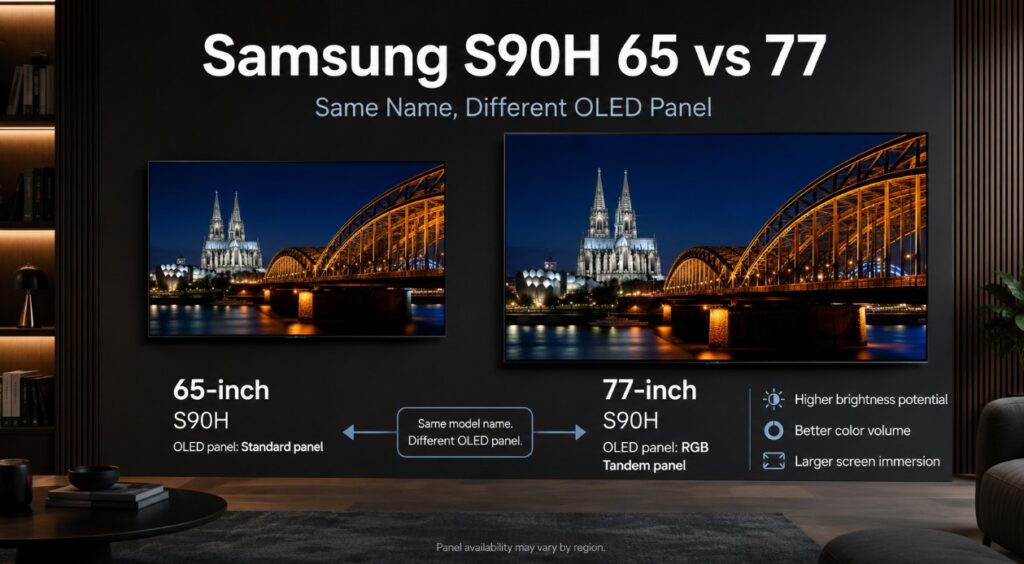
That is what makes Samsung S90H 65 vs 77 unusually important. In North America, the 65-inch model uses a conventional OLED-EX WOLED panel, while the 77-inch version moves to a newer Primary RGB Tandem WOLED panel. Both still carry the S90H name, the same processor, the same 165Hz gaming package and almost identical advertised features.
The panel change is not cosmetic. It affects color volume, bright HDR colors and overall picture performance.
And outside North America, the situation becomes even more complicated.
Samsung S90H 65 vs 77 specifications
| Specification | Samsung S90H 65″ | Samsung S90H 77″ |
|---|---|---|
| North American panel | OLED-EX WOLED | Primary RGB Tandem WOLED |
| OLED architecture | WOLED | Tandem WOLED |
| White subpixel | Yes | Yes |
| Pixel-level dimming | Yes | Yes |
| Resolution | 3840 x 2160 | 3840 x 2160 |
| Maximum gaming refresh | 4K165 | 4K165 |
| Processor | NQ4 AI Gen3 | NQ4 AI Gen3 |
| HDMI 2.1 | 4 | 4 |
| 4K165 HDMI | All 4 ports | All 4 ports |
| HDMI VRR | Yes | Yes |
| FreeSync Premium Pro | Yes | Yes |
| G-SYNC | Yes | Yes |
| HGiG | Yes | Yes |
| ALLM | Yes | Yes |
| HDR10 | Yes | Yes |
| HDR10+ | Yes | Yes |
| HDR10+ Advanced | Yes, region dependent | Yes, region dependent |
| Dolby Vision | No | No |
| Glare Free | Yes | Yes |
| Tizen | Yes | Yes |
| Wi-Fi | Wi-Fi 6E | Wi-Fi 6E |
| Bluetooth | 5.3 | 5.3 |
| Audio | 40W, 2.1-channel | 40W, 2.1-channel |
| Dolby Atmos | Yes | Yes |
Samsung itself presents the two sizes almost identically. Both use the NQ4 AI Gen3 Processor, Motion Xcelerator 165Hz, OLED HDR+, Glare Free, four HDMI inputs capable of 4K165, Wi-Fi 6E and the same 40W 2.1-channel audio system.
The important difference is hidden underneath those specifications.
The 65-inch S90H uses OLED-EX WOLED
The North American 65-inch S90H uses an LG Display OLED-EX class WOLED panel.
That means it uses the familiar WOLED architecture with an additional white subpixel helping produce high luminance.
This is not an old or weak OLED panel. The current 65-inch S90H is dramatically brighter than entry-level OLED models and is much closer to premium OLED territory than the term “standard WOLED” might suggest.
Our review-data cross-check puts its 10% HDR baseline at approximately 1,500 nits.
📺 That is already very strong OLED performance.
The weakness of the traditional WOLED structure becomes more visible when the TV needs to produce extremely bright saturated colors. The white subpixel contributes luminance, but as its contribution increases, highly saturated reds, greens and other colors can lose some purity.
That is where the 77-inch model changes the equation.
Check Current S90H Prices
These two sizes share the same S90H name, but the 77-inch North American model uses more advanced panel hardware. Check the current price gap before deciding.
TVComparePro may earn a commission from qualifying purchases through these links.
OLED-EX WOLED in North America, with the same 165Hz gaming and four HDMI 2.1 ports.
Check price on Amazon →Primary RGB Tandem WOLED in North America, with stronger HDR color volume.
Check price on Amazon →The 77-inch S90H gets Primary RGB Tandem OLED in North America
The 77-inch S90H is not simply a stretched 65-inch S90H.
Its North American version uses Primary RGB Tandem OLED, a more advanced LG Display WOLED architecture.
The name can be confusing.
Primary RGB Tandem does not mean that this Samsung has suddenly become QD-OLED, and it does not mean the panel has abandoned the white subpixel.
It is still part of the WOLED family.
What changes is the structure of the light-emitting stack and its ability to produce brighter, better separated colors.
| Panel detail | 65″ S90H | 77″ S90H |
|---|---|---|
| Architecture | OLED-EX WOLED | Primary RGB Tandem WOLED |
| Tandem structure | No premium tandem implementation | Yes |
| White subpixel | Yes | Yes |
| Color separation | Very good | Better |
| High-luminance color purity | More limited | Better |
| HDR color volume | Good | Significantly higher |
| Dark-room black | Perfect OLED black | Perfect OLED black |
| Viewing angle | Very wide | Very wide |
The difference is most noticeable in HDR material containing both high brightness and strong color saturation.
Think bright red neon signs, orange fire, intense green lighting, saturated game effects or colorful animation.
The 65-inch model can make these elements bright.
The 77-inch model can keep more of their color while making them bright.
The color-volume difference is larger than the spec sheet suggests
The normal DCI-P3 gamut is already excellent on both models.
The more interesting difference appears when we look at the larger BT.2020 container and measure how much color the panel can maintain across different luminance levels.
Current North American measurements put them around:
| Color-volume measurement | 65″ S90H | 77″ S90H |
|---|---|---|
| DCI-P3 volumetric coverage | ~98% | ~100% |
| BT.2020 volumetric coverage | ~71% | ~81% |
| Difference in BT.2020 volume | Baseline | About 10 percentage points higher |
That is a meaningful jump.
It does not mean every Netflix movie will suddenly look dramatically different on the 77-inch model. Most ordinary content does not push the panel to its color-volume limits.
But when HDR content combines very high brightness with deeply saturated colors, the 77-inch panel has more room to reproduce them without washing them toward white.
This is why describing both televisions simply as “Samsung S90H OLED” hides an important hardware distinction.
Peak white brightness is only part of the story
An interesting result of this comparison is that peak white brightness alone does not fully explain why the 77-inch model is better.
The 65-inch S90H already reaches approximately 1,500 nits in our 10% HDR reference, so it is hardly a dim OLED.
The RGB Tandem model’s biggest advantage is not necessarily that every white highlight becomes massively brighter.
It is what happens to color at high luminance.
A white headlight can look impressive on both televisions.
A saturated red, blue or green highlight gives the more advanced panel a better opportunity to show why it exists.
This is one reason color volume is becoming increasingly important as OLED peak brightness climbs.
Europe makes the S90H panel situation even stranger
⚠️ Do not assume the North American panel table applies worldwide.
Samsung continues to mix OLED suppliers and panel types in the S90H family depending on region, size and model code.
For example, independently identified European units show a configuration where the 65-inch HAE version uses WOLED, while a 77-inch HAT version uses QD-OLED rather than the North American Primary RGB Tandem WOLED.
That means a buyer can encounter three different panel stories under the S90H family:
| S90H panel type | Where it can appear |
|---|---|
| Standard / OLED-EX WOLED | Several sizes and markets |
| Primary RGB Tandem WOLED | 48″ and 77″ North American models identified so far |
| QD-OLED | Selected sizes and regions, including identified European 77″ variants |
This is not a reason to avoid the S90H.
It is a reason to check the full model code before buying one.
Samsung has done something similar across several OLED generations, and regional naming is also why our Samsung S95H vs S99H guide focuses heavily on exact model codes rather than the name printed at the top of the product page.
A European 77-inch S90H can therefore behave differently
The European QD-OLED version has its own strengths.
QD-OLED avoids the traditional white-subpixel approach used by WOLED and can maintain extremely saturated colors at high brightness.
A tested 77-inch QD-OLED S90H variant has reached roughly 1,650 nits in synthetic peak HDR conditions, with many demanding real HDR highlights landing around 1,300 to 1,500 nits.
It also approaches complete DCI-P3 coverage and roughly the high-80% range of BT.2020 coverage.
That should not be copied onto the North American RGB Tandem version. They are different panels.
The practical lesson is much more important:
S90H review numbers are not automatically universal.
If a review does not tell you the screen size, market and complete model suffix, its measurements may not describe the TV you are about to buy.
Gaming performance is almost identical
Samsung did not reserve its best gaming connectivity for the more expensive 77-inch model.
🎮 Both sizes are exceptionally well equipped.
| Gaming | 65″ S90H | 77″ S90H |
|---|---|---|
| 4K120 | Yes | Yes |
| 4K144 | Yes | Yes |
| 4K165 | Yes | Yes |
| HDMI 2.1 ports | 4 | 4 |
| FreeSync Premium Pro | Yes | Yes |
| G-SYNC | Yes | Yes |
| HDMI Forum VRR | Yes | Yes |
| ALLM | Yes | Yes |
| HGiG | Yes | Yes |
| Game Bar | Yes | Yes |
| Game Motion Plus | Yes | Yes |
| PS5 / PS5 Pro | Excellent | Excellent |
| Xbox Series X | Excellent | Excellent |
| High-end PC | Excellent | Excellent |
Samsung officially lists 4K165 on HDMI 1, 2, 3 and 4, so you are not forced to choose which device receives the premium input.
Input lag is also extremely low. Current S90H measurements sit around 10ms at 4k 60Hz and roughly 5-6ms at 120Hz, with latency dropping further at very high PC refresh rates.
For gaming alone, I would not buy the 77-inch just because you expect lower latency.
The reason to choose it is the panel and size.
HDR10+ Advanced matters more in 2026
Both models support HDR10, HDR10+ Adaptive, HDR10+ Gaming and HDR10+ Advanced in supported regions.
Samsung still does not support Dolby Vision.
That limitation matters less than it once did if you use Prime Video heavily because HDR10+ Advanced has now begun reaching real streaming content.
Our HDR10+ Advanced vs Dolby Vision 2 comparison goes deeper into the new tone-mapping, brightness and motion features rather than treating the two formats as simple logos.
For S90H buyers, the key point is that panel quality still matters more than the badge.
A superior OLED panel with strong HDR10 processing can have a much larger effect on picture quality than choosing a weaker TV simply because it supports another HDR format.
Glare Free behaves slightly differently depending on panel technology
Samsung uses its matte Glare Free treatment across the S90H line.
It is extremely effective at breaking up direct reflections from lamps and windows, making the S90H particularly interesting for a bright living room.
But panel technology still matters underneath the coating.
Standard WOLED includes a conventional polarizer that generally keeps black levels more stable under strong ambient light.
QD-OLED can show a raised purple or reddish-black appearance when a lot of room light hits the panel.
Primary RGB Tandem WOLED avoids that exact QD-OLED behavior while still delivering much better color volume than standard WOLED.
This gives the North American 77-inch configuration an unusually attractive balance for mixed lighting.
The processor and audio are the same
There is no processor advantage for the 77-inch model.
Both use Samsung’s NQ4 AI Gen3 Processor, including:
- 4K AI Upscaling Pro
- AI Motion Enhancer Pro
- Color Booster Pro
- HDR Brightness Optimizer
- Auto HDR Remastering Pro
- Real Depth Enhancer
Audio is also effectively identical at 40W and 2.1 channels, with Dolby Atmos, OTS Lite, Q-Symphony and Adaptive Sound Pro.
So if someone tells you the 77-inch is the “premium S90H” because it gets better processing, that is not the reason.
The panel is the upgrade.
Price: the 77-inch panel upgrade costs $1,000
Samsung’s current US pricing makes the decision easy to quantify.
| Size | US Samsung price | Difference |
|---|---|---|
| 65-inch S90H | $2,699.99 | Baseline |
| 77-inch S90H | $3,699.99 | +$1,000 |
The extra $1,000 buys substantially more screen area, but in North America it also buys the more advanced RGB Tandem panel.
That makes this different from paying purely for size.
If both televisions used identical hardware, the value calculation would mainly be about viewing distance and room dimensions.
Here, the 77-inch is also technically the stronger display.
Practical setup notes before judging either S90H
Before changing advanced settings, verify the complete model code on the box and rear label. This matters more on the S90H than on most TVs.
Start HDR movies in Filmmaker Mode with HDR Tone Mapping set conservatively if accuracy is the priority. Samsung’s Active tone-mapping setting can make some material appear brighter, but it changes the intended luminance mapping.
For gaming, enable Game Mode and confirm the actual refresh rate through Game Bar. A PC should be able to reach 4K165, while PS5, PS5 Pro and Xbox Series X remain focused on up to 120Hz output.
Do not copy white-balance calibration values from another S90H. Manufacturing variation exists even between two televisions using the same size and panel.
And before the retailer return window closes, use our new TV inspection guide to check panel uniformity, HDMI inputs, HDR playback, VRR and eARC under your normal viewing conditions. ✅
The 77-inch is not just a bigger S90H
For a North American buyer, the 65-inch S90H is already an extremely capable OLED.
Its OLED-EX WOLED panel produces approximately 1,500-nit-class small HDR highlights, perfect black, excellent reflection control and one of the strongest gaming packages in its class.
There is no reason to consider the 65-inch a compromised model.
The 77-inch is simply more advanced.
Primary RGB Tandem OLED gives it noticeably stronger color volume and better high-brightness color reproduction without sacrificing the four HDMI 2.1 ports, 165Hz gaming or Samsung processing that make the smaller version attractive.
If you can comfortably fit 77 inches and the additional $1,000 is within budget, I would choose the North American 77-inch S90H over the 65-inch.
Not merely because it is bigger.
Because this time Samsung actually gives the larger model better panel hardware.
European buyers have an extra step: identify whether the exact 77-inch television is WOLED, RGB Tandem WOLED or QD-OLED before using any review as a buying reference.
And if you are considering LG instead, our LG C6 sizes guide is especially relevant because LG also splits its 2026 C-series into different panel tiers depending on size.