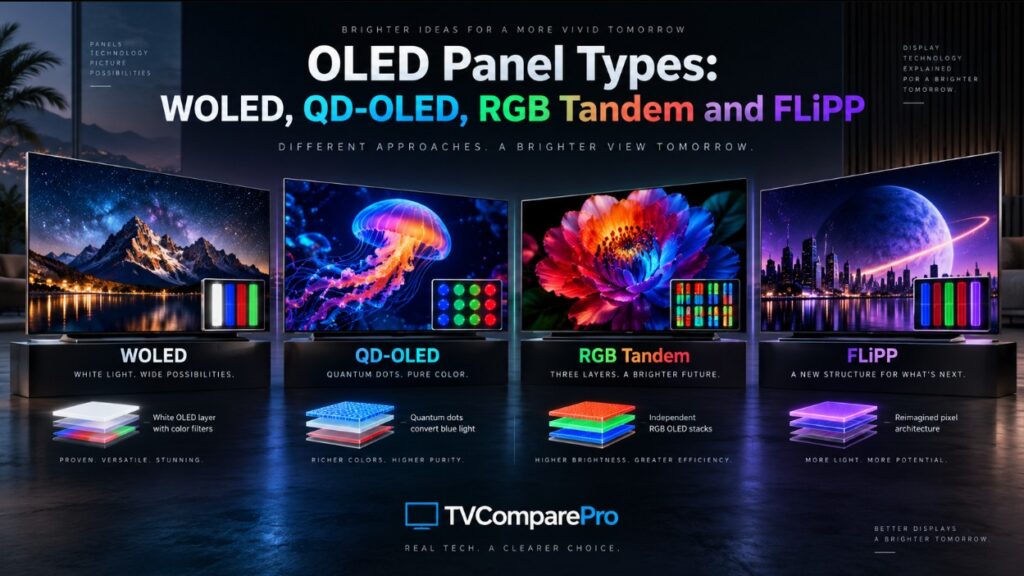

OLED used to be the easy part of buying a premium TV. You chose the size, compared processing and gaming features, and assumed the panel underneath was broadly the same kind of display.
That is no longer true. Modern OLED panel types include conventional WOLED, OLED SE, QD-OLED and Primary RGB Tandem, with real differences in HDR color, reflections, efficiency and cost. Even two sizes carrying the same TV name can use different hardware.
LG Display has shown a new two-stack WOLED design aimed at reducing cost, while FLiPP introduces a completely different manufacturing route that could eventually make large direct-RGB OLED easier to produce.
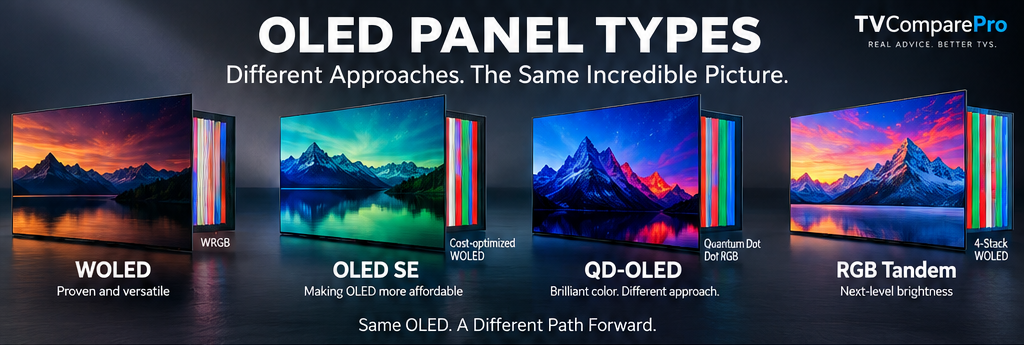
OLED is no longer one panel technology
Every OLED TV shares one defining advantage: its pixels create their own light. There is no LED backlight and no local dimming grid sitting behind the picture. A black pixel can simply switch off.
The important difference is what happens when that pixel lights up again.
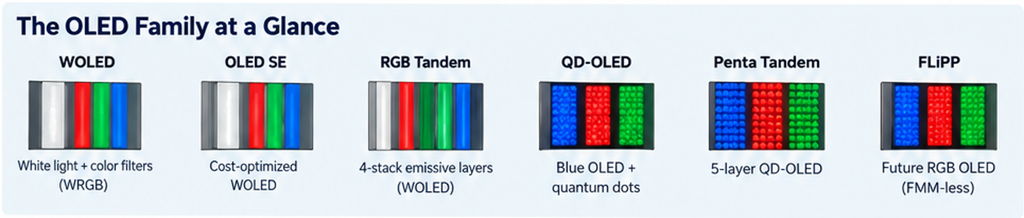
| Technology | Family | How it creates color | Position |
|---|---|---|---|
| Conventional WOLED | WOLED | Broad OLED light plus color filters and a white subpixel | Mainstream |
| OLED-EX | WOLED | More efficient WOLED materials and panel management | Mainstream / premium |
| OLED SE | WOLED | Cost-optimized WOLED with a simplified optical stack | Affordable |
| Primary RGB Tandem 2.0 | WOLED | Four-stack emissive architecture | Flagship |
| QD-OLED | QD-OLED | Blue OLED light plus quantum-dot conversion | Premium |
| QD-OLED Penta Tandem | QD-OLED | Five-layer organic emitting structure | Premium / flagship |
| New 2-stack WOLED | WOLED | Simplified two-stack emitting structure | Future lower-cost OLED |
| FLiPP RGB OLED | Future direct-RGB path | RGB OLED pixels patterned without a Fine Metal Mask | Future |
🔍 The first distinction clears up much of the confusion: OLED-EX, OLED SE and Primary RGB Tandem are not alternatives to WOLED. They are different generations or tiers inside the WOLED family.
WOLED is what made large OLED TVs practical
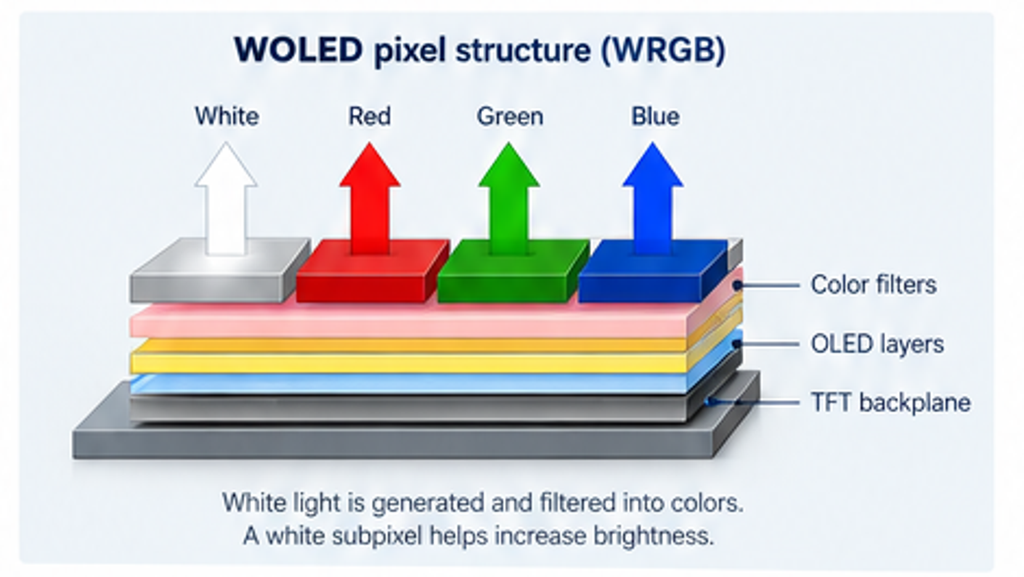
LG Display’s WOLED architecture solved a major large-panel manufacturing problem. Instead of depositing separate red, green and blue emitters for every final subpixel, WOLED produces broad-spectrum light and uses color filters to create red, green and blue.
TV implementations also use a white subpixel that can contribute extra luminance. That helps WOLED produce very bright white highlights, but it also explains why peak white brightness and bright-color performance are not the same thing.
A white reflection can receive a strong boost from the white subpixel. A saturated red object cannot use that extra white light the same way without losing saturation. This is why color volume matters more as OLED TVs get brighter.
OLED-EX improved WOLED rather than replacing it
OLED-EX was an efficiency step inside the same WOLED family. Material improvements, including wider use of deuterium-based compounds, created more brightness headroom without changing the basic architecture. WOLED is the family, OLED-EX is an evolution within it, and Primary RGB Tandem is the newer premium branch.
OLED SE is trying to solve OLED’s price problem
At the opposite end of the market, OLED SE is not designed to win a flagship brightness contest. Its job is to make genuine OLED cheaper.
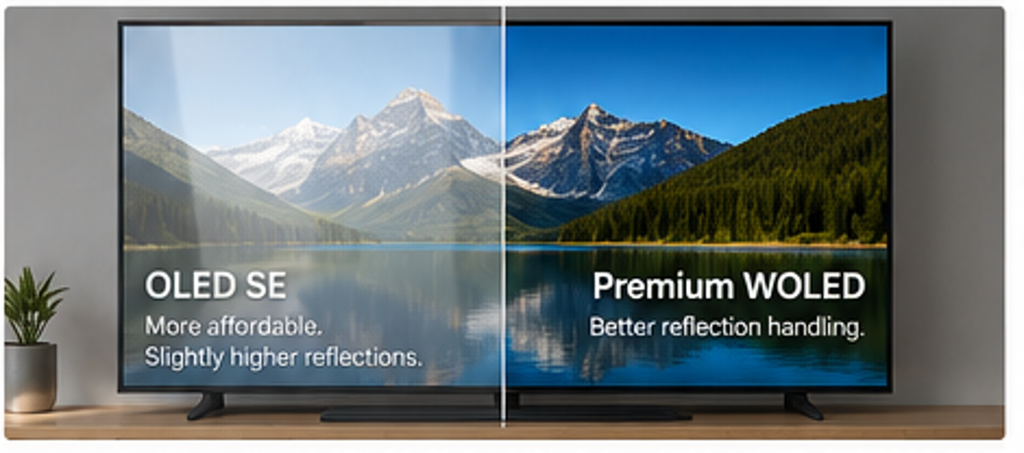
The panel keeps pixel-level dimming and 120Hz capability but uses a cheaper optical construction. One important change is the removal of the traditional polarizer arrangement used by higher-end WOLED panels.
A polarizer helps suppress reflected room light, but it also absorbs some light generated by the display. Removing it allows more OLED light to reach the viewer. The trade-off is that reflections become more noticeable.
| OLED SE characteristic | Practical effect |
|---|---|
| Lower manufacturing cost | OLED can compete at lower TV price points |
| Up to 1,000-nit panel positioning | Entry OLED no longer has to mean very low HDR brightness |
| 120Hz support | Proper modern console and PC gaming capability |
| About 95% DCI-P3 panel specification | Slightly lower color coverage than premium OLED panels |
| About 4.4% reflectance | Bright-room reflections matter more |
The LG B6 is a useful real-world example. Current measurements place it broadly in the 700 to 800-nit HDR class. That is strong for an entry OLED, although the cheaper optical stack becomes easier to notice in a bright room.
Our Sony Bravia 6 vs LG B6 comparison looks more closely at how this affordable OLED class changes the buying decision.
Primary RGB Tandem changed what WOLED could do
For several generations, QD-OLED had a clear advantage over conventional WOLED: bright saturated color without relying on a white brightness subpixel. Primary RGB Tandem is LG Display’s answer, but the RGB name describes the light-producing stack deeper inside the panel. Current Tandem WOLED TVs are still WOLED, not direct-RGB OLED displays.
The 2026 Primary RGB Tandem 2.0 generation uses a four-stack architecture and is specified by LG Display for up to 4,500 nits at a 3% APL condition, 99.5% DCI-P3 coverage and reflectance as low as 0.3%.
⚠️ That 4,500-nit figure is a panel-level capability under a very small test condition. It should not be treated as a normal calibrated 10% HDR result from a finished television. Power limits, cooling, tone mapping, processing and protection algorithms still determine what the TV actually delivers.
For a finished-TV example, our LG G5 vs G6 upgrade analysis focuses on what the newer panel generation changes in real use.
QD-OLED takes the opposite approach to color
Samsung Display’s QD-OLED starts with blue OLED light. Quantum dots convert part of that blue energy into red and green, producing the final RGB output without a dedicated white brightness subpixel.
🎨 This is why QD-OLED is especially convincing with bright saturated HDR color. Red neon signs, orange fire, green lasers and colorful game effects can stay vivid at high luminance without adding a separate white component to chase brightness.
| Characteristic | Premium WOLED | QD-OLED |
|---|---|---|
| Light source | Broad-spectrum OLED light | Blue OLED |
| Color creation | Color filters | Quantum-dot conversion |
| White subpixel | Yes | No |
| Dark-room black | Perfect | Perfect |
| Bright saturated color | Very strong on newer Tandem panels | Excellent |
| Ambient black stability | Very strong | Can lift under strong room light |
QD-OLED’s main optical trade-off appears in strong ambient light. Dark areas can look slightly gray, purple or reddish even though the OLED pixels still switch completely off. In a dark room the effect matters much less.
Penta Tandem gives QD-OLED five emitting layers
Samsung Display’s QD-OLED Penta Tandem moves to a five-layer organic emitting structure. Samsung specifies roughly 1.3x higher luminous efficiency, up to 2x longer lifespan, and TV panel peak brightness of up to 4,500 nits at 3% OPR. The efficiency gain gives manufacturers more room to balance brightness, power and panel stress.
The strangest OLED development of 2026 uses fewer layers
One of LG Display’s most interesting 2026 concepts goes in the opposite direction from the premium stack race. The new two-stack WOLED architecture targets lower-cost future displays and reportedly improves BT.2020 coverage to about 82.5%, versus roughly 76.5% for the referenced three-stack design.
No consumer TV uses it yet, and finished-product HDR data is still unavailable. The important point is lower production cost and better efficiency without an obvious picture-quality sacrifice.
FLiPP could matter more than another brightness record
On August 19, LG Display unveiled FLiPP, short for FMM-Less innovative Pixel Patterning.
FLiPP is not another WOLED tier and not another Tandem stack. It changes how RGB OLED pixels can be manufactured.
Traditional direct-RGB OLED production commonly relies on a Fine Metal Mask used during organic material deposition. Large masks can sag and become harder to align. FLiPP removes that mask and instead uses photolithography and precision UV processing to pattern RGB OLED material.
| FLiPP metric | LG Display’s stated improvement |
|---|---|
| Aperture ratio | About 55% higher |
| Brightness under identical comparison conditions | 1.6x |
| Panel lifespan | 2.4x |
| Power consumption | 13% lower |
| Potential display size range | About 1 to 100 inches |
🔮 For television buyers, the exciting part is not that FLiPP has already beaten WOLED. It has not reached a retail TV.
The important part is that it gives LG Display a possible route toward large direct-RGB OLED without the Fine Metal Mask bottleneck. LG Display plans to begin with IT products before expanding to other categories. There is no confirmed FLiPP TV or TV launch year.
The same TV name can already hide different OLED hardware
You do not need to wait for FLiPP to see why exact panel identification matters.
The Samsung S90H is a current example. In North America, the 65-inch model uses conventional OLED-EX WOLED while the 77-inch model uses Primary RGB Tandem WOLED. Identified European 77-inch HAT variants use QD-OLED instead.
| Samsung S90H example | Panel |
|---|---|
| 65-inch North America | OLED-EX WOLED |
| 77-inch North America | Primary RGB Tandem WOLED |
| Identified European 77-inch HAT variants | QD-OLED |
Our Samsung S90H 65 vs 77 comparison exists because that difference is large enough to change the buying decision.
LG also uses different panel tiers depending on size. We cover the C-series split separately in our LG C6 size guide.
Which OLED panel type should you actually buy?
| Your priority | Panel type worth considering first |
|---|---|
| Lowest OLED price | OLED SE |
| Dark-room movies and HDR | Premium WOLED or QD-OLED |
| Maximum bright-color impact | QD-OLED |
| Bright living room | Primary RGB Tandem WOLED |
| Premium all-round picture | Primary RGB Tandem WOLED or premium QD-OLED |
| Future affordable OLED | Two-stack WOLED is worth watching |
| Future large direct-RGB OLED | FLiPP is the technology to watch |
The panel is only the foundation. HDMI 2.1, VRR, HDR support, tone mapping, motion and near-black processing can still make a less exotic panel the better finished TV.
Practical setup notes before comparing OLED technologies
Store demo modes are not fair comparisons. Use the same source, similar picture modes and similar room lighting. Compare white HDR highlights, saturated colors, near-black detail, large bright scenes and reflections separately.
Most importantly, check the exact screen size and regional model code. A 65-inch review no longer automatically describes every 77-inch version carrying the same product name.
OLED’s next battle may be cost, not peak nits
The premium race is impressive. Four-stack WOLED and five-layer QD-OLED panels now reach specification ceilings that would have sounded unrealistic only a few generations ago.
But the most important OLED developments of 2026 may eventually be the ones aimed at making the technology cheaper. OLED SE already attacks manufacturing cost. The new two-stack WOLED concept tries to simplify the panel without giving up color performance. FLiPP goes further by asking whether large RGB OLED can be patterned without the Fine Metal Mask bottleneck at all.

Today’s OLED TVs are not about to become obsolete. The bigger change is that the familiar OLED badge now hides several increasingly different technologies. At the top end, manufacturers are adding layers to push brightness and efficiency. At the affordable end, engineers are experimenting with fewer layers and lower cost. Beyond both sits FLiPP.
For buyers, the practical lesson is simple: do not buy an OLED TV based on the word OLED alone. Check the exact panel, screen size and regional model before deciding.