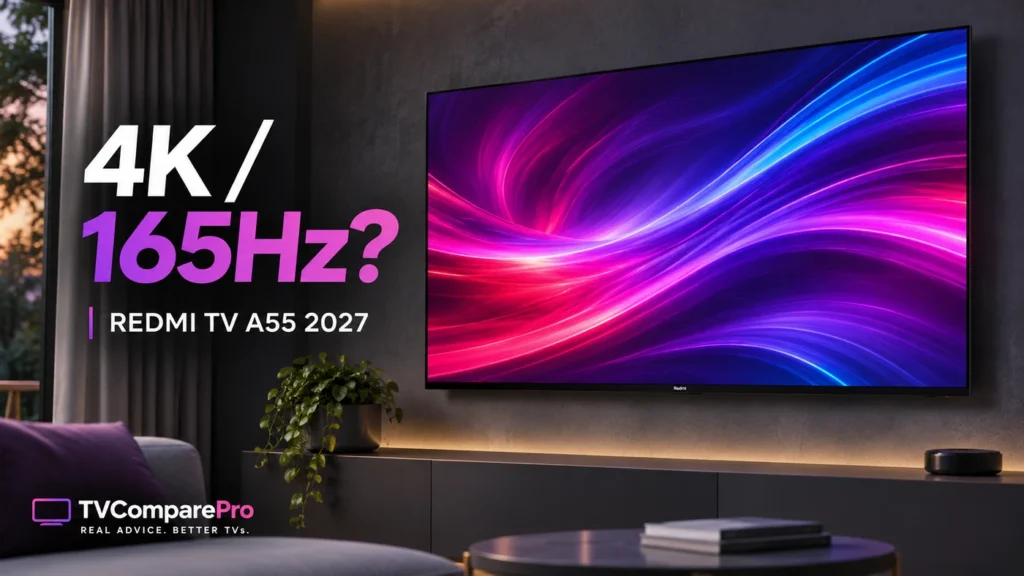
A budget television with a refresh rate of 165Hz certainly gets my attention. The Redmi TV A55 2027 has just gone on sale in China at a launch price of 1,599 yuan, roughly $240. It combines a 55-inch 4K screen with Xiaomi’s latest HyperOS 4 software and a dedicated high-refresh gaming mode.
But there is one detail I would check before buying it for a PS5 or gaming PC. The television has two HDMI 2.0 inputs, and the 165Hz competitive mode is reported to accept a 1080p HDMI signal. That is very different from playing at 3840 × 2160 and 165Hz at the same time.
At this price, the distinction matters more than the number on the box.
Does the Redmi TV A55 2027 support 4K at 165Hz?
Not as a confirmed HDMI input mode. The screen has a native resolution of 3840 × 2160, while the advertised 165Hz feature is tied to a competitive gaming mode. Launch information in China specifies 1920 × 1080 at 165Hz over HDMI when that mode is enabled.
What we still do not know is the panel’s underlying refresh rate at full 4K resolution or exactly how it processes the lower-resolution signal. A television accepting 1080p at 165Hz does not prove that it displays all 4K pixels with the same refresh rate or that every frame is reproduced without compromise.
| Input or feature | What to expect |
|---|---|
| 4K 60Hz HDMI | Expected standard mode; not tested here |
| 4K 120Hz / 165Hz HDMI | Not confirmed; do not buy for these modes |
| 1080p 165Hz HDMI | Reported in competitive mode |
| 1080p 120Hz HDMI | Console compatibility not confirmed |
| 4K 60Hz MEMC | Video interpolation; off in 165Hz mode |
| VRR / ALLM | Not verified |
HDMI 2.0 has a maximum raw link bandwidth of 18 Gbps. A full-color 4K 165Hz signal at just 8 bits per channel already needs about 32.8 Gbps of active pixel data before transmission overhead. At 1080p and 165Hz, the equivalent figure is approximately 8.2 Gbps. These are theoretical calculations, not measurements of this TV, but they explain why the lower resolution is important.
There is another difference that is easy to miss: 4K 60Hz MEMC is a motion interpolation feature for video content. It does not turn a 60 FPS game into a genuine 165 FPS input. MEMC is also disabled in the advertised 165Hz competitive mode.
PS5, PS5 Pro and Xbox Series X compatibility
For consoles, I would treat this as a 4K 60Hz television until Xiaomi provides a more complete input compatibility table. PS5, PS5 Pro and Xbox Series X can output up to 120Hz in compatible games, not 165Hz. None of them can take full advantage of the advertised maximum refresh rate.
Could 1080p at 120Hz work? It is plausible given the reported 1080p high-refresh mode, but Xiaomi has not published a console-specific compatibility list confirming it. The same applies to 1440p 120Hz, VRR and ALLM. I would not buy this model specifically for those features without confirmation.
For single-player games that run at 30 or 60 FPS, the TV could still be a reasonable budget option. If your main reason for upgrading is 4K 120Hz in competitive games, look for a model with explicitly documented 4K120 input support instead.
Is 1080p 165Hz useful for PC gaming on a 55-inch TV?
It can be, particularly for competitive games where a stable high frame rate is more important than resolution. A refresh interval at 165Hz is about 6.06 milliseconds, compared with 16.67 milliseconds at 60Hz. The shorter interval is useful only if the TV actually handles the frames properly and the PC can deliver them consistently. It is not a measurement of input lag.
The trade-off is image detail. A 1080p signal contains one quarter of the pixels of a 4K signal. When it is scaled to a 55-inch 4K display, fine textures, small text and distant objects can look softer, especially if you sit close to the screen.
I would prefer 4K at 60Hz for desktop work and visually detailed single-player games, and consider the 1080p competitive mode for fast shooters. For a PC, check the resolution and active signal mode in Windows Advanced display rather than relying on the refresh number alone. The actual modes available will depend on what the television reports to the graphics card.
Redmi TV A55 2027 specifications and HyperOS 4
Beyond gaming, Xiaomi has put together a fairly straightforward budget smart TV. The direct-lit LCD uses a slim black frame, while the connectivity includes two HDMI ports and both wireless and wired networking.
| Specification | Launch information |
|---|---|
| Display | 55-inch, 3840 × 2160, direct-lit LCD |
| High-refresh mode | Up to 165Hz in competitive mode |
| Processor | Five-core Cortex-A55 |
| Memory / storage | 1.5GB / 32GB |
| Software | HyperOS 4, Xiao AI |
| HDMI / USB | 2 × HDMI 2.0, 2 × USB-A 2.0 |
| Other connections | Ethernet, AV, S/PDIF |
| Wireless | Wi-Fi 6, Bluetooth 5.4 |
| Speakers | 2 × 10W |
| Energy rating | China Grade 1 |
| Launch / regular price | CNY 1,599 / 1,999 |
| Availability | China; global release unconfirmed |
HyperOS 4 includes Xiao AI voice control, screen casting and a children’s mode. Xiaomi also promotes faster app launches and video startup compared with its previous software. I would reserve judgment on everyday responsiveness, though, particularly with only 1.5GB of RAM.
For picture quality, there are still important questions. Peak HDR brightness, local dimming performance, color coverage and input lag have not been established in the launch information I could verify. A 4K resolution and a high-refresh mode alone do not tell us whether the TV can produce convincing HDR highlights or good dark-scene contrast.
Price, availability and whether I would buy it
The launch offer in China is 1,599 yuan (around $240), against a regular price of 1,999 yuan (around $300). Xiaomi has not confirmed a global release. Import costs, regional app support, language options and warranty coverage could change the value considerably for buyers outside China.
If I were shopping for an inexpensive 55-inch TV for films, streaming and occasional gaming, this model would be worth a closer look at its local price. For a console setup intended to deliver 4K120 HDR, I would spend the money on a model that explicitly supports that signal instead. My TV comparison tool is a useful starting point when comparing alternatives, and my guide to why 4K 120Hz drops to 60Hz on TVs covers the separate issue of signal compatibility on televisions designed for 4K120.
The Redmi TV A55 2027 is interesting because it brings a high-refresh option to a low-priced TV. Just remember what you are buying: a 4K screen with a reported 1080p 165Hz gaming mode, not a confirmed native 4K165 gaming television.