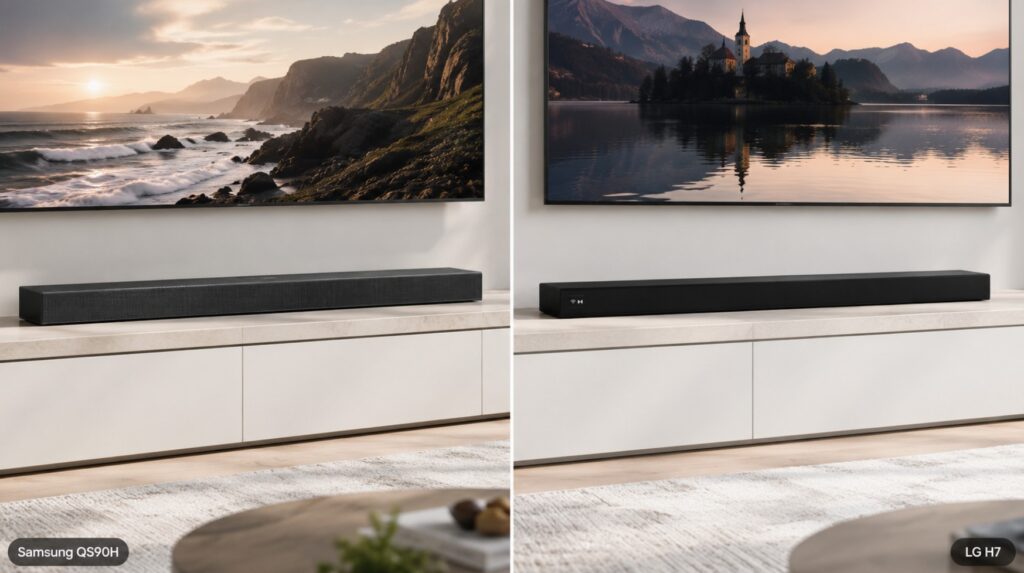

A premium all-in-one soundbar should deliver convincing cinema sound without filling your room with boxes, cables and speaker stands. That is what makes Samsung QS90H vs LG H7 such an interesting comparison. Both are 2026 flagship bars with built-in woofers, Dolby Atmos and room-aware processing, but they follow very different ideas.
Samsung wants the QS90H to feel complete from day one. LG treats the H7 as the center of a modular Sound Suite that can grow with wireless speakers and a separate subwoofer later. At the prices available in late July 2026, that difference becomes even more important. 🔊
Samsung QS90H vs LG H7 at a glance
| Category | Samsung HW-QS90H | LG Sound Suite H7 |
|---|---|---|
| Model year | 2026 | 2026 |
| Advertised layout | 7.1.2 channels | 9.1.6 spatial sound |
| Physical speaker units | 13 | 12 |
| Built-in bass hardware | Four woofers | Four woofers and eight passive radiators |
| Separate subwoofer included | No | No |
| Dolby Atmos | Yes | Yes |
| DTS:X | Listed by Samsung | Not listed in the LG specification reviewed |
| TV connection | HDMI eARC/ARC | HDMI eARC/ARC |
| Additional HDMI input | One | No |
| Main ecosystem feature | Q-Symphony | Dolby Atmos FlexConnect |
The simple version is this: Samsung is the stronger standalone purchase, while LG gives you the more flexible expansion path. Samsung officially lists 13 speakers and four integrated woofers. LG lists 12 physical speakers, including eight Peerless full-range units and four woofers, supported by eight passive radiators.
Samsung QS90H vs LG H7: current price and value 💰
Prices can change quickly, so this comparison uses US pricing checked on July 28, 2026.
| Price detail | Samsung QS90H | LG H7 |
|---|---|---|
| Official US price | $999.99 | $999.99 |
| Best Buy price checked | $849.99 | $999.99 |
| Current difference | Samsung is $150 cheaper | — |
| Extra speakers or subwoofer included | No | No |
Samsung direct still listed the QS90H at $999.99, but Best Buy had reduced it to $849.99. LG and Best Buy both listed the H7 at $999.99. At these prices, the Samsung is easier to recommend because you pay less while receiving an additional HDMI input, DTS:X support and a more complete standalone format list.
The LG price makes more sense when you specifically want Dolby Atmos FlexConnect and plan to add M5 or M7 speakers. Otherwise, you are paying full flagship money for flexibility that you may never use.
Design, size and placement
Both bars are wide enough to look most natural under a 55-inch or larger television. The Samsung is slightly wider, while the LG is deeper and one kilogram heavier.
| Design detail | Samsung QS90H | LG H7 |
|---|---|---|
| Dimensions | 1,245 × 68.8 × 125 mm | 1,200 × 63 × 143 mm |
| Weight | 6.7 kg | 7.7 kg |
| Wall-mount bracket | Included | Included |
| Position adjustment | Gyro-based Convertible Fit | Room Calibration Pro |
| Front display | Status display | 1.3-inch OLED display |
| Finish | Graphite Black | Black fabric with aluminium details |
Samsung’s Convertible Fit detects whether the bar is placed on furniture or mounted on a wall, then changes how the drivers are used. LG relies more on acoustic calibration through Room Calibration Pro and includes a 1.3-inch OLED display for status, modes and playback information.
The H7’s display is a useful ownership advantage because it can show information without forcing you to open the ThinQ app. Samsung remains more conventional, but its shallower cabinet may be easier to accommodate on a narrow media unit.
Speaker hardware and channel claims 🔬
The numbers need context. Samsung describes the QS90H as a true 7.1.2-channel bar with 13 speakers, including center, wide, side and up-firing drivers plus four built-in woofers.
LG advertises 9.1.6 spatial sound, but the H7 contains 12 physical speakers. LG also states that the 9.1.6 presentation is active when Dolby Atmos content is playing. You should not read 9.1.6 as proof that the H7 contains sixteen independently driven speakers.
| Hardware detail | Samsung QS90H | LG H7 |
|---|---|---|
| Physical speakers | 13 | 12 |
| Full-range or wide-range drivers | Nine | Eight |
| Built-in woofers | Four | Four |
| Passive radiators | Not publicly listed | Eight |
| Up-firing drivers | Yes | Yes |
| Side or wide-firing drivers | Yes | Yes |
| Output power | Not publicly disclosed | 500 W |
| Named processor | Not publicly disclosed | Alpha 11 AI Processor Gen 3 |
LG publishes a 500 W output figure, but wattage alone does not tell you which bar produces deeper, cleaner or more controlled bass. Room size, tuning, cabinet design and distortion matter more than one headline number.
Practical setup notes 🛠️
Leave open space above and beside either bar. Up-firing speakers need a reasonably flat ceiling, while side-firing drivers work best when they are not blocked by cabinet walls, decorations or tall furniture.
Samsung is the simpler fixed setup: connect HDMI eARC, run SpaceFit Sound Pro and decide whether Q-Symphony sounds better with your television. LG also works as a standalone eARC soundbar, but its most distinctive feature only becomes active when compatible wireless speakers are added.
Dolby Atmos FlexConnect requires at least two M5 speakers or one M7 speaker connected to the H7. LG’s Sound Follow feature also needs an active FlexConnect configuration and a compatible smartphone with UWB support. Neither feature should therefore be presented as a complete standalone H7 function.
Samsung QS90H vs LG H7 for movies and Dolby Atmos 🎬
| Movie feature | Samsung QS90H | LG H7 |
|---|---|---|
| Dolby Atmos | Yes | Yes |
| Dolby TrueHD | Listed | Not listed on the official page |
| DTS:X | Listed | Not listed on the official page |
| Multichannel LPCM | Listed | Not publicly detailed on the page |
| Room processing | SpaceFit Sound Pro | Room Calibration Pro |
| Dialogue processing | AVA Pro and Voice Enhance | Clear Voice Pro+ and AI Sound Pro+ |
| TV-speaker integration | Q-Symphony | WOW Orchestra |
Samsung is the safer choice for a mixed movie library because its official format list includes Dolby TrueHD, DTS:X and multichannel LPCM. LG’s official specification highlights Dolby Atmos, Dolby Digital and AAC, but does not list DTS or DTS:X. Regional specifications can vary, so anyone with a large DTS disc or local-media library should verify the exact H7 regional version before buying.
LG’s real cinema advantage is not the standalone channel label. It is the ability to add wireless speakers in positions that would be awkward for a traditional rear-speaker kit. FlexConnect detects the compatible speakers’ locations and optimizes the presentation around the room instead of requiring a perfectly symmetrical arrangement.
The H7 can still play Dolby Atmos on its own. The extra speakers are required for the flexible FlexConnect arrangement, not for basic standalone Atmos playback.
Bass, dialogue and music 🎵
Neither model includes a separate subwoofer. That keeps the room cleaner, but buyers with a large open-plan living space may eventually want greater low-frequency extension and impact.
| Everyday use | Samsung QS90H | LG H7 |
|---|---|---|
| Bass system | Four built-in woofers | Four woofers and eight passive radiators |
| Voice enhancement | AVA Pro, Voice Enhance Mode | Clear Voice Pro+, object separation |
| Night listening | Night Mode | Custom EQ and app adjustments |
| Music services | AirPlay, Chromecast, Spotify, Tidal, Roon Ready | AirPlay 2, Spotify, Tidal, Google Cast support |
| Hi-resolution audio | Common lossless formats listed | 24-bit/96 kHz listed |
| Control app | SmartThings | LG ThinQ |
Samsung’s AI Dynamic Bass Control and four-woofer design are intended to deliver useful weight without a separate cabinet. LG uses eight passive radiators alongside its four woofers and gives you a clear bass-upgrade route through the optional W7 subwoofer.
For dialogue, both companies provide several processing tools. Samsung includes AVA Pro and Voice Enhance Mode. LG’s Alpha 11 processor separates voice, music and effects through its AI Sound Pro+ processing. Google Cast was announced for the H7 through a software rollout, so availability should be checked by region and current firmware.
HDMI connections and gaming 🎮
This is where the earlier wording needed correction: the LG H7 absolutely has HDMI. It has one HDMI 2.1 eARC/ARC connection for the television. What it does not have is an additional HDMI input for connecting an external source directly to the soundbar.
| Connection | Samsung QS90H | LG H7 |
|---|---|---|
| HDMI eARC/ARC to TV | Yes | Yes |
| Additional HDMI input | One | No |
| HDMI output | One, used for TV/eARC | One, used for TV/eARC |
| Video passthrough | Up to 4K 60Hz | No source passthrough |
| HDR passthrough | HDR10+ listed | Not applicable |
| Optical input | Yes | Not listed |
| USB playback | No | USB-A |
| Bluetooth | 5.3 | 5.4 |
| Wi-Fi | Yes | Yes |
Samsung officially lists one HDMI input, one HDMI output with eARC, optical input and video passthrough up to 4K 60Hz with HDR10+. LG lists one HDMI 2.1 output with ARC/eARC and CEC, but no separate HDMI input.
The Samsung HDMI input is useful for a Blu-ray player, streaming box or 4K60 device. It is not the ideal route for PS5, Xbox Series X or a gaming PC when you want 4K120 and VRR because the QS90H’s passthrough is limited to 4K60.
For either soundbar, connect high-refresh gaming devices directly to the television and return audio through eARC. With the LG, that arrangement is required for every HDMI source because the bar has no additional HDMI input.
TV ecosystems and expansion
Samsung works most naturally with a compatible Samsung TV. LG is the more interesting choice when you own a compatible LG television and want to build a flexible wireless room system.
| Ecosystem feature | Samsung QS90H | LG H7 |
|---|---|---|
| TV and bar play together | Q-Symphony | WOW Orchestra |
| Main TV audio connection | HDMI eARC or compatible Wireless Atmos | HDMI eARC/ARC |
| Optional rear expansion | SWA-9500S in selected regions | M5 or M7 speakers |
| Optional subwoofer | No dedicated option listed on the page reviewed | W7 |
| Flexible speaker placement | Conventional rear-kit approach | Dolby Atmos FlexConnect |
| App | SmartThings | LG ThinQ |
| Multi-room direction | Samsung audio ecosystem | LG Sound Suite system |
Samsung lists Q-Symphony, Wireless Dolby Atmos with selected Samsung televisions and compatibility with the SWA-9500S rear kit in the UK specification. LG lists WOW Orchestra, Dolby Atmos FlexConnect, M5 and M7 speakers and the W7 wireless subwoofer. Availability can vary by country.
The H7 becomes much more distinctive after expansion, but the total price rises quickly. LG listed the M5 at $249.99, the M7 at $399.99 and the W7 at $599.99 in the US. An H7 and W7 combination therefore costs substantially more than either standalone soundbar.
Which one is better for you?
| Your priority | Better choice | Why |
|---|---|---|
| Best value at current US prices | Samsung QS90H | It was $150 cheaper when checked |
| Most complete standalone bar | Samsung QS90H | Stronger documented format and connection list |
| DTS:X or local disc playback | Samsung QS90H | DTS:X and Dolby TrueHD are listed |
| One extra HDMI source | Samsung QS90H | Includes one HDMI input |
| Compatible Samsung TV | Samsung QS90H | Q-Symphony and Wireless Dolby Atmos |
| Compatible LG TV | LG H7 | WOW Orchestra and ThinQ integration |
| Flexible wireless speaker placement | LG H7 | Dolby Atmos FlexConnect |
| Gradual system expansion | LG H7 | M5, M7 and W7 components |
| Clean setup without a subwoofer | Either | Both place four woofers inside the bar |
Which premium soundbar should you buy? ✅
At the current prices checked, the Samsung QS90H is the better purchase for most buyers. It costs less, has one additional HDMI input, supports 4K60 passthrough and offers the clearer official list of Dolby TrueHD, DTS:X and multichannel LPCM support. Its 7.1.2 design is also easier to understand because the channel claim more closely reflects the physical hardware inside the bar.
Choose the LG H7 when Dolby Atmos FlexConnect is the main reason you are buying it. It is the more creative platform for rooms where wireless speakers cannot sit in conventional rear positions, and it can grow through M5, M7 and W7 components. The H7 is also the natural match for an LG owner who wants WOW Orchestra, ThinQ control and the Alpha 11 audio-processing platform.
The H7 does have HDMI eARC/ARC, so it connects normally to a modern television. It simply lacks a second HDMI input for an Apple TV, console or disc player. With that distinction corrected, the decision is straightforward: Samsung wins as the stronger all-in-one value, while LG wins for modular expansion and flexible speaker placement.